PHOTO
European Bank for Reconstruction and Development (EBRD) is studying senior debt financing of up to $223.5 million for two standalone battery energy storage system (BESS) projects being developed by Dubai-based AMEA Power in Egypt.
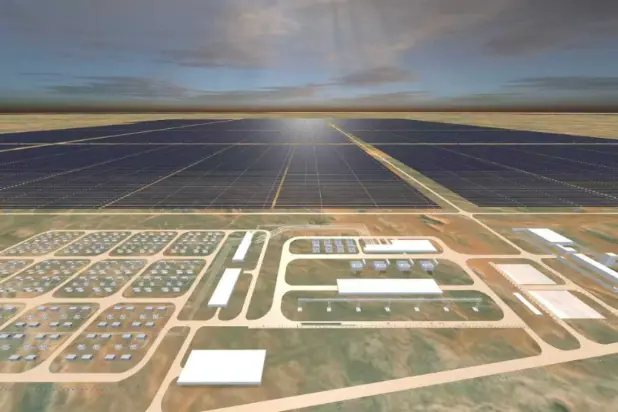
The projects - Nefertiti in Aswan and Horus in the Gulf of Suez - represent Egypt’s first standalone, utility-scale battery storage developments, with a combined storage capacity of 1.5 gigawatt-hours (GWh) and total investment estimated at around $442 million.
While Nefertiti focuses on solar, Horus is positioned to manage the wind energy generated along the Gulf of Suez.
The proposed financing includes up to $162.5 million for Nefertiti for Battery Energy Storage SAE and up to $61 million for Horus for Battery Energy Storage SAE, both special purpose vehicles (SPVs) established for the projects.
The 500 MW / 1,000 MWh Nefertiti project, located at Benban Solar Park, is expected to cost up to $297 million, while the 250 MW / 500 MWh Horus project near the Zafarana wind complex is estimated at around $145 million.
Both projects will operate under 20-year capacity purchase agreements with Egyptian Electricity Transmission Company (EETC). Additionally, they will be developed on state-owned land allocated for renewable energy under usufruct arrangements managed by New and Renewable Energy Authority (NREA).
EBRD said the two projects are expected to enhance grid stability, improve integration of intermittent renewable energy and support Egypt’s long-term decarbonisation strategy.
Construction is scheduled to begin by the end of the second quarter of 2026, with commercial operations targeted for 2027.
EPC award and scope
In March 2026, a consortium comprising Energy China International, China Energy Engineering Group Zhejiang Thermal Power Construction (ZTPC) and Southwest Electric Power Design Institute of China Power Engineering Consulting Group was awarded the Engineering, Procurement and Construction (EPC) contract for the Nefertiti project.
The EPC scope also includes development of a 220 kV substation and upgrades to the receiving substation under a turnkey model.
The same EPC consortium is also building the 1,000 MW/600 MWh Abydos II project in Aswan for AMEA Power.
Moving forward with storage projects
The projects form part of a broader acceleration in Egypt’s storage and hybrid renewable pipeline.
These include progress on the 258.5 MWp Nefer Benban solar-plus-storage project at Benban Solar Park and new capacity agreements signed by EETC for multiple solar and standalone storage schemes.
Last month, Hassan Allam Constructions, the EPC contractor for the 200 MW / 120 MWh Nefer Benban signed two supply agreements for trackers and inverters. Commercial operation is targeted for the third quarter of 2027.
In the same period, EETC signed power/capacity purchase agreements with Egypt’s Kemet Industries, part of United Egypt Group for National Industries, for three solar and one BESS schemes. These include a 2,000 MW solar PV power project and a standalone 2,000 MWh BESS project in Nagaa Hammadi, and two solar projects in El Owainat with capacities of 320 MW and 400 MW. These projects are expected to start operations in 2027.
Egypt is targeting 42 percent share for renewable energy its electricity mix by 2030 and 65 percent by 2040 as part of its long-term energy transition strategy.
(Writing by Dennis Daniel; Editing by Anoop Menon)
Subscribe to our Projects' PULSE newsletter that brings you trustworthy news, updates and insights on project activities, developments, and partnerships across sectors in the Middle East and Africa.