PHOTO
Study conducted among the largest GCC family-owned businesses which collectively generate US$100 billion in annual revenues
Only 33% of GCC-based family businesses have fully implemented governance systems that they have designed - significant potential for improvement in institutionalising governance by focusing on implementation
While 44% of family businesses have an employment policy in place for next generation family members, a clear development strategy and an effective integration plan would facilitate leadership transition and set a reference to manage conflict
New identity for Family Business Network-GCC reflects Council's growth from a network of influential family businesses to an assembly, committed to pioneer and spearhead activities to support the continuity of GCC family businesses
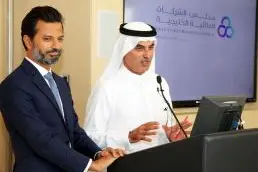
Dubai, UAE, 13 October 2015: The newly rebranded Gulf Family Business Council (GFBC), the regional association of Family Business Network International (FBN), and McKinsey & Company, unveiled findings of a GCC family business study.
Chairman of GFBC, His Excellency Abdulaziz Abdullah Al Ghurair said: "At GFBC we have partnered with McKinsey & Company, to pioneer the first study assessing the unique challenges, opportunities and common trends facing family businesses in the GCC."
Conducting a study to assess the health and preparation of family business at this stage is critical. More than half of GCC's family businesses are in the midst of the transition from the second to third generation. This is a critical transition as just around 15% of those businesses are likely to survive it.
Al Ghurair stated: "At the council we understand that the majority of family business owners in the GCC are relatively young, between 40-60 years old, facing the critical juncture of transition of leadership from first to second or second to the third generation. One major risk during this transition is for large family businesses to get fragmented. Preparation is needed to avoid loss of family harmony and business disruption which in turn leads to loss of economic value. With around 75% percent of GCC private sector economy being family-owned, it is pertinent that we support the families to be equipped for the transition."
Ahmed Youssef, Partner at McKinsey & Company, said: "The inaugural GCC Family Business survey gives us a baseline against which future progress can be tracked. The study assessed current GCC family business practices and benchmarked them against five dimensions that are critical for the longevity of any family business - family, ownership, business, philanthropy, and wealth management."
On the family side, the study revealed that 44 percent of family businesses have an employment policy in place for next generation from the family, nonetheless only 17 percent of businesses have an effective assessment method in place to identify roles and responsibility for the next generation. A development plan for the next generation and a clear business integration policy would ease the transition of leadership and set a reference to manage conflict. The study recommends that the 'rules of the game' should be clearly stated to the next generation as early as possible to allow for effective succession planning and transition of leadership.
Two other key findings of the study were related to corporate governance and the businesses' philanthropic efforts.
While family businesses have made significant progress in putting corporate governance systems in place, few have been successful in completing end-to-end effective implementation. Of the businesses researched, over 66 percent of participants reported that they have started to put the building blocks in place. However, only around 33 percent reported that the practices are fully adopted and are working effectively.
The study also finds that ensuring successful implementation requires the engagement of the broader family, not just those who are in positions of authority or involved in the business. This is required to ensure wide buy-in and commitment amongst family members.
Youssef also mentioned, "while all famlies are involved in some form of charitable giving, very few have developed organised philanthropic efforts: Only 36% of the sample group had defined a clear strategy for their giving; 20% had established a robust governance structure to oversee their giving; and, 16% were clear about how they would evaluate the impact of their efforts. Given the general desire of many families in the region to engage in philanthropy and give back to society, as well as the role philanthropy can play in galvanising family members around a common set of values, many families would benefit from being more systematic about their philanthropic efforts."
"Looking forward, we are optimistic about the pace of change, especially given the surge in awareness among family businesses on the need to change. We are also conscious that the real test is yet to come," added Youssef. "Our survey participants are amongst the largest family businesses in the GCC region and they have a responsibility to serve as pioneers and role models for their peers, who could learn from their achievements to date."
GFBC's core mandate has been to facilitate the continuity of GCC family businesses over generations. The organisation has delivered unique content and programmes since its launch in 2012.
Al Ghurair stated: "The study strengthens our understanding of GCC family businesses and enlightens our actionable agenda, based on the areas where family businesses struggle the most.
"The findings of this study validate the direction of some of the Council's existing initiatives designed to facilitate successful transition for GCC families while addressing both the external and internal factors impacting family businesses."
Last April, GFBC released a legal white paper on succession planning, discussing challenges. GFBC chairman disclosed a legal initiative launched with policy makers to develop legal structures that consider family business challenges in the region.
On preparing the next generation of leaders, GFBC is collaborating with leading education institutions to bring family business-specific courses to the region. Later this month GFBC is running a next generation workshop developed by a leading family business professor from INSEAD Wendel International Centre of Family Enterprise.
Al Ghurair concluded: "Our organisation has grown from a network of influential family businesses to a GCC-focussed family business assembly. We are growing to become a reference in GCC family business issues and we will continue to facilitate solutions and development opportunities for member family businesses."
Some other key factors related to the McKinsey & Company study are:
- 60-70% of the Middle East businesses are owned by family businesses
- Roughly 60 percent of family businesses still derive more than 75 percent of their revenues from their home countries
- GCC family businesses have fairly concentrated ownership and heavy family involvement
- More than 50% of the businesses have at least five shareholders
- More than 50% of the businesses have at least five members employed in the business
- Three-quarters of the businesses are run by the first or second generation
- 88% of businesses are present in five or more sectors, most common being real estate, construction, retail, manufacturing, and travel and leisure
- 76% of businesses have presence outside of GCC
- Many family firms in the GCC are approaching a critical phase in growth with 52% moving from the second to third generation
- First-generation businesses underperformed their older peers as first-generation members are consumed in building the business and often postpone building the needed "guardrails" for continuity
- Talent management emerges as one of the biggest challenges from a business perspective. Less than a third of the study participants believe that they have an effective career-development and retention program in place for their non-family executives.
About Gulf Family Business Council:
Family Business Network GCC (FBN GCC) is a non-profit membership organisation was established in April 2012 in Dubai, UAE under the patronage of His Highness Sheikh Hamdan Bin Mohammed Bin Rashid Al Maktoum. Rebranded as the Gulf Family Business Council (GFBC) to better reflect its mandate and activities, the Council is governed by a Board of Directors, representing eleven leading GCC family businesses, which steers and builds the organisation. GFBC's board shares a common view that the continuity and prosperity of family businesses is vital not only for their families' legacy but also for the economic sustainability of the region.
GFBC is member of a worldwide organisation, the Family Business Network International (FBN) which is the largest global network 'by families, for families' and has over 8,000 individual members in 52 countries, representing leading family businesses all over the world.
For further information on GFBC, log on to www.gfbcouncil.org
About McKinsey & Company:
McKinsey & Company is a global management consulting firm, deeply committed to helping institutions in the private, public, and social sectors achieve lasting success. For over eight decades, our primary objective has been to serve as our clients' most trusted external advisor. With consultants in more than 100 offices in 60 countries, we bring unparalleled expertise to clients across all industries and functions, anywhere in the world. We work closely with teams at all levels of an organisation to shape winning strategies, mobilize for change, build capabilities, and drive successful execution.
For further information, please contact:
Gladson Ronad
ASDA'A Burson-Marsteller
Dubai, UAE
T: +971 4 4507600
E: gladson.ronad@bm.com
© Press Release 2015