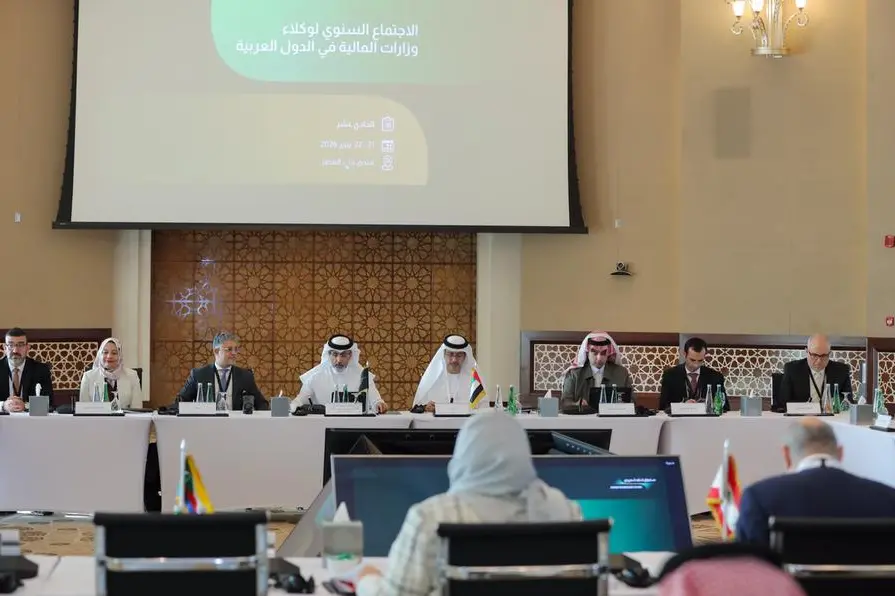
PHOTO
- Discussing fiscal policy reforms and their role in supporting sustainable growth
- Exchanging perspectives on fiscal policy, innovation, and sustainability
- Reviewing major financial issues and challenges in the Arab region and prospects for developing Arab fiscal policies
- Exploring sustainable finance for building sustainable infrastructure
Abu Dhabi: The UAE chaired the Eleventh Meeting of The Deputies of Arab Finance Ministries, organised by the Arab Monetary Fund (IMF), which was held in Abu Dhabi on January 21 and 22.
The meeting brought together deputies of Arab ministries of finance, representatives of regional and international financial institutions, and was attended by H.E Fahad M. Alturki, Director General Chairman of the Board of the Arab Monetary Fund.
The UAE delegation included H.E. Younis Haji AlKhoori, Undersecretary of the Ministry of Finance, H.E. Ali Abdullah Sharafi, Assistant Undersecretary for International Financial Relations, along with a number of ministry specialists.
Strengthening dialogue channels
During the meeting, H.E. Ali Abdullah Sharafi said the UAE is committed to supporting joint Arab action and strengthening channels of dialogue and coordination among Arab ministries of finance. His Excellency noted that such cooperation plays a key role in facilitating the exchange of expertise and in developing more flexible fiscal policies capable of responding to global economic challenges.
He added that the topics discussed at the meeting, particularly fiscal policy reforms, artificial intelligence and sustainable finance, are of strategic priority at the current stage. “The rapid transformations in the global economy require innovative tools for public financial management, greater spending efficiency and a clear focus on fiscal sustainability,” he said.
Sharafi reaffirmed that the UAE will continue to support regional efforts aimed at enhancing financial stability and achieving sustainable growth. He expressed his hope that the outcomes of the meeting would contribute to shaping practical visions and recommendations that strengthen the capacity of Arab economies to address future challenges and support pathways for comprehensive development.
Fiscal policy reforms
The first day featured an opening session, which included a welcome address by H.E. Fahad M. Alturki, Director General and Chairman of the Board of the Arab Monetary Fund, followed by a keynote from the meeting’s chair, His Excellency Younis Haji AlKhouri, Undersecretary of the UAE Ministry of Finance.
The first working session focused on “Revamping Fiscal Policy in the Face of Shocks and Uncertainties: Lessons Learnt in the Arab Region.” The International Monetary Fund delivered a presentation, followed by interventions from several Arab nations and an open discussion with Their Excellencies, the Deputies of Arab Finance Ministries.
AI Opportunities in Public Finance
The second session explored the theme “Unlocking AI Opportunities in Fiscal Policy and Public Finance: Use Cases and Overcoming Challenges.”
The session included a presentation by the Arab Monetary Fund, interventions from several Arab countries, and an extended dialogue on leveraging modern technologies to enhance the efficiency of fiscal policy.
Sustainable finance
The first day of the meeting concluded with a third session titled “Sustainable financing for sustainable infrastructure.” The session featured a presentation by the World Bank on global best practices, followed by a review of Arab experiences and an open discussion on sustainable financing mechanisms and their role in supporting long-term development.
During his intervention in the 3rd session, H.E. Ali Abdullah Sharafi, Assistant Undersecretary for International Financial Relations, stressed that sustainable finance is a fundamental pillar for supporting long-term development and strengthening economic resilience.
He cited World Bank estimates on the scale of the infrastructure financing gap in emerging economies and highlighted leading UAE models of public-private partnerships across several sectors, including renewable energy, water desalination, road and utilities management, as well as healthcare service delivery.
He also pointed to the UAE’s leading role in continuously developing sustainable finance frameworks and strengthening partnerships with international financial institutions in support of more efficient and sustainable infrastructure.
Day Two Sessions
The second day’s agenda included the fourth session, which discussed "Countercyclical Fiscal Policies and Growth". This was followed by the fifth session, which reviewed recent developments in the implementation of the BEPS actions and the progress made across the Four Minimum Standards.
It included contributions from representatives of the Organisation for Economic Co-operation and Development (OECD). The sixth session addressed fiscal consolidation and debt sustainability, featuring presentations and insights from several Arab countries. The meeting concluded with a preparatory session for the upcoming seventeenth meeting of the Council of Arab Finance Ministers.
During the fifth session, H.E. Sharafi delivered an intervention highlighting the UAE’s commitment to international tax cooperation and transparency, in line with OECD and G20 standards.
He outlined the key legislative and regulatory steps taken by the UAE to implement the four minimum international tax standards. These measures, he said, align with international best practices and enhance the integrity and efficiency of the tax system.
He added that the UAE adheres to international standards on tax transparency and information exchange, which has been consistently affirmed through ongoing reviews conducted by the OECD.
It is worth noting that the Eleventh Meeting of the Deputies of Arab Finance Ministries is a consultative and preparatory meeting ahead of the 17th Meeting of the Council of Arab Finance Ministers, scheduled to be held in Abu Dhabi in May.