PHOTO
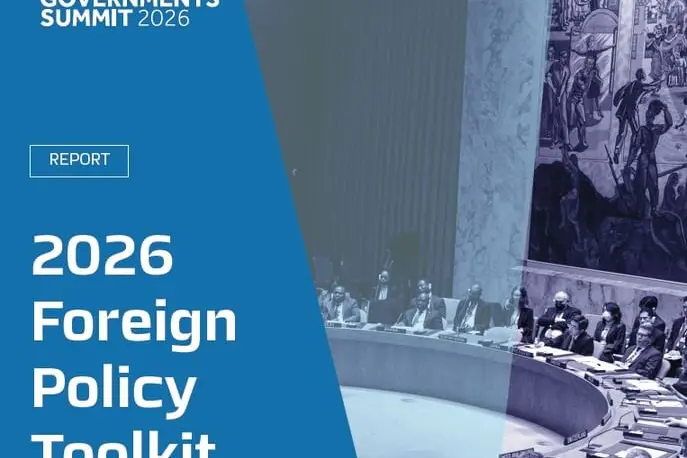
The World Governments Summit (WGS) and Fiker Institute launched the “Foreign Policy Toolkit” for 2026. Based on Fiker Institute’s analysis and expert insights, the Toolkit forecasts key global geopolitical trends to watch in 2026, and outlines implications for governments and the private sector.
Divided by region, the report highlights security, political, and environmental issues with global geopolitical and geoeconomic impacts in the Middle East and North Africa, Asia-Pacific, Africa, the Americas, and Europe.
Dubai Abulhoul, Fiker Institute’s Founder and CEO, said, “Our collaboration with the World Governments Summit on the 2026 Foreign Policy Toolkit aims to support government and private sector actors with an analytical framework to respond to a shifting multilateral landscape, bridging strategy, diplomacy, and foresight.”
The Toolkit calls attention to the issue of water security in the Middle East and North Africa (MENA) region. It underscores the political and economic implications of insufficient regional frameworks for cross-border water governance, and highlights the potential of the 2026 UN Water Conference, co-hosted by the UAE and Senegal to bring water security to the top of the regional agenda.
In the Asia-Pacific, it foregrounds the opportunities and challenges of India’s BRICS presidency while in Europe, it draws attention to the economic and political risks of polarization and the fragmentation of politics on a domestic and European Union level. By highlighting such issues, the Toolkit’s global mapping can guide government and the private sector officials in their contextual analysis and provide an early-warning tool for emerging trends and issues with potential geopolitical spillover effects in 2026.
Fiker Institute has been a knowledge contributor of the WGS since 2022, supporting the WGS’s mission to foster innovation, discussions, and international exchange on future challenges for governments across the world.