PHOTO
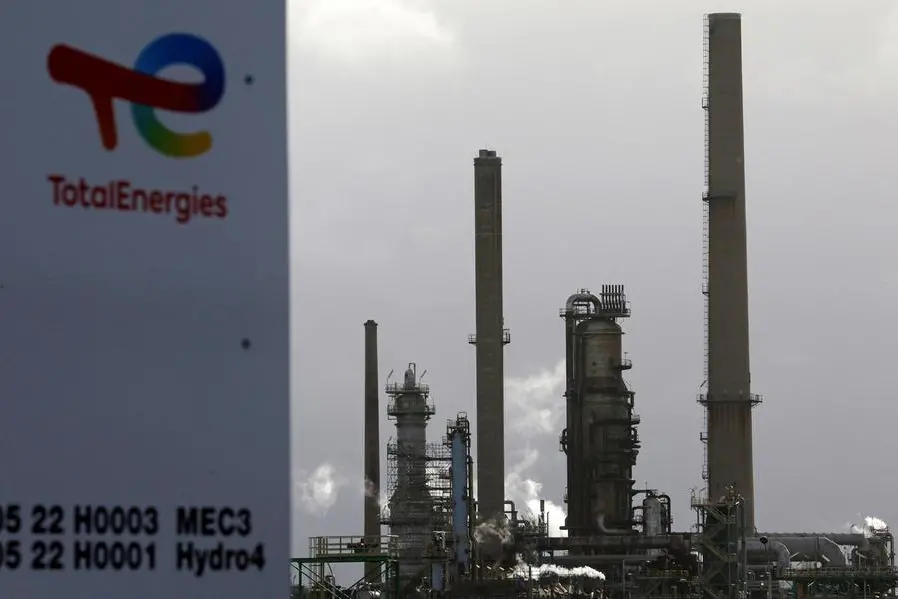
TotalEnergies has shut down upstream production in Qatar, Iraq and offshore United Arab Emirates (UAE) due to the Iran war, curtailing 15 percent of its total oil and gas production, the global energy giant said on Wednesday.
The shutdown is equivalent to about 360,000 barrels per day (bpd) in April compared with pre-conflict levels, the company said in its first quarter 2026 financial results statement.
The exception is onshore UAE production which remains unaffected by the conflict at this stage, according to the statement.
TotalEnergies CEO Patrick Pouyanne confirmed during an analysts’ call on Wednesday that onshore UAE oil production continues unaffected, with around 210,000 bpd of the company’s equity share evacuated through Fujairah, while Dolphin gas production between Qatar and the UAE also remains operational,
The impacted 15 percent of volumes from Iraq, Offshore UAE and Qatar account for around 10 percent of upstream cash flow at $60 per barrel but higher oil prices and production boost in other regions more than offset the production losses, the statement said. An $8 per barrel rise in Brent would compensate for the expected 2026 cash flow loss from affected assets, it noted
First quarter production increased by around 4 percent year-on-year to reach 2.553 2.553 million barrels of oil equivalent per day, supported by new project start‑ups and ramp‑ups, especially in Brazil and Libya this quarter, the company said.
SATORP and Amiral status in Saudi Arabia
The 460,000 bpd SATORP refinery, the company’s joint venture with Aramco located on Saudi Arabia’s east coast, was hit by incidents during the night of April 7-8, damaging three units and triggering a precautionary shutdown.
The statement said undamaged units were restarted and the refinery has been operating at around 230,000 bpd since 14 April.
Pouyanne said during the analysts call that repair works on one vacuum distillation unit are progressing and output is expected to rise to more than 300,000 bpd in early May. However, if the Strait of Hormuz remains closed, refinery throughput could remain limited to 300,000-330,000 bpd as vacuum gas oil (VGO) exports would be constrained.
Repairs to other two damaged units including a conversion unit for processing VGO into diesel and other products, could take at least six months or longer, depending on final damage assessments.
Meanwhile, the Amiral petrochemical project in Jubail is around 70 percent complete, with start-up targeted by end-2027 or early 2028, he said.
Last week, Saudi Arabia’s Ministry of Investment and SATORP had signed an agreement to develop and expand downstream industries linked to the Amiral petrochemical complex.
Qatar: North Field East delay
In Qatar, the North Field East expansion is likely to face a delay of up to two months, according to Pouyanne. The project comprises 4 mega trains, each with a capacity of 8 million tonnes per annum (MTPA) of Liquefied Natural Gas (LNG), with the capability to process 6 billion standard cubic feet per day of feed gas from the North Field.
The start-up of the first train was planned for the second quarter of 2026 but is likely to be delayed to the third or fourth quarter of 2026 with the first LNG cargoes expected by end-2026 or early 2027, the TotalEnergies CEO said.
He cautioned that these timelines are linked to how long the war will last. While onshore construction for the project [contracted to a JV of Technip Energies and Chiyoda] has continued, offshore work [contracted to McDermott, Saipem and China Offshore Oil Engineering Company] was stopped due to the conflict.
TotalEnergies said the impact of LNG production shutdowns in Qatar and Abu Dhabi on its trading business is limited at around 1.5 million tonnes for the remainder of 2026, as most of the LNG produced by the JV in which TotalEnergies is a shareholder in Qatar is marketed by QatarEnergy, which had declared force majeure on its long-term LNG supply contracts in March.
In March 2026, QatarEnergy’s CEO had told Reuters that Iranian attacks have knocked out 17 percent of its LNG export capacity, damaging two out of 14 LNG trains and one of the two gas-to-liquids (GTL) facilities.
Iraq: Ratawi delayed, solar starts up
In Iraq, the 1.25-gigawatt (GW) solar photovoltaic (PV) power plant, part of the $10 billion Gas Growth Integrated Project (GGIP) in Ratawi oil and gas field, has started initial operations and is supplying electricity to Basra since late February 2026 as gas shortages due to the war constrained conventional power generation, Pouyanne said.
However, first phase start-up of the Ratawi oilfield expansion is expected later than previously planned second-quarter 2026 timeline. Pouyanne said start-up may slip to third or even fourth quarter 2026 due to the inability to export oil.
Market impact
Oil markets have remained highly volatile as the closure of the Strait of Hormuz disrupted around 20 percent of global crude oil, refined products and energy exports, with limited spare production capacity available outside the Gulf.
TotalEnergies said prices are likely to remain elevated in the second quarter given the two-to-three months needed to restart regional production facilities.
“Eight of the ten most volatile trading days in the past 25 years occurred in March and April,” noted Pouyanne. He said he expects oil prices to remain high even if the conflict ends, with at least $80 per barrel seen for 2026.
The conflict’s impact on global hydrocarbon inventories is leading to the drop of the 2026 surplus scenario that was anticipated at the beginning of the year.
Pouyanne said estimates indicate that around 500 million barrels have already been drawn from inventories and this could rise to one billion barrels by the time some of the disrupted production returns to market.
Competition between Europe’s winter restocking and Asian summer cooling demand is expected to support LNG prices in coming months.
Pouyanne said QatarEnergy will wait for the Hormuz situation to stabilise before restarting production, noting that liquefaction facilities cannot be shut down and restarted quickly. He said the time lag before Qatari LNG supply returns to the market could lend support to higher prices during the summer demand season.
TotalEnergies said it anticipates an average LNG selling price of around $10/MMBtu in the second quarter of 2026.
(Writing by Anoop Menon; Editing by SA Kader)
Subscribe to our Projects' PULSE newsletter that brings you trustworthy news, updates and insights on project activities, developments, and partnerships across sectors in the Middle East and Africa.