PHOTO
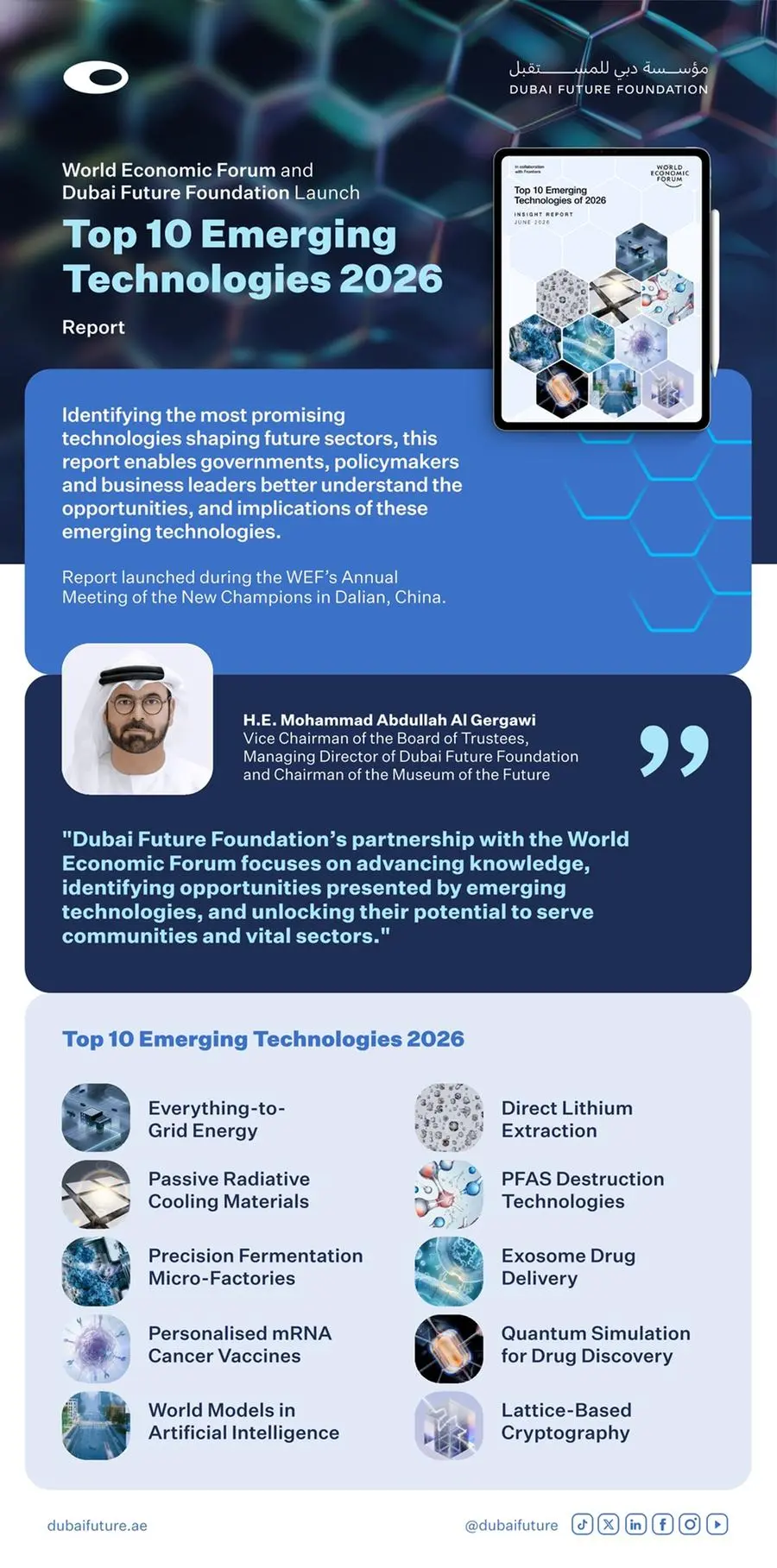
Dubai, UAE – Dubai Future Foundation (DFF), in collaboration with the World Economic Forum (WEF), has announced the launch of the Top 10 Emerging Technologies of 2026 report, an annual publication that identifies the most promising technologies expected to deliver significant impact across economies, industries, and societies in the years ahead.
The report was launched alongside the participation of the UAE delegation in the World Economic Forum’s Annual Meeting of the New Champions 2026, commonly known as “Summer Davos”, taking place in Dalian, China, from 23 to 25 June and bringing together thousands of government officials, business leaders, experts, and decision-makers to discuss the world's most pressing challenges and emerging opportunities.
His Excellency Mohammad Abdullah Al Gergawi, Vice Chairman of the Board of Trustees and Managing Director of Dubai Future Foundation, and Chairman of the Museum of the Future said: “International collaboration in understanding and advancing emerging technologies is essential to accelerating human progress and ensuring that innovation delivers meaningful benefits for societies. It also enables governments and institutions to strengthen their competitiveness and build the capabilities needed to navigate future transformations.”
He added: “Our partnership with the World Economic Forum focuses on expanding knowledge, accelerating innovation, and identifying opportunities to harness emerging technologies in ways that positively impact people and vital sectors, including healthcare, energy, food, education, and scientific research. Keeping pace with technological change and accelerating the adoption of innovative solutions are essential drivers of sustainable development, prosperity, and improved quality of life.”
His Excellency further noted: “Emerging technologies continue to open new horizons for development and progress. They empower governments to enhance services, improve efficiency, adopt more innovative solutions, and address critical challenges across strategic sectors, ultimately creating tangible benefits for communities around the world.”
A Practical Guide for Decision-Makers
The report is designed to help governments, businesses, investors, policymakers, researchers, and innovation leaders better understand emerging technologies and assess their potential impact. It provides a forward-looking perspective on how these technologies may evolve, scale, and contribute to shaping the future.
For the second consecutive year, Dubai Future Foundation contributed to the development of the report by participating in the evaluation and selection of technologies, assessing their future impact, application potential, and role in reshaping key sectors. The World Economic Forum’s research teams led the analysis and assessment of each technology’s current maturity and future trajectory.
Technologies were selected based on three core criteria: novelty, transformative potential, and their expected contribution to building a more prosperous and sustainable future.
The Top 10 Emerging Technologies of 2026
The report identifies ten technologies with the potential to deliver transformative impact: Everything-to-Grid Energy; Direct Lithium Extraction; Passive Radiative Cooling Materials; PFAS Destruction Technologies; Precision Fermentation Micro-Factories for Food, Medicine and Materials; Exosome Drug Delivery; Personalised mRNA Cancer Vaccines; Quantum Simulation for Drug Discovery; World Models in Artificial Intelligence; and Lattice-Based Cryptography.
Everything-to-Grid Energy
The first technology enables a wide range of assets, including vehicles, homes, factories, infrastructure, agricultural land, and open spaces, to contribute to renewable energy generation. Artificial intelligence and the Internet of Things aggregate and manage this distributed energy for seamless integration into power grids, supporting a future where energy generation is more distributed and collaborative.
Direct Lithium Extraction
The second technology enables more efficient extraction of lithium, a critical component in batteries and energy storage systems. By moving away from more traditional evaporation-based methods toward more targeted processes, it significantly reduces environmental impact, carbon footprint, and water use.
Passive Radiative Cooling Materials
The third technology involves advanced cooling materials that emit heat naturally without consuming energy. Capable of reflecting more than 95% sunlight, they can significantly reduce cooling requirements in semiconductors, computing systems, and data centres that support AI infrastructure.
PFAS Destruction Technologies
The fourth technology addresses the breakdown of persistent chemical compounds in water supplies. It enables municipalities and water authorities to accelerate the decomposition of harmful substances through heat, electrochemical processes and ultraviolet radiation.
Precision Fermentation Micro-Factories
The fifth technology transforms how food, medicine and materials are produced by using precision fermentation to efficiently synthesise proteins and other compounds. It reduces pressure on agricultural land, enhances food security, and strengthens supply chain resilience.
Exosome Drug Delivery
The sixth technology uses exosomes, naturally occuring microscopic vesicles, to deliver drugs to precise locations within the body, improving treatment effectiveness and accelerating patient recovery.
Personalised mRNA Cancer Vaccines
The seventh technology harnesses personalised mRNA cancer vaccines to train the immune system to recognise and attack cancer cells, improving treatment outcomes and lowering the risk of recurrence.
Quantum Simulation for Drug Discovery
The eighth technology applies quantum simulation to model molecular interactions with exceptional precision, significantly accelerating the discovery and development of new treatments.
World Models in Artificial Intelligence
The ninth technology advances AI through world models that can analyse real-world phenomena, human behaviour, and operational systems. Going beyond language-based data, these models enable more comprehensive and universally applicable AI systems.
Lattice-Based Cryptography
The tenth technology introduces advanced lattice-based cryptography to protect data against future threats posed by quantum computing. It secures information within complex mathematical structures, making decryption extremely difficult even for advanced systems.
The full report is available at: www.dubaifuture.ae/top-10-emerging-technologies-of-2026/