PHOTO
Fitch Ratings - London: Fitch Ratings has affirmed Saudi Arabia's Long-Term Foreign-Currency Issuer Default Rating (IDR) at 'A+' with a Stable Outlook. A full list of rating actions is at the end of this rating action commentary.
The rating reflects strong fiscal and external balance sheets, with government debt/GDP and sovereign net foreign assets (SNFA) considerably stronger than the 'A' and 'AA' medians, and significant fiscal buffers in the form of deposits and other public sector assets. Oil dependence and World Bank Governance Indicators (WBGI) have improved but remain weaknesses. Geopolitical risk is high, but the economy and public finances have been resilient to the US-Iran war.
Key Rating Drivers
Iran War Risks: A deal between the US and Iran allowing for a ceasefire and the reopening of the Strait of Hormuz is broadly in place, although flare-ups highlight risks to its near-term sustainability. We believe Iran's nuclear programme and capabilities will remain a source of tension in its relations with the US and Israel and further US or Israeli military actions against Iran remain quite likely, although it is less clear whether these would lead to a repeat of the recent escalated regional conflict. Fitch expects the reopening of the Strait to return the oil market to oversupplied, pulling down Brent to an average of USD60/b in 2028 from USD87/b in 2026.
Resilient Economy: Fitch forecasts real GDP growth will slow to 0.6% in 2026 due to disruption to trade caused by the closure of the Strait. Flows through the East-West pipeline supported oil production during the war and we expect output to be ramped up to meet external demand following the reopening of the Strait and to rebuild domestic stocks, but at an annual average of 9m b/d it will be below the 2025 level. Non-oil growth will be hit by an inability to export petrochemicals during the closure of the Strait, but consumer spending held up and business confidence is recovering.
Growth will rebound in 2027 as the normalisation of flows through the Strait allows higher oil and petrochemicals production, before easing to 2.9% in 2028 The phased opening of gigaprojects (many of which have launched initial operations), the proximity of key events and guidance that the Public Investment Fund will keep domestic spending largely unchanged in its new five-year plan, will also support growth. This will be balanced by project recalibration, lower government capex and slower credit growth. It is too early to discern medium-term impacts from the war on growth. Saudi Arabia has a small exposure to confidence-sensitive sectors such as tourism; exploiting logistical advantages gives some upside.
Temporary Narrowing of Fiscal Deficit: The fiscal deficit is projected to narrow in 2026 owing to higher oil revenues, as prices will offset lower volumes. Spending will also rise, reflecting the impact of the war, but much of the jump in 1Q was the precautionary frontloading of spending from later in the year. Fitch forecasts that lower oil revenues will widen the deficit to 4.7% in 2027, consistent with a fiscal breakeven oil price of USD94/b. Spending is expected to decline in 2027, due to an easing of war-related pressures, lower capex and ongoing efforts to reduce rigidities in current spending. Expenditure adjustment will allow the deficit to narrow in 2028 despite a projected further fall in oil prices.
Rising Government Debt: Our fiscal projections are consistent with a further increase in debt/GDP, which we project at 41.3% at end-2028 (projected peer median of 58.1%), from 31.8% at end-2025. based on deposits remaining around 10% of GDP. Fitch's debt projection is above the government's guidance of a ceiling of 40% and fiscal policy will be tested by lower oil prices and a record of missing budgetary targets. Borrowing by government-related entities will continue to rise, but from a very low base and within prudent limits.
Healthy External Balance Sheet: We project reserves will be broadly stable in nominal terms at 11.6 months of current external payments in 2026, well above the peer median of 1.9 months, and staying broadly stable over the forecast period. SNFA will decline due to higher borrowing, but remain a clear credit strength, at 38.5% of GDP at end-2028 against a projected peer median of -0.9%. However, large external borrowing will move the economy to a net external debtor position in 2027 that will be slightly above the peer median.
Current Account Returning to Deficit: Fitch forecasts a small current account surplus for 2026 due to higher oil export revenues. Lower oil prices and ongoing domestic demand growth that has a heavy component of imported goods, services and labour, will lead to a deficit of 5% of GDP by 2028. Current account deficits will be financed by external borrowing and the ongoing reorientation of public assets to domestic from foreign investments.
Sound Banks: Banks have been resilient to the war and did not require any support measures from the central bank. At end-1Q, non-performing loans were 1.1% and the Tier 1 capital ratio 19.2%, both improved from end-2024. Credit growth has slowed, particularly mortgages, in response to policy measures, and is being outpaced by deposit growth. This should continue to slow the widening of the sectors' net external creditor position. Fitch maintained its mid-year 2026 sector outlook for Saudi banks at 'neutral', despite moving the regional outlook to 'deteriorating'.
ESG - Governance: Saudi Arabia has a medium WBGI ranking at 56. Elevated geopolitical risks and weak Voice and Accountability are pronounced weaknesses, but institutions and regulatory quality are strong.
RATING SENSITIVITIES
Factors that Could, Individually or Collectively, Lead to Negative Rating Action/Downgrade
- Public Finances: A deterioration in the overall public finance position, reflected in government debt/GDP remaining on a firm upward trend or marked drawdowns of government assets, including government deposits at the central bank.
- Structural Features: A prolonged deterioration in the security environment, which could include greater disruption to Saudi Arabia's ability to export oil and gas due to significant damage to energy production, processing and transportation assets; or an extended disruption to export routes.
- Public Finances: Significant increases in contingent liabilities that undermine the strength of the public-sector balance sheet, for example, due to a sustained rise in government-related entity debt.
Factors that Could, Individually or Collectively, Lead to Positive Rating Action/Upgrade
- Public Finances: Fiscal reforms that increase the budget's resilience to oil price volatility, for example, greater non-oil revenue generation or rationalision of expenditure, while maintaining the strength of the wider public-sector balance sheet.
- Public/External Finances: A sustained period of oil prices markedly above our current forecasts that would allow an improvement in the sovereign and external balance sheets.
- Structural Features: A continuation of economic reform that supports strong growth of the non-oil economy and reduces its dependence on public spending.
Sovereign Rating Model (SRM) and Qualitative Overlay (QO)
Fitch's proprietary SRM assigns Saudi Arabia a score equivalent to a rating of 'A' on the Long-Term Foreign-Currency (LTFC) IDR scale.
Fitch's sovereign rating committee adjusted the output from the SRM to arrive at the final LTFC IDR by applying its QO, relative to SRM data and output, as follows:
- Public Finances: +1 notch, to reflect large public sector assets, including state-owned entities, sovereign funds, government deposits held with the central bank and state pension funds, that could be mobilised to support government funding.
Fitch's SRM is the agency's proprietary multiple regression rating model that employs 18 variables based on three-year centred averages, including one year of forecasts, to produce a score equivalent to a LT FC IDR. Fitch's QO is a forward-looking qualitative framework designed to allow for adjustment to the SRM output to assign the final rating, reflecting factors within our criteria that are not fully quantifiable and/or not fully reflected in the SRM.
Debt Instruments: Key Rating Drivers
Senior Unsecured Debt Equalised: The senior unsecured long-term debt ratings are equalised with the applicable Long-Term IDR, as Fitch assumes recoveries will be 'average' when the sovereign's Long-Term IDR is 'BB-' and above.
Country Ceiling
The Country Ceiling for Saudi Arabia is 'AA-', one notch above the LTFC IDR. This reflects moderate constraints and incentives, relative to the IDR, against capital or exchange controls being imposed that would prevent or significantly impede the private sector from converting local currency into foreign currencies and transferring the proceeds to non-resident creditors to service debt payments.
Fitch's Country Ceiling Model produced a starting point uplift of +1 notch above the IDR. Fitch's rating committee did not apply a qualitative adjustment to the model result.
REFERENCES FOR SUBSTANTIALLY MATERIAL SOURCE CITED AS KEY DRIVER OF RATING
The principal sources of information used in the analysis are described in the Applicable Criteria.
Climate Vulnerability Signals
The results of our Climate.VS screener did not indicate an elevated risk for Saudi Arabia.
ESG Considerations
Saudi Arabia has an ESG Relevance Score of '5' for Political Stability and Rights as WBGI have the highest weight in Fitch's SRM and are therefore highly relevant to the rating and a key rating driver with a high weight. As Saudi Arabia has a percentile rank below 50 for the respective Governance Indicator, this has a negative impact on the credit profile.
Saudi Arabia has an ESG Relevance Score of '5[+]' for Rule of Law, Institutional & Regulatory Quality and Control of Corruption as WBGI have the highest weight in Fitch's SRM and are therefore highly relevant to the rating and are a key rating driver with a high weight. As Saudi Arabia has a percentile rank above 50 for the respective Governance Indicators, this has a positive impact on the credit profile.
Saudi Arabia has an ESG Relevance Score of '4' for Human Rights and Political Freedoms as the Voice and Accountability pillar of the WBGI is relevant to the rating and a rating driver. As Saudi Arabia has a percentile rank below 50 for the respective Governance Indicator, this has a negative impact on the credit profile.
Saudi Arabia has an ESG Relevance Score of '4[+]' for Creditor Rights as willingness to service and repay debt is relevant to the rating and is a rating driver for Saudi Arabia, as for all sovereigns. As Saudi Arabia has a record of 20+ years without a restructuring of public debt, which is captured in our SRM variable, this has a positive impact on the credit profile.
The highest level of ESG credit relevance is a score of '3', unless otherwise disclosed in this section. A score of '3' means ESG issues are credit neutral or have only a minimal credit impact on the entity, either due to their nature or the way in which they are being managed by the entity. Fitch's ESG Relevance Scores are not inputs in the rating process; they are an observation on the relevance and materiality of ESG factors in the rating decision. For more information on Fitch's ESG Relevance Scores, visit www.fitchratings.com/topics/esg/products#esg-relevance-scores
RATING ACTIONS
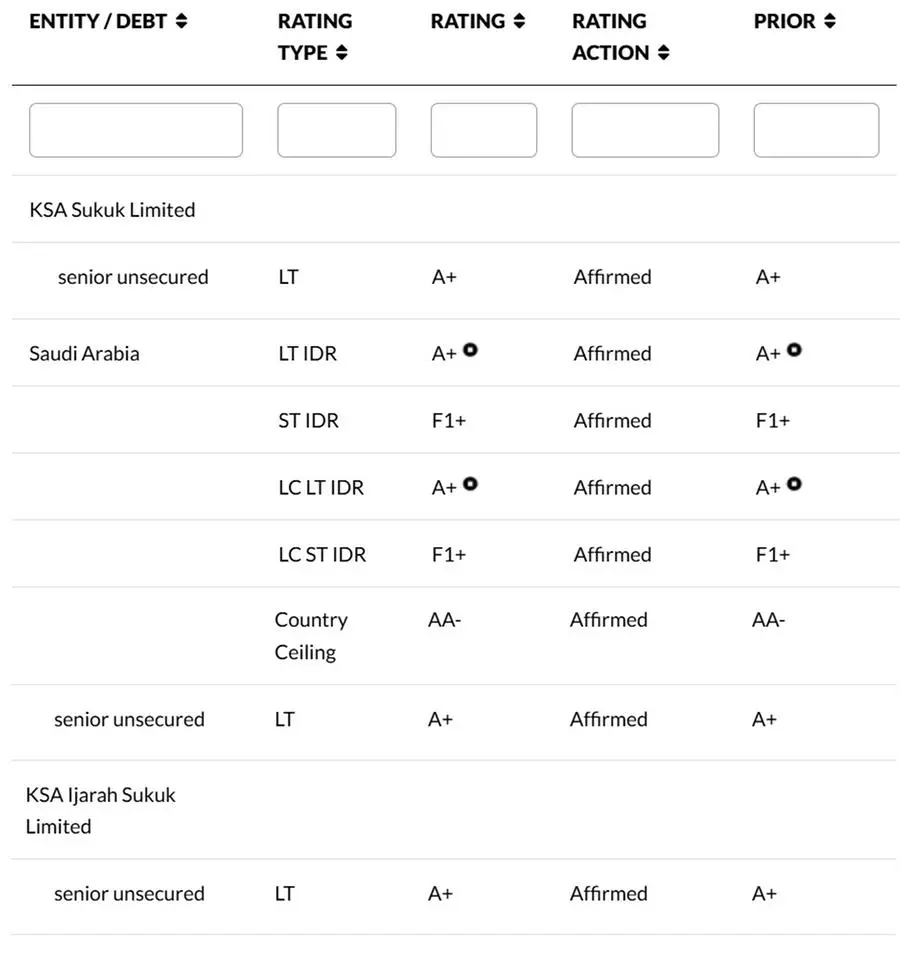
Additional information is available on www.fitchratings.com
PARTICIPATION STATUS
The rated entity (and/or its agents) or, in the case of structured finance, one or more of the transaction parties participated in the rating process except that the following issuer(s), if any, did not participate in the rating process, or provide additional information, beyond the issuer’s available public disclosure.
APPLICABLE CRITERIA
- Country Ceiling Criteria (pub. 24 Jul 2023)
- Sukuk Rating Criteria (pub. 14 Oct 2025)
- Sovereign Rating Criteria (pub. 27 Apr 2026) (including rating assumption sensitivity)
APPLICABLE MODELS
Numbers in parentheses accompanying applicable model(s) contain hyperlinks to criteria providing description of model(s).
- Country Ceiling Model, v2.0.3 (1)
- Debt Dynamics Model, v1.3.3 (1)
- Macro-Prudential Indicator Model, v1.5.0 (1)
- Sovereign Climate Risk Model, v1.0.0 (1)
- Sovereign Rating Model, v3.14.4 (1)
DDITIONAL DISCLOSURES
- Dodd-Frank Rating Information Disclosure Form
- Solicitation Status
- Endorsement Policy
ENDORSEMENT STATUS
| KSA Ijarah Sukuk Limited | UK Issued, EU Endorsed |
| KSA Sukuk Limited | UK Issued, EU Endorsed |
| Saudi Arabia | UK Issued, EU Endorsed |
DISCLAIMER & DISCLOSURES
All Fitch Ratings (Fitch) credit ratings are subject to certain limitations and disclaimers. Please read these limitations and disclaimers by following this link: https://www.fitchratings.com/understandingcreditratings. In addition, the following https://www.fitchratings.com/rating-definitions-document details Fitch's rating definitions for each rating s
Solicitation Status
The ratings above were solicited and assigned or maintained by Fitch at the request of the rated entity/issuer or a related third party. Any exceptions follow below.
Fitch's solicitation status policy can be found at www.fitchratings.com/ethics.
Endorsement Policy
Fitch’s international credit ratings produced outside the EU or the UK, as the case may be, are endorsed for use by regulated entities within the EU or the UK, respectively, for regulatory purposes, pursuant to the terms of the EU Regulation or the UK Regulation, as the case may be. Fitch’s approach to endorsement in the EU and the UK can be found on Fitch’s Regulatory Affairs page on Fitch’s website. The endorsement status of international credit ratings is provided within the entity summary page for each rated entity and in the transaction detail pages for structured finance transactions on the Fitch website. These disclosures are updated on a daily basis.