PHOTO
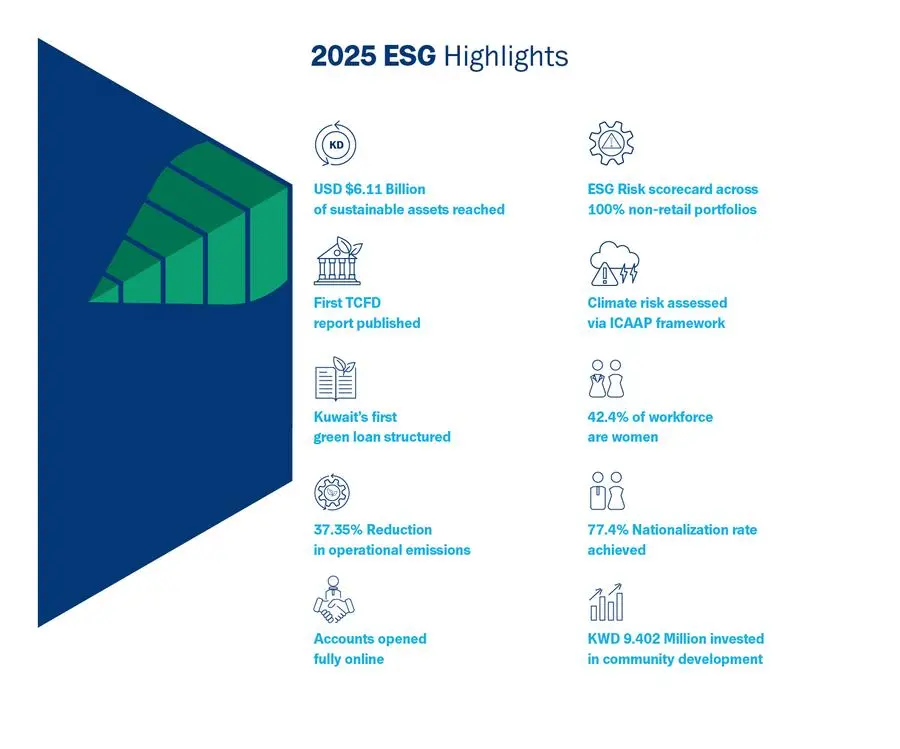
- NBK’s sustainable assets portfolio reached USD 6.11 billion, reflecting a 23% year-on-year growth
- The Bank exceeded its interim operational emissions reduction target, achieving a 37.35% reduction in 2025
- NBK introduced its ESG Risk Scorecard across all Group non-retail lending portfolios, embedding ESG considerations into credit decision-making and aligning lending practices with global Responsible Banking standards
- NBK financed 18 green projects across the Middle East, Europe, North America, and Asia-Pacific
- NBK successfully structured and led Kuwait’s first-ever green loan, valued at KD 25 million
- NBK published its first Task Force on Climate-related Financial Disclosures (TCFD) report
- The Bank reduced its water consumption by 11.6% compared to the 2021 baseline
- The Bank scaled the adoption of AI technologies across core functions to enhance operational efficiency
- The Bank enabled digital onboarding, delivering a more seamless and accessible banking experience
- Women accounted for 42.4% of the NBK’s workforce, with 27.2% holding management positions
- The Bank achieved a Kuwaitization rate of 77.4% by year-end
- NBK expanded the SME financing portfolio to KWD 26.4 million, reflecting 5.43% year-on-year growth
- The Bank extended the Bankee program’s reach to 53,098 students and 11,321 teachers
Aligned with its leadership role and institutional approach to fully embedding sustainability at the core of its business and operations, National Bank of Kuwait (NBK) issued its tenth Sustainability Report titled: “Sustainability at the Core: From Strategy to Impact”. Reaffirming its commitment to delivering tangible, long-term impact across environmental, social, and governance (ESG) dimensions, strengthening business resilience and reinforcing its leadership in the banking sector.
The report reflects the Bank’s notable progress during 2025 in advancing its leadership in sustainable finance and responsible banking, through the continued development of governance frameworks, enhanced climate transparency, expansion of sustainable financing solutions, and improved resource efficiency, in line with leading global standards and best practices.
Structured around four core pillars that form the foundation of the Bank’s ESG strategy, it outlines key achievements across each pillar: Governance for Resilience, Responsible Banking, Capitalizing on Our Capabilities, and Investing in Our Communities. Alongside the material topics associated with each pillar and the initiatives implemented by NBK across these areas.
This year’s Sustainability Report highlights NBK’s strong progress in advancing its sustainable finance agenda, noting that the Bank’s sustainable assets portfolio grew by 23% year-on-year to reach USD 6.11 billion as of end-December 2025. This growth was driven by a diversified suite of ESG-linked products and remains aligned with the Bank’s strategic objective of reaching USD 10 billion in sustainable assets by 2030. The report also underscores that NBK surpassed its interim operational emissions reduction target for Scope 1 and Scope 2 emissions, achieving a 37.35% reduction in 2025 compared to the 2021 baseline. This performance reflects the accelerated execution of its strategy toward achieving net-zero emissions by 2060.
In addition, the report highlights the Bank’s continued efforts to enhance disclosure and transparency, marked by the publication of its first Task Force on Climate-related Financial Disclosures (TCFD) report in April 2025, alongside the release of its inaugural Green Bond Allocation and Impact Report in May 2025, following the issuance of NBK’s first green bond in mid-2024.
Governance for Resilience
NBK made substantial progress under the Governance for Resilience pillar during 2025, through the implementation of the ESG Risk Scorecard circulated across all Group non-retail lending portfolios in October 2025. This ensures the integration of sustainability considerations into credit decision-making and alignment with global responsible banking standards.
The Bank also developed a standalone ESG risk management framework encompassing climate-related risks, with climate considerations fully embedded into risk management processes and capital planning. Furthermore, NBK utilized is proprietary climate-adjusted stress test model alongside scenario analysis based on the Network for Greening the Financial System (NGFS) to assess climate risks on a semi-annual basis as part of its Internal Capital Adequacy Assessment Process (ICAAP), reinforcing the alignment between financial resilience and environmental responsibility.
During 2025, NBK continued to advance its participation in the Partnership for Carbon Accounting Financials (PCAF) initiative by integrating emissions intensity data to enhance ESG scorecards and obligor-level assessments and refine its approach to calculating its baseline absolute financed emissions.
Responsible Banking
Aligned with the Responsible Banking pillar, NBK continued to expand its sustainable finance activities, with total accumulated sustainable assets reaching USD 6.11 billion as of 31 December 2025.
Furthermore, the Bank published its first Green Bond Allocation and Impact Report for its inaugural Green bond issuance mid-2024, reflecting an allocation of USD 625.44 million toward financing green projects and delivering tangible environmental benefits. NBK’s inaugural green bond contributed to financing 18 green projects across the Middle East, Europe, North America, and Asia-Pacific.
Among NBK’s key achievements in 2025 within the Responsible Banking pillar was the execution of Kuwait’s first green financing agreement, through which the Bank provided KWD 25 million to Mabanee, one of the largest real estate developers in the Middle East and North Africa, to support Sabah Al Ahmad Project (S3). The financing agreement is aligned with the Green Loan Principles (GLP) published by the Loan Market Association (LMA) in 2023 and will support the project in achieving a LEED Gold Certification.
In addition to its progress on emission reductions, NBK achieved an 11.6% reduction in water consumption in 2025 compared to its 2021 baseline, alongside improvements in energy and water efficiency across all operational locations, including its headquarters and branch network. These efforts were supported by building management systems, optimization of cooling systems, water circulation upgrades, and solar solutions, enhancing environmental performance and operational efficiency across its footprint.
The Bank also continued to offer preferential pricing on eco-friendly housing loans and electric vehicle financing, supporting more sustainable consumer choices.
Capitalizing on Our Capabilities
Building on the Capitalizing on Our Capabilities pillar, NBK continued to progressively expand the adoption of artificial intelligence technologies across its core functions to enhance operational efficiency and innovation. This initiative earned the AI Excellence Award at the Microsoft AI Summit – Kuwait.
The Bank also enabled customers to open accounts fully online using Kuwait Mobile ID and facial recognition, without the need to visit branches, delivering a more seamless banking experience and supporting inclusive banking.
Moreover, NBK recorded notable progress in empowering its workforce and strengthening diversity and inclusion. Women represented 42.4% of the total workforce across the Group and held 27.2% of managerial positions. In 2025, NBK further reinforced its commitment by establishing a Group‑wide Diversity and Inclusion Council, enhancing governance, accountability, and the strategic integration of D&I priorities across the organization.
Enhancements also included the modernization of procurement systems through the integration of SharePoint and OpenText, enabling the automation of invoice management and workflows, alongside the digitization of credit approvals and exception monitoring, strengthening governance and efficiency.
In 2025, NBK advanced its digital transformation agenda through initiatives such as PIN digitization and Digital Eidiya, promoting cashless transactions, improving operational efficiency, and reducing paper usage in line with Kuwait’s digital economy vision. In the same context, Weyay Bank, Kuwait’s first digital bank continued to scale eco‑friendly practices, with over 80% of its cards manufactured from recycled materials and the Aura Prepaid Card transitioning to a fully digital format, eliminating paper and plastic packaging.
Investing in Our Communities
Reflecting the Investing in Our Communities pillar, NBK continued to play a key role as a partner in sustainable development, supporting a broad range of community initiatives throughout 2025.
The year also marked the completion and commissioning of the Shuwaikh Waterfront development project, a landmark addition to Kuwait’s recreational and tourism infrastructure. This was complemented by the development of a multi‑storey parking facility as part of the Sharq area redevelopment project, undertaken in collaboration with Kuwait Municipality and Al Shaab National Real Estate Company. The project further includes a public park, underscoring the Bank’s commitment to urban development, enhancing quality of life, supporting sustainable growth, and creating tangible social value.
In terms of workforce nationalization, NBK continued to prioritize attracting, developing, and retaining local talent. As a result, the Bank’s Kuwaitization rate increased to 77.4% by the end of the year, in line with the requirements of the Central Bank of Kuwait.
Building on its commitment to supporting Kuwait’s economic diversification, NBK also strengthened its support for entrepreneurs and small and medium‑sized enterprises. The Bank’s SME financing portfolio grew by 5.43% year‑on‑year, reflecting sustained demand and NBK’s role in enabling private‑sector growth.
In parallel, NBK advanced financial inclusion efforts, with continued expansion of tailored services. The number of accounts within the “Al Aamil” segment increased to 125,850 by year‑end, representing 14.3% year‑on‑year growth and reinforcing the Bank’s focus on inclusive access to financial services.
Complementing these efforts, NBK further invested in financial literacy and capability‑building. During 2025, the Bankee program—one of NBK’s flagship initiatives aimed at promoting financial awareness among school students in Kuwait—continued to expand, reaching 53,098 students and 11,321 teachers.
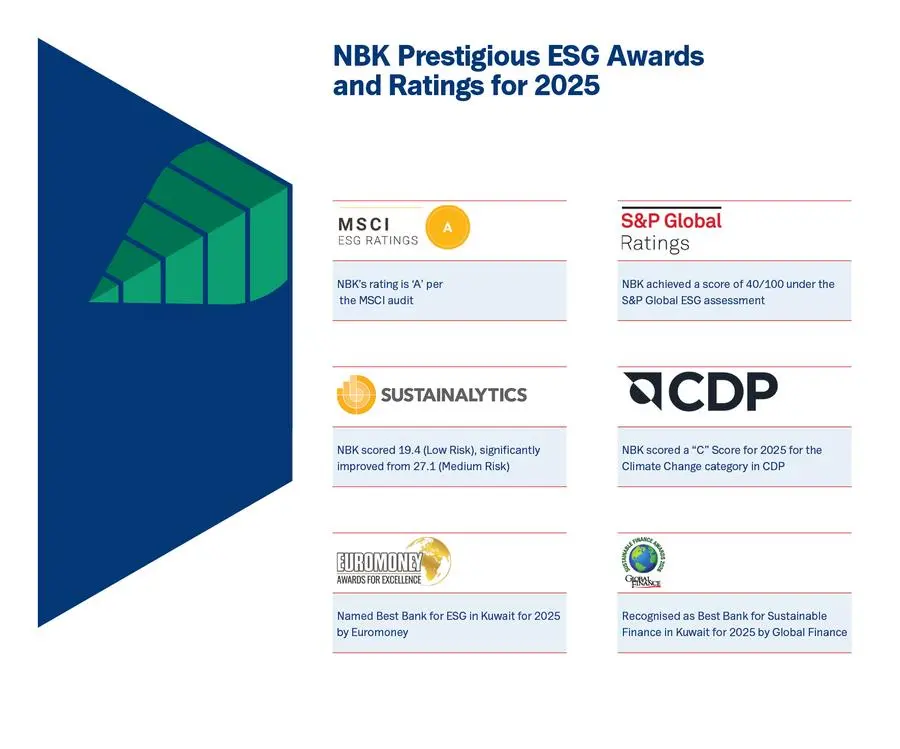
These achievements underscore NBK’s strong and accelerating ESG performance, reflected through its continuous improvement in ratings across leading global ESG assessments, and recognition from Euromoney and Global Finance as Kuwait’s leading bank for ESG and sustainable finance in 2025. Building on this momentum, NBK’s forthcoming strategy update will refresh and deepen the integration of environmental, social, and governance principles across the Group’s core operations, while fostering innovation, inclusive growth, and robust governance. Central to this next phase will be the launch of a centralized ESG data management system to ensure consistent, accurate, and transparent reporting across all locations, enhancing auditability, strengthening oversight, and enabling informed, data‑driven decision‑making. Through a continued focus on sustainable finance, climate risk management and portfolio emissions, capacity building, and reducing its environmental footprint, NBK reaffirms its commitment to leading a just transition toward a low‑carbon future and delivering long‑term value for all stakeholders.