PHOTO
Tokyo, Japan — The MIT Jameel Clinic, the epicentre of artificial intelligence (AI) and health at the Massachusetts Institute of Technology (MIT), and the National Cancer Center Hospital in Japan have announced a new collaboration to evaluate Mirai, a groundbreaking deep learning model that can analyse mammogram to accurately predict the patients’ risk of developing breast cancer up to five years in advance.
Developed at the Jameel Clinic, which was co-founded in 2018 by MIT and Community Jameel, an international organisation that advances science and learning for communities to thrive, Mirai has been validated on more than two million mammograms in 72 hospitals across 23 countries.
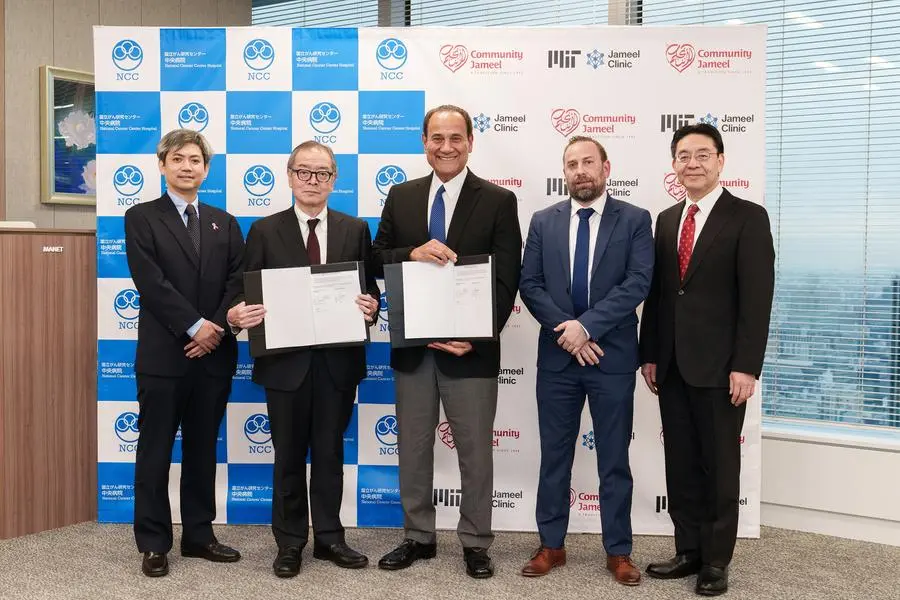
The collaboration was presented at a ceremony attended by Mohammed Jameel KBE, founder and chairman of Community Jameel, and Dr Yasuyuki Seto, director of the National Cancer Center Hospital.
The collaboration will launch with a study that will aim to evaluate Mirai’s ability to predict breast cancer risk in Japanese women using mammography images. This joint study will analyze mammography data collected between 2013 and 2024 to determine whether Mirai can accurately assess breast cancer risk in Japanese women, further building on its successful validation records.
If successful, the findings could help shape a more personalized approach to breast cancer screening in Japan, enabling closer monitoring for higher-risk individuals while reducing unnecessary tests for those at lower risk.
Early detection for better health outcomes
Breast cancer remains the most common cancer among women in Japan, accounting for approximately 23% of all female cancer cases, equivalent to around 98,782 diagnoses each year.*1 It is estimated that approximately 16,000 women die from breast cancer annually.*2 By contrast, when breast cancer is detected at an early stage, the five-year relative survival rate exceeds 90%, demonstrating significantly better outcomes.
This data highlights the importance of identifying risk earlier and ensuring appropriate follow-up and care. In Japan, mammography screening is currently recommended every two years for women aged 40 and above. While mammograms allow physicians to detect small lumps and microcalcifications not visible through self-examination, interpretation is still primarily visual and dependent on clinical experience.
Mohammed Jameel KBE, founder and chairman of Community Jameel, said: “Mirai is a powerful tool that harnesses AI to improve cancer care for women around the world. With the Jameel family’s deep and longstanding connection to Japan, we are delighted that the MIT Jameel Clinic and Community Jameel are collaborating with the National Cancer Center Hospital to open the way for Mirai to improve care for Japanese women at risk of breast cancer.”
Dr Kan Yonemori, Director, Department of Medical Oncology at the National Cancer Center Hospital, said: “This study has the potential to contribute to improving women’s health by predicting an individual’s future risk of breast cancer using large-scale mammography screening data from the past and present. Our team in Japan is committed to advancing this work as part of an international collaboration with the MIT Jameel Clinic, and we look forward to contributing meaningfully to this important global research effort.”
Regina Barzilay, AI faculty lead at the MIT Jameel Clinic, said: “With Mirai’s ability to predict a patient’s cancer risk up to five years in advance, my hope is that this research collaboration will inspire new approaches to breast cancer screening and treatment in Japan.”
Evaluation within a Japanese clinical context
The study will focus on analysing data from individuals screened for breast cancer at the National Cancer Center Hospital and Yotsuya Medical Cube between 2013 and 2024. Mirai will analyse mammography images from these screenings to predict breast cancer risk over a one-to-five-year horizon. Predicted risk scores will then be compared with actual outcomes to evaluate the model’s accuracy and reliability in a Japanese clinical context.
If validated, this research could mark an important step toward introducing AI-supported, risk-based breast cancer screening in Japan — helping detect cancer earlier and personalize care through advanced technology.
The study is supported by Community Jameel and Jameel Corporation.
About Community Jameel:
Community Jameel advances science and learning for communities to thrive. Community Jameel was launched in 2003 to continue the tradition of philanthropy and community service established by the Jameel family of Saudi Arabia in 1945. Community Jameel supports scientists, humanitarians, technologists and creatives to understand and address pressing human challenges in areas such as climate change, health and education.
The work enabled and supported by Community Jameel has led to significant breakthroughs and achievements, including the MIT Jameel Clinic’s discovery of the new antibiotics halicin and abaucin, critical modelling of the spread of COVID-19 conducted by the Jameel Institute at Imperial College London, and a Nobel Prize-winning experimental approach to alleviating global poverty championed by the co-founders of the Abdul Latif Jameel Poverty Action Lab at MIT.
communityjameel.org
About National Cancer Center Hospital
Since 1962, the National Cancer Center Hospital has been a leading institution in cancer treatment and research in Japan, driven by the vision of "delivering the best possible treatment and prevention to all people through collaboration with society”. The hospital has built a high-volume, high-quality care system for all types of cancer. National Cancer Center Hospital actively advances industry-sponsored trials, investigator-initiated trials, first-in-human (FIH) trials, and international collaborative clinical trials, with a commitment to establish and disseminate standard medical care.