PHOTO
DUBAI: African leaders and financial experts gathering at the World Governments Summit (WGS 2026) said the continent does not need aid, it needs investments.
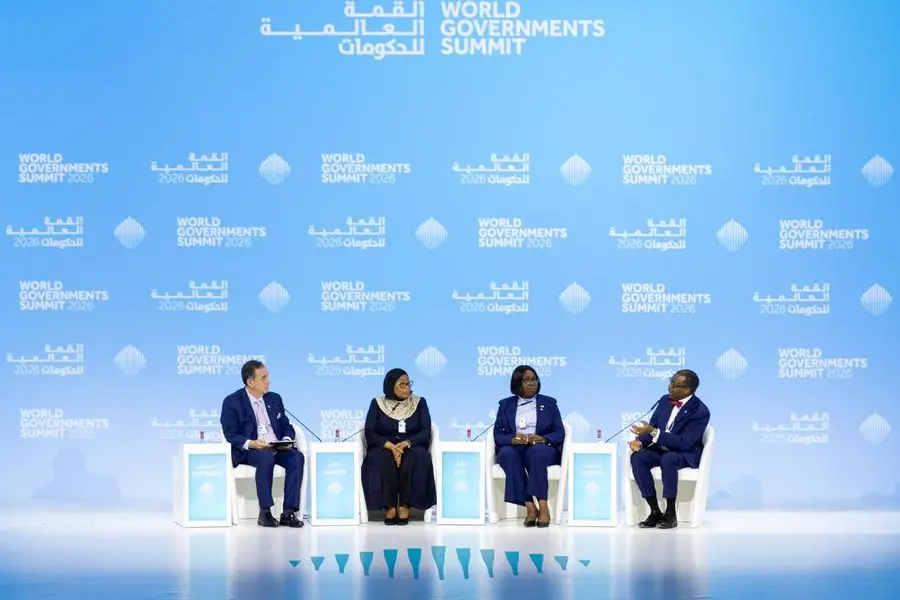
Leaders of Tanzania, Mozambique and the African Development Bank examined at a session, titled “Government and the Future of Investment: An African Perspective”, how the continent can unlock private capital at a pivotal moment in its economic transformation.
The session brought together Dr. Samia Suluhu Hassan, President of the United Republic of Tanzania; Maria Benvinda Delfina Levi, Prime Minister of the Republic of Mozambique; and Dr. Akinwumi Adesina, 8th President of the African Development Bank Group and was moderated by John Defterios, former CNN anchor and Strategic Advisor at APCO Worldwide.
Defterios framed Africa as standing at a historic inflection point, citing its fast-growing population, accelerating digital transformation, vast natural resources, and expanding tourism sector. Yet, he noted, Africa continues to receive a disproportionately small share of global foreign direct investment. Of the $1.6 trillion in global FDI recorded in 2025, only around $60 billion—approximately 4 to 5 percent—flowed to Africa.
Dr. Adesina of the African Development Bank Group argued that the moment demands a decisive move away from aid-led development and toward investment-driven growth. “Africa does not need aid; it needs investment,” he said, pointing to sustained economic momentum across the continent.
According to IMF projections, Africa is expected to grow at around 4 percent annually and to maintain one of the highest real GDP growth rates globally over the next four years, reflecting what he described as “structural momentum, not a temporary blip.”
He highlighted successful African and global corporations operating across the continent, strong returns from infrastructure assets, and Africa’s low correlation with global public markets. Together, these factors position Africa as a compelling destination for long-term investors.
Dr. Adesina also underscored the continent’s estimated $6 trillion in critical minerals and natural assets, stressing the need to convert these endowments into structured, revenue-generating investment opportunities.
President Hassan outlined the reforms Tanzania has undertaken to attract capital, emphasizing policy consistency, regulatory reform, and large-scale infrastructure investment. She detailed major transport projects, including a 2,100-kilometre standard gauge railway linking Tanzania to Burundi and the Democratic Republic of Congo, alongside significant port development across the Indian Ocean and key inland lakes.
“These reforms have created a more predictable and attractive investment environment,” President Hassan said, noting that registered investment projects in Tanzania have risen from around 250 in 2018 to nearly 970 today, with investment values increasing from $3.8 billion to almost $12 billion.
She highlighted close cooperation with the African Development Bank, the World Bank, and partners such as the UAE in financing these projects.
Prime Minister Levi focused on Mozambique’s progress in structuring large-scale energy and infrastructure investments. She cited the resumption of the Mozambique LNG project led by TotalEnergies, ExxonMobil’s Rovuma LNG project, ENI-operated floating LNG platforms, and a new $5 billion hydroelectric partnership with EDF and Sumitomo.
According to Levi, Africa’s challenge lies not in a lack of assets, but in bridging the gap between those assets and global capital through better governance, risk mitigation, and project structuring.
Closing the session, Dr. Adesina emphasized the role of development banks, guarantees, and the forthcoming Global Africa Investment Summit in converting African assets into investable portfolios.
“Africa is not optional; Africa is inevitable,” he said, stressing that the continent’s leadership is aligned on moving up value chains and positioning Africa as one of the world’s most attractive regions for sustainable, long-term investment.