PHOTO
HONG KONG: Airline shares rebounded on Thursday as more flights took off from the Middle East, providing some reprieve for carriers after U.S.-Israeli strikes on Iran wiped billions of dollars off their market value earlier in the week.
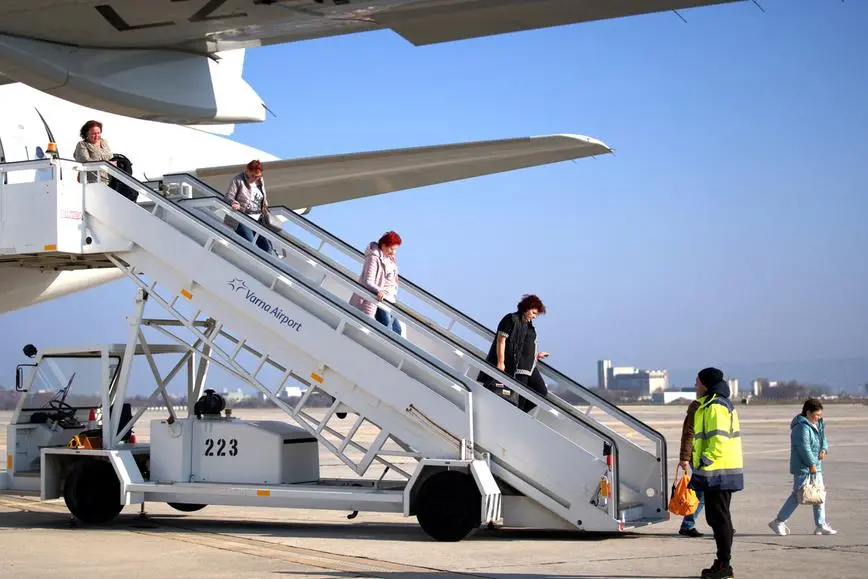
Governments have been scrambling to arrange flights out of the Middle East for tens of thousands of citizens stranded by the intensifying U.S. and Israeli conflict with Iran, which has closed most of the region's airspace due to the risk of missiles hitting passenger planes.
Dubai, the world's busiest international airport, normally handles more than 1,000 flights a day and its closure upended travel and sent ticket prices soaring on popular routes such as Australia to Europe.
Emirates and Etihad Airways are now operating a limited number of services from Dubai and Abu Dhabi through the United Arab Emirates' safe air corridors, while Qatar Airways flights from Doha remain completely halted.
As of early on Thursday morning, Emirates flights had departed from Dubai to destinations including Sydney, Amsterdam, Toronto and Mumbai, according to flight-tracking service Flightradar24, though the vast majority of services remained cancelled.
Three commercial flights were scheduled to depart the United Arab Emirates for Australia on Thursday, the Australian government said, after about 200 Australians arrived on an Emirates flight from Dubai on Wednesday night with emotional scenes at arrival gates as families embraced returning travellers.
A U.S. government charter flight was bringing Americans to the United States from the Middle East, and additional flights were being arranged for locations across the region, the U.S. State Department said.
Canada said it was working to repatriate stranded citizens by organising seats on commercial flights and contracting charter flights.
Air India said it had a flight planned for Thursday on the Mumbai-Dubai-Delhi route on a Boeing 777 with a larger capacity to fly back stranded passengers.
ASIAN AIRLINE SHARES REBOUND
Many Asian airline shares rebounded following double-digit percentage drops in the past few days amid concerns over how long the conflict might last and the impact of surging oil prices.
"For now, I consider this rebound to be primarily short-term in nature, and its sustainability will still depend on the ongoing situation in the Iranian conflict," said Kenny Ng, a securities strategist at China Everbright Securities International.
Potentially providing some relief, operatives from Iran's Ministry of Intelligence signalled openness to the U.S. Central Intelligence Agency (CIA) to talks on ending the war, the New York Times reported, citing officials briefed on the matter.
Shares in Hong Kong's Cathay Pacific Airways rose 4.2%, Japan Airlines was up 0.25%, Qantas Airways rose more than 1% and Korean Air Lines gained more than 5%.
Major Chinese carriers including Air China, , China Eastern Airlines , and China Southern Airlines, fell between 1% and 3% in both the Hong Kong and Shanghai markets, stabilising after steeper falls earlier this week.
"Asian airlines are highly sensitive to Iran's situation due to exposure through routes and energy in both revenue and costs. Any news on shortening the duration of the war can easily turn sentiment," said Gary Ng, a senior economist at Natixis.
With airspace severely constrained, airlines have been forced to reroute flights, carry extra fuel or make additional refuelling stops to guard against sudden diversions or longer flight paths through safer corridors.
Marooned tourists and some expatriates have also tried to find their own way out of the Middle East through Saudi Arabia or Oman, where the airspace remains open.
(Reporting by Julie Zhu in Hong Kong; Additional reporting by Li Gu in Shanghai; Writing by Anne Marie Roantree; Editing by Jamie Freed)