PHOTO
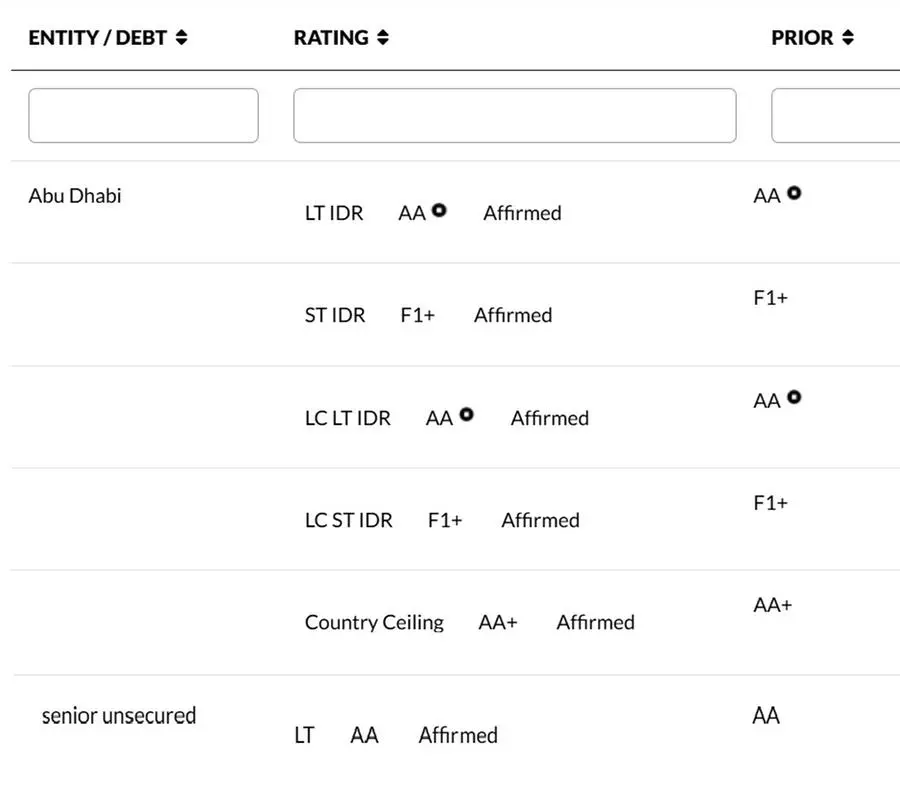
Fitch Ratings - London: Fitch Ratings has affirmed Abu Dhabi's Long-Term Foreign-Currency Issuer Default Rating (IDR) at 'AA' with a Stable Outlook.
The rating affirmation reflects Abu Dhabi's high GDP per capita and very strong fiscal and external metrics. Government debt is among the lowest of Fitch-rated sovereigns and sovereign net foreign assets are among the highest. The rating is constrained by high dependence on hydrocarbons, a relatively weak but improving economic policy framework, geopolitical risks and low governance indicators compared with peers.
The Stable Outlook reflects the resilience of oil export revenue during the Iran war, which significantly offsets the negative impact of the war, as well as abundant fiscal and external buffers.
Key Rating Drivers
Iran War Risks: We expect the ceasefire to broadly hold, allowing a gradual re-opening of the Strait of Hormuz. However, the course of the war is highly uncertain. There are significant risks of a renewed flare-up, which could include greater disruption to oil and gas exports due to significant damage to energy production, processing and transportation assets, as well as a prolonged closure of the Strait, both of which would weigh on Abu Dhabi's credit profile. A more lasting and structural deterioration in the regional security environment would challenge economic diversification, non-oil growth, and, potentially, the sovereign balance sheet.
Resilient Hydrocarbon Revenue: Abu Dhabi's export revenues are likely to remain close to pre-war forecasts despite the disruption, as higher prices and exports via Fujairah offset lower volumes through the Strait of Hormuz. Crude oil is the bulk of exports, and we consider Abu Dhabi's oil export infrastructure less vulnerable to long-term damage than more concentrated and bespoke downstream oil or liquefied natural gas (LNG) plants.
Rise in Government Spending: Fitch assumes higher government financial support for some of Abu Dhabi's core government-related entities (GREs), aimed at preventing a significant deterioration in their financial sustainability while they incur war-related costs, in particular in the logistics sector. This will moderately increase spending during the war, as some other expenses are put on hold. After the war ends, we anticipate that the government will introduce support programmes aimed at reviving the non-oil economy.
Modest Budget Surplus: We project the general government surplus, including our estimate of Abu Dhabi Investment Authority's (ADIA) investment income, to narrow to 3.0% of GDP in 2026 from 6.5% in 2025. Excluding ADIA's estimated investment income, we project a deficit of 2.2%, the first since 2020. Revenue will benefit from the first distribution of corporate income tax proceeds, which were collected on 2023-2024 corporate performance.
Low but Rising Government Debt: Government debt was 19.5% of GDP at end-2025, well below the peer median of 50.3%. Fitch expects this to rise to 25.3% in 2026 due to higher war-related borrowing, before stabilising post-war. Abu Dhabi plans to issue in local currency to support the domestic debt market amid high bank liquidity and is likely to refinance upcoming external debt maturities locally.
Exceptional Balance-Sheet Strength: We estimate Abu Dhabi's sovereign net foreign assets, mostly comprising ADIA assets, at 291% of GDP at end-2025 ('AA' median: 45.4%). The largest shares of the 2025 surplus were allocated to Abu Dhabi Developmental Holding Company PJSC and Mubadala, both GREs with long-term development mandates, with some also channeled to MGX, a venture focused on AI investments owned by Mubadala and G42, which is partly government-owned.
Manageable Contingent Liabilities: Abu Dhabi has larger contingent liabilities than peers due to its role as the financial backer of the UAE and its use of GREs to finance long-term projects. We estimate Abu Dhabi's GRE debt at over 50% of GDP in 2025. We view these contingent liabilities as manageable, given Abu Dhabi's ample fiscal buffers, the generally profitable nature of GREs and their large asset bases.
Abu Dhabi Banks Resilient: Abu Dhabi's banks have significant buffers against shocks. First Abu Dhabi Bank PJSC and Abu Dhabi Commercial Bank PJSC both have liquid assets/deposits ratios of over 30%. UAE banks' Viability Ratings could face risks from asset-quality deterioration under an adverse scenario in which the Iran war has severe effects, with real estate lending the most likely source of stress. Lower business volumes and higher impairments under such a scenario would reduce profitability and weaken capital buffers. Abu Dhabi's flagship banks have limited concentration in corporate real estate and would retain ample liquidity buffer in a stress scenario
Economic Contraction: We project Abu Dhabi's economy to shrink by 1% in 2026, with both oil and non-oil activity contracting. The closure of the Strait of Hormuz will be mitigated by a rise in oil production to 3.3 million barrels per day (mmbpd) post-war. We expect the non-oil economy to return to growth rapidly, although at a slower pace than pre-war, and to remain heavily dependent on GRE-funded projects.
ESG - Governance: Abu Dhabi has an ESG Relevance Score (RS) of '5[+]' for Political Stability and Rights, and the Rule of Law, Institutional and Regulatory Quality and Control of Corruption. These scores reflect the high weight that the World Bank Governance Indicators (WBGI) have in our proprietary Sovereign Rating Model (SRM). Abu Dhabi has a high WBGI ranking at the 71st percentile, reflecting its record of domestic political stability, strong institutional capacity, effective rule of law and a low level of corruption.
RATING SENSITIVITIES
Factors that Could, Individually or Collectively, Lead to Negative Rating Action/Downgrade
- Structural: A prolonged deterioration in the security environment, which could include greater disruption to Abu Dhabi's ability to export oil and gas due to significant damage to energy production, processing and transportation assets; or a prolonged closure of the Strait of Hormuz, which has a significant impact on the economy and public finances of Abu Dhabi
- Public Finances: Substantial erosion of fiscal and external positions, for example, due to a sustained decline in oil prices, or a materialisation of contingent liabilities, which trigger a rise in sovereign borrowing or foreign asset sales
Factors that Could, Individually or Collectively, Lead to Positive Rating Action/Upgrade
- Structural/Macro: Improvement in structural factors, such as a reduction in oil dependence, a strengthening in governance and a reduction in geopolitical risk, while maintaining strong fiscal and external balance sheets
Sovereign Rating Model (SRM) and Qualitative Overlay (QO)
Fitch's proprietary SRM assigns Abu Dhabi a score equivalent to a rating of 'AA+' on the Long-Term Foreign-Currency (LTFC) IDR scale.
Fitch's sovereign rating committee adjusted the output from the SRM to arrive at the final LTFC IDR by applying its QO, relative to SRM data and output, as follows:
- Structural: -1 notch to reflect risks from the ongoing Iran war, geopolitical risks and the high reliance on hydrocarbons as a source of fiscal and external revenues relative to peers
Fitch's SRM is the agency's proprietary multiple regression rating model that employs 18 variables based on three-year centred averages, including one year of forecasts, to produce a score equivalent to a LTFC IDR. Fitch's QO is a forward-looking qualitative framework designed to allow for adjustment to the SRM output to assign the final rating, reflecting factors within our criteria that are not fully quantifiable and/or not fully reflected in the SRM.
Debt Instruments: Key Rating Drivers
Senior Unsecured Debt Equalised: The senior unsecured long-term debt ratings are equalised with the applicable Long-Term IDR, as Fitch assumes recoveries will be 'average' when the sovereign's Long-Term IDR is 'BB-' and above. No Recovery Ratings are assigned at this rating level.
Country Ceiling
The Country Ceiling for Abu Dhabi corresponds to that of the UAE, which is 'AA+'. See the latest RAC for the UAE, "Fitch Affirms the United Arab Emirates at 'AA-'; Outlook Stable" published 24 June 2025.
REFERENCES FOR SUBSTANTIALLY MATERIAL SOURCE CITED AS KEY DRIVER OF RATING
The principal sources of information used in the analysis are described in the Applicable Criteria.
There is no disclosure on the size of Abu Dhabi's external assets (mostly relating to ADIA).
There is a degree of disclosure on the assets' composition and returns of ADIA's and Fitch is provided with some guidance on inflows and outflows. Fitch's estimates of Abu Dhabi's external assets are derived by compounding estimated government cash surpluses using assumptions about returns and asset allocations.
The mitigants above provide us with sufficient confidence in our analysis of the credit profile to maintain or assign the rating.
Climate Vulnerability Signals
The results of our Climate.VS screener did not indicate an elevated risk for the United Arab Emirates.
ESG Considerations
Abu Dhabi has an ESG Relevance Score of '5[+]' for Political Stability and Rights as WBGI have the highest weight in Fitch's SRM and are therefore highly relevant to the rating and a key rating driver with a high weight. As the UAE has a percentile rank above 50 for the respective Governance Indicator, this has a positive impact on the credit profile.
Abu Dhabi has an ESG Relevance Score of '5[+]' for Rule of Law, Institutional & Regulatory Quality and Control of Corruption as WBGI have the highest weight in Fitch's SRM and are therefore highly relevant to the rating and are a key rating driver with a high weight. As the UAE has a percentile rank above 50 for the respective Governance Indicators, this has a positive impact on the credit profile.
Abu Dhabi has an ESG Relevance Score of '4' for Human Rights and Political Freedoms as the Voice and Accountability pillar of the WBGI is relevant to the rating and a rating driver. As the UAE has a percentile rank below 50 for the respective Governance Indicator, this has a negative impact on the credit profile.
Abu Dhabi has an ESG Relevance Score of '4[+]' for Creditor Rights as willingness to service and repay debt is relevant to the rating and is a rating driver for the UAE, as for all sovereigns. As the UAE has a record of 20+ years without a restructuring of public debt and captured in our SRM variable, this has a positive impact on the credit profile.
The highest level of ESG credit relevance is a score of '3', unless otherwise disclosed in this section. A score of '3' means ESG issues are credit neutral or have only a minimal credit impact on the entity, either due to their nature or the way in which they are being managed by the entity. Fitch's ESG Relevance Scores are not inputs in the rating process; they are an observation on the relevance and materiality of ESG factors in the rating decision. For more information on Fitch's ESG Relevance Scores, visit www.fitchratings.com/topics/esg/products#esg-relevance-scores.
Additional information is available on www.fitchratings.com
PARTICIPATION STATUS
The rated entity (and/or its agents) or, in the case of structured finance, one or more of the transaction parties participated in the rating process except that the following issuer(s), if any, did not participate in the rating process, or provide additional information, beyond the issuer’s available public disclosure.
APPLICABLE CRITERIA
Country Ceiling Criteria (pub. 24 Jul 2023)
Sovereign Rating Criteria (pub. 27 Apr 2026) (including rating assumption sensitivity)
APPLICABLE MODELS
Numbers in parentheses accompanying applicable model(s) contain hyperlinks to criteria providing description of model(s).
Country Ceiling Model, v2.0.3 (1)
Macro-Prudential Indicator Model, v1.5.0 (1)
Sovereign Climate Risk Model, v1.0.0 (1)
Sovereign Rating Model, v3.14.4 (1)
ADDITIONAL DISCLOSURES
Dodd-Frank Rating Information Disclosure Form
Solicitation Status
Endorsement Policy
ENDORSEMENT STATUS
| Abu Dhabi | UK Issued, EU Endorsed |
DISCLAIMER & DISCLOSURES
All Fitch Ratings (Fitch) credit ratings are subject to certain limitations and disclaimers. Please read these limitations and disclaimers by following this link: https://www.fitchratings.com/understandingcreditratings. In addition, the following https://www.fitchratings.com/rating-definitions-document details Fitch's rating definitions for each rating s
Read More
Solicitation Status
The ratings above were solicited and assigned or maintained by Fitch at the request of the rated entity/issuer or a related third party. Any exceptions follow below.
Fitch's solicitation status policy can be found at www.fitchratings.com/ethics.
Endorsement Policy
Fitch’s international credit ratings produced outside the EU or the UK, as the case may be, are endorsed for use by regulated entities within the EU or the UK, respectively, for regulatory purposes, pursuant to the terms of the EU CRA Regulation or the UK Credit Rating Agencies (Amendment etc.) (EU Exit) Regulations 2019, as the case may be. Fitch’s approach to endorsement in the EU and the UK can be found on Fitch’s Regulatory Affairs page on Fitch’s website. The endorsement status of international credit ratings is provided within the entity summary page for each rated entity and in the transaction detail pages for structured finance transactions on the Fitch website. These disclosures are updated on a daily basis.
Confidentiality Notice: The information contained in this e-mail and any attachment(s) is confidential and for the use of the addressee(s) only. If you are not the intended recipient of this e-mail, do not duplicate or redistribute it by any means. Please delete this e-mail and any attachment(s) and notify us immediately. Unauthorized use, reliance, disclosure or copying of the contents of this e-mail and any attachment(s), or any similar action, is strictly prohibited. Fitch Ratings reserves the right, to the extent permitted by applicable law, to retain, monitor and intercept e-mail messages both to and from its systems.