PHOTO
Dubai – UAE: The Mohammed Bin Rashid Space Centre (MBRSC) has announced the successful completion of the scientific experiment developed by students from the United Arab Emirates University (UAEU) representing the UAE, aboard the International Space Station (ISS). The experiment was conducted as part of the Asian Try Zero-G 2025 competition, led by the Japan Aerospace Exploration Agency (JAXA) in collaboration with space agencies and entities, including MBRSC.
The Asian Try Zero-G 2025 competition saw participation from 11 teams representing nine countries, reflecting strong regional engagement in space science and student innovation. The UAE’s participation was facilitated by MBRSC as part of its continued efforts to advance science education and create pathways for students to engage in applied research.
The final event featured presentations from each country, followed by a live viewing of the experiments being carried out aboard the ISS. The UAEU team, comprising six students and a faculty advisor, represented the UAE virtually, witnessing the real-time implementation of their experiment in orbit.
The experiment
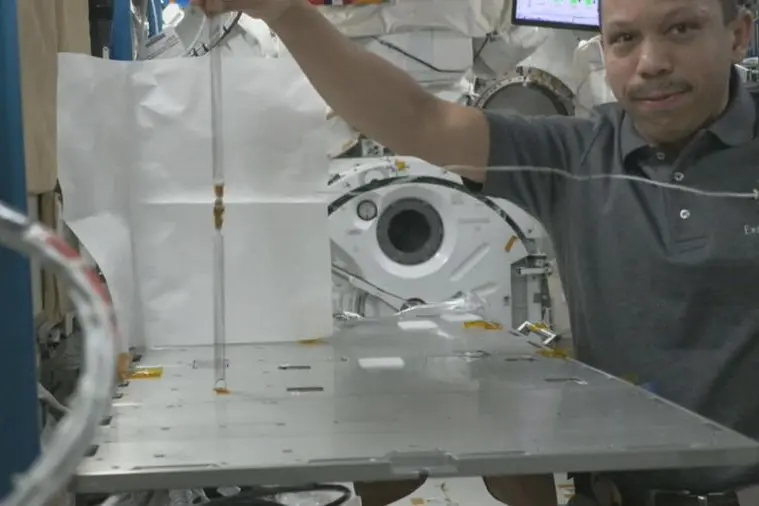
The experiment, titled “Investigating Harmonic Motion and Damping Effects in Microgravity,” was conducted by NASA astronaut Christopher Williams inside the Japanese Experiment Module “Kibo,” marking a significant milestone for student-led research from the UAE in a microgravity environment.
Developed by a team of engineering students, the experiment examined the harmonic motion of a spring-mass system and how it gradually slows down in microgravity. By analysing damping effects in the absence of Earth’s gravitational forces, the research offers insights into how mechanical systems behave in space, with relevance to satellite operations and experiments conducted aboard the ISS.
In preparation for the final phase, the students conducted multiple ground-based trials, testing the system using different masses and repeating experiments to ensure accuracy and consistency in their results. This hands-on approach formed a critical foundation for adapting the experiment to the microgravity conditions aboard the ISS.
Selected participants
The successful execution of the experiment builds on the earlier selection of the UAEU team, which emerged from a competitive national process involving 17 proposals submitted by 74 students from eight universities across the UAE. Beyond the final experiment, the initiative also brought together a wider group of students from across the country, whose ideas contributed to the broader scientific dialogue around the programme.
For Media Queries:
MBRSC Media Team - mbrsc@quillmena.com
ABOUT MOHAMMED BIN RASHID SPACE CENTRE (MBSRC):
MBRSC is an advanced scientific and technological hub, responsible for making the UAE a world leader in space services and exploration.
Starting with a small team of dedicated engineers in 2006, MBRSC has grown into the incubator of the UAE National Space Programme, fostering scientific research, and building a sustainable space sector in the UAE. MBRSC is home to the Satellite Development Programme, UAE Astronaut Programme, and Emirates Lunar Mission, among others. Under its satellite programme, the Centre has built, developed, and operated several Earth observation satellites, including DubaiSat-1; DubaiSat-2; KhalifaSat, the first satellite that was fully built by Emiratis; MBZ-SAT, the most advanced satellite in the region and Etihad-SAT, the Centre’s first SAR satellite.
Under the UAE Astronaut Programme, MBRSC currently has four astronauts, two of who have undertaken missions to the International Space Station, including the longest Arab space mission in history by H.E. Dr. Sultan Saif AlNeyadi.