PHOTO
U.S. stock index futures rose on Wednesday, buoyed by easing oil prices, while jittery investors awaited the Federal Reserve's update on the monetary policy and the economy to assess the impact of the Middle East conflict.
Sentiment was also lifted by signs of strong demand for infrastructure powering artificial intelligence tools, with both Nvidia and Advanced Micro Devices gaining 0.9% and 1.4% in premarket trading.
Nvidia secured Beijing's approval to sell its second-most powerful artificial intelligence chips in China, and is also preparing a version of the Groq AI chip for the Chinese market, according to a report.
Meanwhile, AMD signed a deal with Samsung Electronics to expand their strategic partnership on memory chip supplies for AI infrastructure.
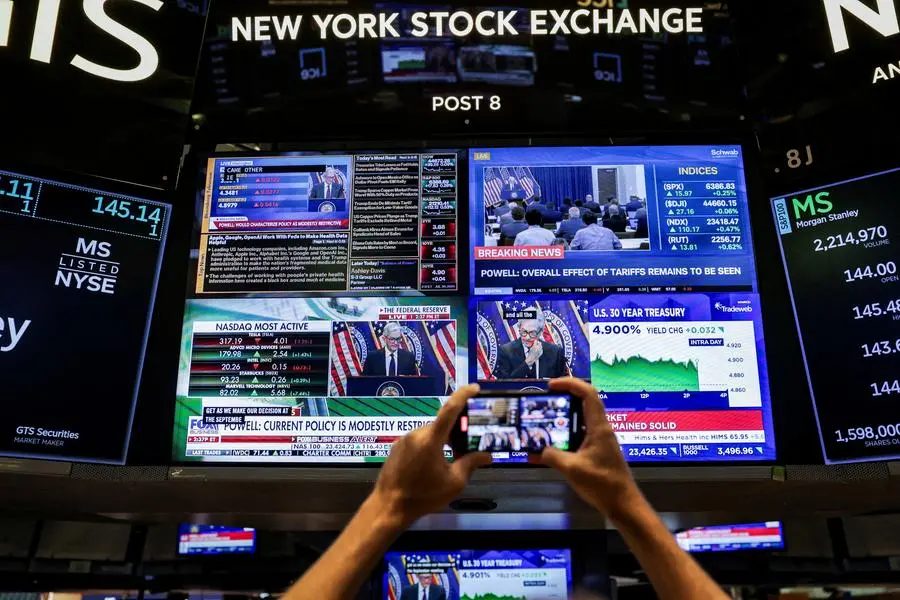
All eyes will be on the Fed, which is expected to leave benchmark interest rates unchanged at the end of its two-day meeting at 2 p.m. ET.
The greater focus, however, will be on Chair Jerome Powell's remarks on how tariffs, higher energy costs triggered by the Middle East crisis and a weakening job market will influence monetary policy decisions later this year.
Traders have pushed back expectations for the Fed’s first rate cut of 2026 toDecember from July, according to LSEG-compiled data.
"Our economists suspect the FOMC will trim growth forecasts marginally, push up its inflation forecast and then delay the 2026 rate cut until 2027," said Benjamin Schroeder, senior rates strategist at ING.
"That said, given the situation, the Fed will likely have little conviction in its forecasts, and Chair Powell will be certain to underline the challenges in the current volatile environment."
February's producers' prices data is due at 8:30 a.m. ET, which will give policymakers a final look at underlying price pressures ahead of their decision.
At 7:16 a.m. ET, Dow E-minis were up 220 points, or 0.47%, and S&P 500 E-minis were up 32 points, or 0.48%. Nasdaq 100 E-minis were up 155.75 points, or 0.63%.
Meanwhile, the conflict in the Middle East showed no signs of easing, with crude prices still hovering above $100 a barrel.
However, investors welcomed the temporary relief to supply constraints after North Oil Company said crude exports from Iraq's Kirkuk fields to Turkey's Ceyhan port have resumed via a pipeline.
Travel stocks such as Delta, American and Carnival rose more than 1% each, building on Tuesday's rebound after the airlines raised their current-quarter forecast on hopes that strong demand will offset a rise in fuel-related operating costs.
Energy company Occidental fell 1%.
The Middle East conflict has exacerbated volatility in global markets; however, U.S. stocks have been buoyed by a rebound in technology shares and on relief that the U.S. is a net energy exporter.
Wall Street's fear gauge, the CBOE VIX index, has eased to a two-week low after touching April 2025 highs earlier this month, while the benchmark S&P 500 logged its second straight day of gain for the first time in three weeks on Tuesday.
Among others, Lululemon lost 1% after forecasting 2026 revenue and profit below analysts' estimates. The yoga-wear maker, which is in the middle of a proxy fight, appointed a former chief of Levi Strauss to the board.
Drone autonomy software company Swarmer surged 38%, a day after its Nasdaq debut.
Department store chain Macy's added 7% after saying the hit from import tariffs could ease in the second half of the year.
Micron gained 2.3% ahead of its earnings after markets close.
(Reporting by Johann M Cherian and Utkarsh Hathi in Bengaluru; Editing by Anil D'Silva and Maju Samuel)