South Africa will remain an economic laggard in Africa, as the government has few answers to the structural challenges facing the country, according to analysts.
"The government has reached the limits of its ability to provide further significant fiscal support to the economy," said Robert Burgess, analyst at Deutsche Bank Securities Inc.
"Faced with a weaker growth outlook earlier this year, it scaled back spending increases in order to stick to a broadly unchanged consolidation path. It will face a similar challenge in presenting its October budget statement."
The German bank has a "gloomy view" of the economy, especially as a number of challenges remain unaddressed, such as the industrial strikes that have plagued the country over the past two years.
"Industrial strife shows little sign of abating: the last few weeks have seen further strikes in the platinum and automotive sectors and inflation-busting wage settlements (over 8% for the next two years) in the coal sector," said the bank.
Meanwhile, the South African rand has depreciated 12% against the US dollar year-to-date, but it has done little to stimulate growth to date.
"Still, we do believe that the rand's depreciation is proving to be a growth fillip, particularly in those parts of the manufacturing sector that compete with imports (such as plastics, intermediate chemicals, textiles, etc), although widespread strikes in August and September will likely keep the lid on Q3 GDP," said Peter Worthington, analyst at Absa Capital.
INFRASTRUCTURE CONSTRAINTS
South Africa is also showing signs of capacity constraints that are restricting growth.
Analysts say delays to the all-important Medupi Power Station highlights the huge infrastructure constraints facing the country.
Electricity shortages have had a negative impact on economic growth, as the government has not been able to keep up with rising demand.
State-owned utility Eskom says its two projects Medupi and Kusile, and a new pump storage scheme, Ingula, is expected to add 10,896 megawatts (MW) to the national grid, expanding Eskom's current installed capacity by over 25%.
But the first of Medupi's six 800 MW units, which was set to be delivered to the grid by the end of 2013, is being pushed back to the second half of 2014.
"The power system will remain tight, as we have said, but demand for electricity has been muted because of slower than expected economic growth, and we are working to put initiatives in place to close the gap," said Brian Dames, Eskom chief executive.
At least a fifth of the installed capacity of 42,000 MW has been offline, according to industry estimates, while available electricity this year has been 4% below average usage in 2007.
"Lack of reliable electricity supply has a further insidious and long-lasting negative effect on growth, in that it deters investment by any company that needs a reliable (and affordable) electricity supply for its production activities," Absa Capital noted.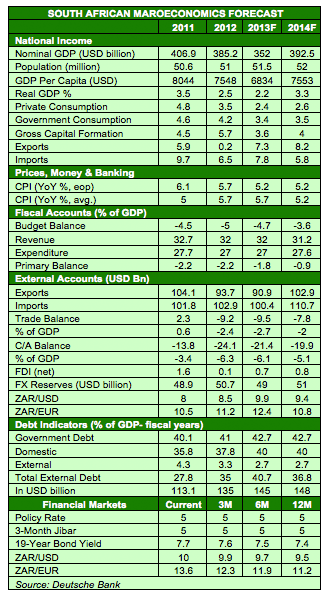
LOW BUSINESS CONFIDENCE
The poor infrastructure and industrial strikes in the mining and manufacturing sectors have dampened growth prospects, weakened business confidence and inserted fresh uncertainty.
"As for households, a lack of job growth and decelerating credit extension has slowed private consumption from it peppy rates of increase a few years ago. We forecast subdued real GDP growth of 2.0% this year and 2.8% next year," Absa Capital's Worthington said.
Despite the gloom, the country's GDP grew 3% in the second quarter, quarter-on-quarter, suggesting a rebound, but analysts believe it was a short-term blip and GDP growth in the third quarter is expected to trend lower to a more subdued 2.3%.
"The jump in the PMI index to a six-year high of 56.5 in August implies upside risks to output," said Matthew Sharratt, analyst at Bank of America Merrill Lynch.
"That said, we do not expect this pace to be sustained into 4Q as inventory levels, particularly in the motor sector, appeared to rise ahead of widely anticipated strike action."
Poor export flows could further dampen sentiment, especially in an uncertain global economic environment, and low gold and metal prices.
Bank of America analysts say a 30% correction in commodity prices could widen the current account deficit by 3 percentage points and weaken the rand real effective exchange rate by 10%.
"Already, the weakening terms of trade since late 2011 have occurred against a backdrop of the current account deficit widening some 3.5% of GDP to 6.3% in 2012." 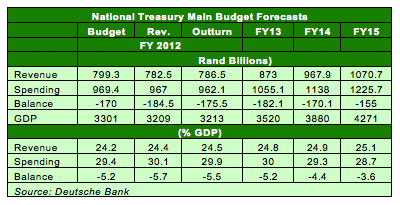
TAX HIKE
South Africa will most likely miss its target of cutting deficit to 5.2% of GDP in the current fiscal year due to lower growth.
In the first four months of the fiscal year, expenditure grew 9.7% year-on-year (above the budget target of 9.1%), while revenues rose 9.3% year-on-year (significantly below the budget target of 11.6%).
In a bid to reassure the credit rating agencies and markets worried about fiscal sustainability and the rise in debt-to-GDP ratios, the South African government had said it would announce remedial measures around the time of the Medium Term Budget Policy Statement (MTBPS) on October 23 if fiscal slippage seemed inevitable.
"The government is reluctant to cut expenditure ahead of elections due in the second quarter 2014, and seems likely to rely instead on tax hikes," Absa's Worthington wrote. "We think it quite likely that the top rate of income tax will rise from 40% currently. However, if the fiscal gap is sufficiently large, other revenue measures such as a graduated increase in VAT, could be introduced."
© alifarabia.com 2013