Africa is expected to spend more than a trillion dollars on electricity generation over the next 40 years, but it may still not be enough to meet the continent's need.
"Globally, between 730 million and 880 million people will still be without access to electricity in 2030, predominantly in Sub-Saharan Africa, and this figure would only decrease to 319 million and 530 million people in 2050," according to the World Energy Council (WEC).
The WEC report envisions two contrasting policy scenarios, the more consumer-driven 'Jazz' scenario and the more environmental-friendly 'Symphony' scenario, which will ensure that the countries pass through the Doha Climate Gateway benchmarks.
The African continent will face the biggest electrification challenges in both scenarios, and will need to spend well over USD 1 trillion.
Close to 600 million people in Sub-Saharan Africa are without electricity, but even after USD 1.26 trillion investment, just over 260 million people will be without electricity in Africa. If African countries pursue the sustainable method (Symphony), they will need to invest more than USD 1.38 trillion - but just over 400 million people will still remain without electricity.
In short, seven to eight out of every 10 people in the world without electricity will be found in Sub-Saharan Africa in the future, WEC data suggested.
"Income inequality is also an important issue at the regional level. Especially in Africa where the WEC expects population growth without economic growth, obstacles to economic development include income inequality, a low life expectancy (52 years), and high illiteracy and poverty rates (one-half of the sub-Saharan African population survives on less than USD 1.25 a day)."
The report is not exactly an advertisement for renewable energy, as it will require huge investments with no guarantee of a rapid affordability and accessibility of electricity for Africans.
In the 'Jazz' scenario, Sub-Saharan African states are expected to invest USD 580 billion over the next four decades in solar power alone. Coal will also play a big role, with investments worth USD 180 billion, while countries will invest USD 100 billion in natural gas-generated electricity plants.
MIDEAST'S ALL LIT UP
In contrast, the Middle East and North African states will be able to provide 100% electricity access to their citizens within the next four decades, the council predicted.
In the 'Jazz' scenario, the region is expected to invest USD 670 billion in electricity generation during the period, with just over 50% to be invested in natural-gas powered plants.
The region is also expected to invest USD 150 billion in solar energy and USD 50 billion in nuclear energy in that scenario.
Hundred-percent electrification will cost Middle East and North Africa a lot more, if it pursues a more sustainable environmental policy, the report notes.
The region is expected to invest a whopping USD 1.4 trillion over the next 40 years, with heavy investment in solar (USD 840 billion) and USD 270 billion in natural gas to meet its greenhouse gas emission targets.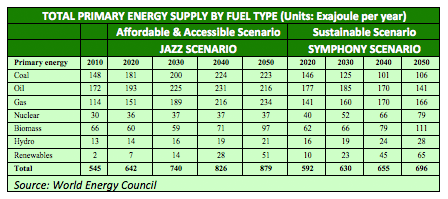
FOSSIL FUELS REMAIN CENTRAL
Despite the best efforts of environmentalists to wean us off hydrocarbons, fossil fuels will remain a crucial part of the global energy mix for decades to come.
Natural gas, which is a welcome compromise between carbon-intensive coal and expensive nuclear and hydropower energy sources, will emerge as the major player in both scenarios envisioned by the WEC.
In the affordable scenario, natural gas will emerge as the major fuel type with 234 exajoules per year by 2050, while even the sustainable scenario will see natural gas as the most popular with 166 exajoules per year.
In both scenarios, fossil fuels will make up more than half of the energy supply over the next four decades.
"Oil will continue to remain dominant for transport, an increase in importance of unconventional sources - in particular oil sands, and oil shale - is expected. No renaissance of nuclear energy is anticipated," said the WEC.
"Nuclear energy is not a game-changer - with limited impact also because of restrictions in economics. In the Symphony scenario, the WEC anticipates a large increase in the share of renewables - mainly in solar PV, hydro and wind globally."
The report notes that this is a time "of unprecedented uncertainty for the energy sector", but it also offers huge opportunities for companies investing heavily across the energy spectrum.
The WEC estimates that total primary energy supply (equal to consumption) will increase globally from 546 EJ (152 PWh) in 2010 to 879 EJ (144 PWh) in the Jazz scenario and 696 EJ (193 PWh) in the Symphony scenario in 2050.
This corresponds to an increase of 61% in Jazz and 27%
in Symphony. Just to compare: from 1990 to 2010 - which is roughly half the time span covered in this scenario study - total global primary energy consumption rose by approximately 45%.
"It is expected that global primary energy consumption will continue to rise, but at a much lower rate than in previous decades," the WEC concluded.
"Meeting both global and regional energy demand will be a challenge. There is no one global solution to the energy supply issue. Instead, each of the individual parts of the challenge must be worked out to reach the global goal of sustainable, affordable and secure energy supply for all."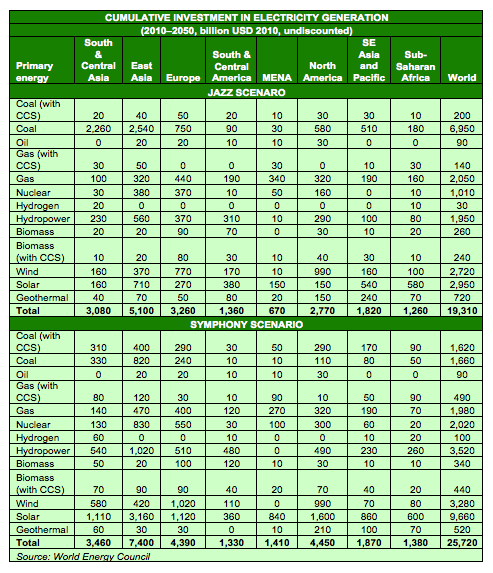
© alifarabia.com 2013