03 June 2012
Did Iraq overplay its hand in the failed fourth bid for oil and gas exploration with energy companies?
Sure, the country presents one of the last few destinations in the world that promises easy access - geologically speaking - to an abundance of oil and gas riches, but the Iraqi government appears to have misread the dynamic changes that are turning the global oil industry on its head.
"We have to say we didn't expect this weak turnout from the companies, but we acknowledge terms for the contracts were tough," Sabah Abdul-Kadhim, head of the legal section of Iraq's oil ministry contracts and licensing directorate, told the media, which suggests Iraqi officials over-estimated the interest of oil majors.
Only three of the 12 blocks were awarded, as oil companies complained off tough conditions imposed by the Iraqi government.
One of the winning bids came from Russian firm Lukoil and its Japanese partner Inpex Corp, which secured a deal to explore 5,500-square-km Block 10 in Muthanna and Dhi Qar provinces in the south.
Pakistan Petroleum clinched a gas Block 8 in Diyala and Wasit provinces in eastern Iraq. Meanwhile, Kuwait Energy Co and Turkiye Petrolleri sealed an oil exploration deal.
While the country sits on 115-billions barrels of oil reserves, the fifth largest conventional oil reserves in the world, oil majors are now able to explore other deposits elsewhere in the world thanks to new drilling technologies and high crude prices.
While the world has 1.3 trillion barrels of oil reserves in conventional reserves, there are estimated to be another 1.1 trillion barrels of 'unconventional' reserves, a catch-all phrase for oil recovered from shale, tight formations, apart from geologically-challenging areas such as offshore and the Arctic. Oil sands in Canada and Venezuela, and deepwater riches in Brazil, and a resurgent North Sea, is shifting the focus away somewhat from the Middle East.
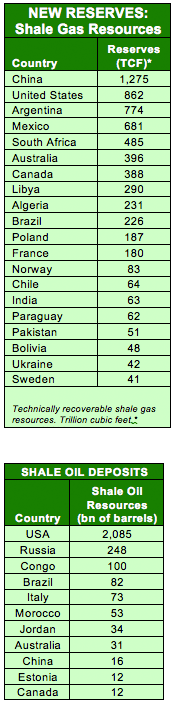
Similarly, shale gas, which has transformed the North American industry, is another game changer that could threaten the influence of oil players such as Iraq. China, now the world's biggest consumer of oil natural gas, is sitting on 1,275 trillion cubic feet of unconventional gas - the highest in the world.
"Unconventional gas now accounts for half of the estimated natural gas resource base and it is more widely dispersed than conventional resources, a fact that has positive implications for gas security," notes the IEA.
The 'security' the IEA refers to is paramount for energy-importing countries who are increasingly wary of instability in the Middle East.
The IEA expects the share of unconventional gas to rise to one-fifth of total gas production by 2035, although the pace of this development will vary considerably by region.
DRILLING FAR AND WIDE
Energy companies have been investing heavily in technologies to access theses riches. More importantly, these oil and gas are in North America, in Poland, offshore deepwater in Latin America and the more benign parts of East Africa.
The seismic changes -- and their speed -- has taken many traditional players by surprise.
Canada, for example is on course to raise oil production from 3.5 million to 6 million within a few years. Brazil's pre-salt deepwater resources could add 2 million barrels per day, whereas pundits believe Venezuela, which has the world's largest oil reserves, is expected to ramp up oil production rapidly in a post-Hugo Chavez world.
The International Energy Agency notes that unconventional oil developments will make up for the decline in conventional oil production.
To compensate for declining crude oil production at existing fields, 47 million barrels per day of gross capacity additions are required, twice the current total oil production of all OPEC countries in the Middle East. A growing share of output comes from natural gas liquids (over 18 million bpd in 2035) and unconventional sources (10 million bpd).
"In recent years, supermajors and other resources giants have made up for their previous apathy by buying their way into the US shale gas market. ExxonMobil became North America's foremost gas producer when it paid USD36-billion in 2010 for XTO Energy, a US company with stakes in a number of major U.S. shales," says the Economist Intelligence Unit.
"Exxon has followed up with smaller deals and remains on the prowl. Supermajors have set their sights on the gigantic Marcellus Shale, with Royal Dutch Shell snapping up East Resources and Chevron inking a deal for Atlas. Total and BP have also invested billions in shale plays, while Australia's BHP Billiton, the world's largest mining company, in August 2011 completed its acquisition of Petrohawk Energy, a US shale gas producer, for USD12-billion."
In its global forecast for crude production, ExxonMobil believes that as conventional crude oil production holds relatively flat through 2040, demand growth will be met by newer sources.
"The biggest gains will come from global deepwater production, which more than doubles through 2040. This growth illustrates the power of new technologies. Deepwater production was in its infancy just 10 years ago; by 2025, it will provide 10% of global liquid fuels supplies."
IRAQI DOMINANCE NOT UNDER THREAT - YET
Iraq remains a major prospect for the energy industry, though - it's just that it's not the only major prospect out there. The IEA estimates that the largest increase in oil production will be led by Iraq, followed by Saudi Arabia, Brazil, Kazakhstan and Canada, so expect the oil majors to snoop around for a fifth round of oil and gas.
In a recent interview with Chatham House, Iraq's Deputy Prime Minister for Energy, Dr Hussain Al-Shahristani confirmed that it's still aiming to raise capacity to 12 million barrels per day. "There are 78 discovered fields in Iraq and we have only contracted 12 of them so far," said Mr. Al-Shahristani, but concedes that 'political discussions' and differences are hindering growth and keeping international oil companies at bay.
The central government's well-documented problems with the Kurdistan Regional Government are also creating uncertainty in the eyes of foreign investors.
But it appears unlikely that the federal government is ready to soften its stance.
"Our differences with the KRG are serious," said Mr. Al-Shahristani. But these differences have not really impacted our oil development in a significant way, as the majority of the oil development is in the south. We are producing 3 million barrels of oil per day, and the KRG produces 175,000 bpd per day -- which is 5% of Iraqi production. But they are getting 17% of the country's oil revenues. We are not even getting that 5% - the least they can do is give up that 5%."
The federal government's decision to bar ExxonMobil for signing a contract with the KRG, is not lost on other oil companies who remain unclear of their rights in the absence of a hydrocarbons law that sets out a clear jurisdiction and regulatory framework.
Oil companies are no strangers to working in volatile environments, war-ravaged jurisdictions and with unstable regimes, but even their end-customers are now looking for stable sources of supplies.
Production issues in Iran, Libya, Nigeria, Syria, Egypt, Yemen and Sudan over the past year has left many oil-importing countries concerned about their security supplies.
Many oil-importing countries such as China, Thailand, South Korea and India are stockpiling reserves to avoid another global shock. Part of their conversations with oil companies included securing supplies from stable regimes. Hence, the oil majors' drive towards jurisdictions such as Canada, Brazil, the North Sea, and even the more stable Gulf regimes of the UAE, Qatar and Saudi Arabia.
CONCLUSION
There will likely be another effort by the Iraqi government to attract oil companies, and most probably it will be far more successful. But what will sweeten the deal for oil majors will be some resolution on the hydrocarbons law and the dispute with Kurdistan Regional Government.
In the new energy world, the global oil industry is moving too deepwater, shale deposits, tight oil and even Arctic riches and moving away from the Middle East.
In this scenario, Iraq - for all its riches - will need to create a far more predictable regulatory environment to entice oil majors.
Did Iraq overplay its hand in the failed fourth bid for oil and gas exploration with energy companies?
Sure, the country presents one of the last few destinations in the world that promises easy access - geologically speaking - to an abundance of oil and gas riches, but the Iraqi government appears to have misread the dynamic changes that are turning the global oil industry on its head.
"We have to say we didn't expect this weak turnout from the companies, but we acknowledge terms for the contracts were tough," Sabah Abdul-Kadhim, head of the legal section of Iraq's oil ministry contracts and licensing directorate, told the media, which suggests Iraqi officials over-estimated the interest of oil majors.
Only three of the 12 blocks were awarded, as oil companies complained off tough conditions imposed by the Iraqi government.
One of the winning bids came from Russian firm Lukoil and its Japanese partner Inpex Corp, which secured a deal to explore 5,500-square-km Block 10 in Muthanna and Dhi Qar provinces in the south.
Pakistan Petroleum clinched a gas Block 8 in Diyala and Wasit provinces in eastern Iraq. Meanwhile, Kuwait Energy Co and Turkiye Petrolleri sealed an oil exploration deal.
While the country sits on 115-billions barrels of oil reserves, the fifth largest conventional oil reserves in the world, oil majors are now able to explore other deposits elsewhere in the world thanks to new drilling technologies and high crude prices.
While the world has 1.3 trillion barrels of oil reserves in conventional reserves, there are estimated to be another 1.1 trillion barrels of 'unconventional' reserves, a catch-all phrase for oil recovered from shale, tight formations, apart from geologically-challenging areas such as offshore and the Arctic. Oil sands in Canada and Venezuela, and deepwater riches in Brazil, and a resurgent North Sea, is shifting the focus away somewhat from the Middle East.
Similarly, shale gas, which has transformed the North American industry, is another game changer that could threaten the influence of oil players such as Iraq. China, now the world's biggest consumer of oil natural gas, is sitting on 1,275 trillion cubic feet of unconventional gas - the highest in the world.
"Unconventional gas now accounts for half of the estimated natural gas resource base and it is more widely dispersed than conventional resources, a fact that has positive implications for gas security," notes the IEA.
The 'security' the IEA refers to is paramount for energy-importing countries who are increasingly wary of instability in the Middle East.
The IEA expects the share of unconventional gas to rise to one-fifth of total gas production by 2035, although the pace of this development will vary considerably by region.
DRILLING FAR AND WIDE
Energy companies have been investing heavily in technologies to access theses riches. More importantly, these oil and gas are in North America, in Poland, offshore deepwater in Latin America and the more benign parts of East Africa.
The seismic changes -- and their speed -- has taken many traditional players by surprise.
Canada, for example is on course to raise oil production from 3.5 million to 6 million within a few years. Brazil's pre-salt deepwater resources could add 2 million barrels per day, whereas pundits believe Venezuela, which has the world's largest oil reserves, is expected to ramp up oil production rapidly in a post-Hugo Chavez world.
The International Energy Agency notes that unconventional oil developments will make up for the decline in conventional oil production.
To compensate for declining crude oil production at existing fields, 47 million barrels per day of gross capacity additions are required, twice the current total oil production of all OPEC countries in the Middle East. A growing share of output comes from natural gas liquids (over 18 million bpd in 2035) and unconventional sources (10 million bpd).
"In recent years, supermajors and other resources giants have made up for their previous apathy by buying their way into the US shale gas market. ExxonMobil became North America's foremost gas producer when it paid USD36-billion in 2010 for XTO Energy, a US company with stakes in a number of major U.S. shales," says the Economist Intelligence Unit.
"Exxon has followed up with smaller deals and remains on the prowl. Supermajors have set their sights on the gigantic Marcellus Shale, with Royal Dutch Shell snapping up East Resources and Chevron inking a deal for Atlas. Total and BP have also invested billions in shale plays, while Australia's BHP Billiton, the world's largest mining company, in August 2011 completed its acquisition of Petrohawk Energy, a US shale gas producer, for USD12-billion."
In its global forecast for crude production, ExxonMobil believes that as conventional crude oil production holds relatively flat through 2040, demand growth will be met by newer sources.
"The biggest gains will come from global deepwater production, which more than doubles through 2040. This growth illustrates the power of new technologies. Deepwater production was in its infancy just 10 years ago; by 2025, it will provide 10% of global liquid fuels supplies."
IRAQI DOMINANCE NOT UNDER THREAT - YET
Iraq remains a major prospect for the energy industry, though - it's just that it's not the only major prospect out there. The IEA estimates that the largest increase in oil production will be led by Iraq, followed by Saudi Arabia, Brazil, Kazakhstan and Canada, so expect the oil majors to snoop around for a fifth round of oil and gas.
In a recent interview with Chatham House, Iraq's Deputy Prime Minister for Energy, Dr Hussain Al-Shahristani confirmed that it's still aiming to raise capacity to 12 million barrels per day. "There are 78 discovered fields in Iraq and we have only contracted 12 of them so far," said Mr. Al-Shahristani, but concedes that 'political discussions' and differences are hindering growth and keeping international oil companies at bay.
The central government's well-documented problems with the Kurdistan Regional Government are also creating uncertainty in the eyes of foreign investors.
But it appears unlikely that the federal government is ready to soften its stance.
"Our differences with the KRG are serious," said Mr. Al-Shahristani. But these differences have not really impacted our oil development in a significant way, as the majority of the oil development is in the south. We are producing 3 million barrels of oil per day, and the KRG produces 175,000 bpd per day -- which is 5% of Iraqi production. But they are getting 17% of the country's oil revenues. We are not even getting that 5% - the least they can do is give up that 5%."
The federal government's decision to bar ExxonMobil for signing a contract with the KRG, is not lost on other oil companies who remain unclear of their rights in the absence of a hydrocarbons law that sets out a clear jurisdiction and regulatory framework.
Oil companies are no strangers to working in volatile environments, war-ravaged jurisdictions and with unstable regimes, but even their end-customers are now looking for stable sources of supplies.
Production issues in Iran, Libya, Nigeria, Syria, Egypt, Yemen and Sudan over the past year has left many oil-importing countries concerned about their security supplies.
Many oil-importing countries such as China, Thailand, South Korea and India are stockpiling reserves to avoid another global shock. Part of their conversations with oil companies included securing supplies from stable regimes. Hence, the oil majors' drive towards jurisdictions such as Canada, Brazil, the North Sea, and even the more stable Gulf regimes of the UAE, Qatar and Saudi Arabia.
CONCLUSION
There will likely be another effort by the Iraqi government to attract oil companies, and most probably it will be far more successful. But what will sweeten the deal for oil majors will be some resolution on the hydrocarbons law and the dispute with Kurdistan Regional Government.
In the new energy world, the global oil industry is moving too deepwater, shale deposits, tight oil and even Arctic riches and moving away from the Middle East.
In this scenario, Iraq - for all its riches - will need to create a far more predictable regulatory environment to entice oil majors.
© alifarabia.com 2012