Qatar and Morocco will be the fastest growing Middle East economies this year, but emerging market economies are facing the dual challenge of slow growth and tightening global liquidity, according to the International Monetary Fund's latest report.
The IMF cut growth forecast for the Middle East region by 9 percentage points to 2.1% - less than half of the 4.5% expected from emerging and developing markets. The fund also lowered 2014 growth for the region by 2 percentage points.
Much depends on events playing out in Washington.
A US default could send oil prices crashing, sucking up liquidity and business confidence out of the global economy - affecting everything in its wake from a real estate boom in Dubai to agricultural produce in Tunisia.
"The damage to the US economy from a short government shutdown is likely to be limited, but a longer shutdown could be quite harmful," said the IMF. "Even more importantly, the debt ceiling will need to be raised again later this year; failure to do so promptly could seriously damage the global economy."
A US default could send oil prices trending downwards to USD 60 per barrel and hurt growth in emerging Asia and Europe.
A 10% decline in energy prices would broadly lead to deterioration in trade balances of many Middle East countries, the IMF warns. Countries Libya, Kuwait, Oman, UAE, Saudi Arabia and Qatar could see their trade balances deteriorate between 2-4%.
"A sustained decline in oil prices would leave many oil exporters in the region with fiscal deficits," the fund said. "Over the past several years, increased spending has raised fiscal break-even oil prices (oil prices at which government budgets are balanced) faster than actual oil prices have risen. As a result, a number of economies (Algeria, Bahrain, Iran, Iraq, Libya and Yemen) have fiscal break-even prices above the projected oil price for 2014."
Only oil-importing Jordan and Lebanon will materially benefit from a drop in oil prices.
WORST TIMING
The possible catastrophe may come at a time when a number of Middle East countries are vulnerable and weak.
Jordan and Lebanon are deeply affected by the Syrian crisis, while Egypt, Tunisia and Yemen are struggling with civil unrest and political issues. Even oil-exporting Iraq, Iran and Libya are facing production disruptions and, in the case of Iran, heavy sanctions.
Most of these countries are in the midst of their own unique challenges. Egypt has been unable to pursue political reformation, even as economic problems pile up.
Lack of investor confidence in the economy is weakening the economy and undoing years of infrastructure development and economic policies that had made the country an investor magnet.
Financing from several Gulf countries have addressed short-term issues, but Egypt needs to pursue long-term political reforms and take on serious policy issues to improve the country's economic fundamentals.
The economies of Lebanon and Jordan remain hostage to events unfolding in Syria, while Tunisia is suffering from political and security crises.
Meanwhile, Morocco which is the region's best performing country along with Qatar this year, will see its 5.1% growth this year fade by 2014.
"Morocco's growth is expected to slow in 2014 as rain-dependent agricultural production normalizes after an exceptional harvest in 2013," the IMF said.
Furthermore, risks in the region remain tilted to the downside.
Setbacks in political transitions and continued social and security tensions could delay a return of confidence and reforms. Downside risks to growth in the euro area and the GCC economies also present risks for the region's oil importers, through spillovers on tourism, trade, and remittances, the IMF said.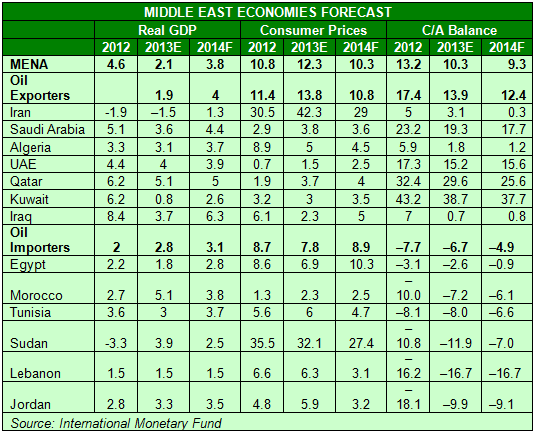
GULF NOT IMMUNE
Oil-exporting nations in the Gulf are in safer territory but not immune, and the IMF warns that many exporters don't have the "fiscal space" to manage an oil-led downturn.
But if the world's catastrophic events do not materialize, oil exporters can expect some decent growth.
Next year, Iraq is expected to lead regional growth, with 6.3% GDP growth as oil production returns after suffering outages this year.
Qatar's non-oil economy will help the country clock another 5% growth in 2014, while the region's biggest economy Saudi Arabia will register a 4.4% improvement in GDP in the New Year.
The IMF has also imparted its age-old advice on "diversification" and "structural reforms", but it is clear that most Gulf oil exporters have note worked fast enough to cushion the blow of cooling energy prices.
MIDDLE EAST CUSTOMERS
Most crucially, Asia, which is the Middle East's biggest customer, is also showing signs of weakness.
China, Japan, South Korea and India - some of the Middle East oil and gas exporters' major clients - are experiencing a period of low growth.
China will see growth decelerate to 7.6% this year and 7.3% in 2014, while Japan will post 2.3% and 1.2% growth during the same period.
India and South Korea may see modest improvements, but any recovery will be gradual.
"Capital inflows have declined, and domestic assets have been re-priced and exchange rates depreciated, especially in countries where fundamentals were perceived to be weaker," said the IMF.
The next few days in Washington could well determine the medium-term trajectory of the global economy. And while some Middle East economies can weather the storm, others remain in a very vulnerable state.
© alifarabia.com 2013