A streak of sunlight just cut through the gloom in North Africa.
On January 26, Tunisia adopted a brand new balanced constitution, taking a break from the political discord that has characterized North Africa since the long-forgotten Arab Spring in 2011.
The new consensus constitution pulls together the efforts of various stakeholders including human rights groups, labor unions, employers' unions, the bar association - known as the quartet - along with the Islamic government of Ennahada.
Work on the constitution saw numerous delays, including assassination of political players and frustration among all parties amid a deteriorating security situation.
Most crucially, Tunisian stakeholders managed to keep the constitution largely secular - despite Ennahada party's assistance of crafting a conservative constitution.
Analysts believe that the Muslim Brotherhood's failed effort to impose an Islamic constitution in Egypt played a role in helping change the Tunisian Islamic party's mind. Still, the constitution acknowledges that Islam is the country's state religion.
The adoption of the new constitution was swiftly followed by the appointment of new prime minister Mehdi Jomaa, who now has the task of setting a date for elections before the end of 2014.
While Tunisians can take a moment to rejoice in this rare triumph of consensus in the Middle East, there are more challenges ahead.
"Both the adoption of the new constitution and the formation of a non-partisan, technocratic government suggest that political dialogue and compromise are still viable in Tunisia despite the increase in social and political polarization and terrorism seen in 2013," said Amelie Roux, director of sovereigns at Fitch Ratings.
"However, Tunisia's political transition will face another challenge when postponed elections are held. These will take the interim government several months to organize and are unlikely to take place before the second half of the year. The elections will test the extent to which social polarization has permanently reduced political stability, and are no guarantee against further social and political fragmentation."
The interim government will also have to implement a 2014 budget at a time when security issues, unemployment and economic performance remain areas of great concern.
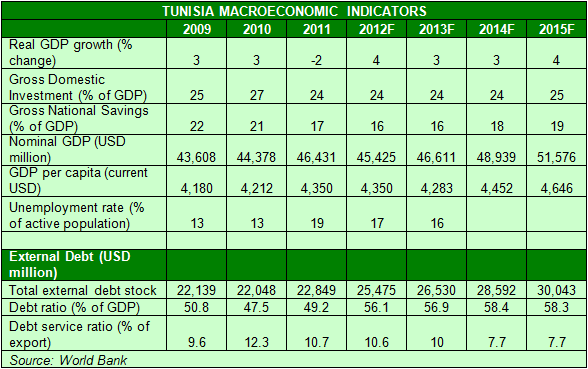
"In 2014 and in the future, Tunisia faces a difficult economic outlook due to limited flexibility in expansionary policies; but if conditions are put in place for the private sector, it could play an important role in accelerating growth, which has the potential to benefit the whole country," said the World Bank, which expects Tunisia to post a 2.6% growth in 2013, 3% in 2014 and 4.1% in 2015 - well below the country's economic potential.
TUNISIA MUST UP THE ANTE
PM Jomaa has already sought financial support from the international community as it takes tentative steps towards full-fledged democracy.
But the International Monetary Fund, which has supported the country with a USD 1.7 billion standby loan, is keeping the pressure by insisting on a quicker pace of structural reforms.
On January 29, the IMF completed its first and second reviews of Tunisia's economic performance, which is set to lead to an immediate disbursement of USD 506.7 million to the country.
But the fund warned that the country's performance under the program has been "mixed."
"Lower external financing weighed on reserve targets and high liquidity needs led to a monetary target being missed," said Nemat Shafik, deputy managing director and acting chair at the IMF. "The end-December primary deficit was lower than programmed, mostly because of under execution of the budget and deferred cash payments. Structural reforms have been progressing, but at a slow pace."
The IMF has welcomed the government's decision to raise electricity rates, reducing energy subsidies, and has recommended more monetary policy tightening.
"Accelerated implementation of structural reforms is needed to reduce unemployment. Putting in place a well-targeted social safety net as fuel subsidies are phased out would protect the most vulnerable segments of the population and reduce inequality."
The IMF report echoes a study by Banque Centrale de Tunisie - the country's central bank, which noted that it was "imperative" that political stability was restored, that "urgent measures" were taken to deal with the widening budget and current-account deficits, and that reform of the banks, fuel and food subsidies and public investment policies were speeded up.
But such reforms are hard to implement as the economy has been hit by a stagnating tourism, mining and energy sectors as security incidents rose in the country. Tunisia was also broadsided by a dilapidating recession in the Eurozone -- its biggest trading partner.
NOT REALISTIC: 2014 BUDGET
The 2014 budget, approved last December, has already been criticized by various parties, as the government aims to cut budget deficit to 5.7% of GDP from around 7% of GDP last year, even as it reduces tax burden on the poor and raises investment spending.
The Economist Intelligence Unit believes that the budget numbers are "not realistic."
"We will reflect in the forecast our expectation that the deficit target of 5.7% of GDP will be missed, but not by too much; investment spending is likely to be cut to meet revenue shortfalls," the EIU said in its latest report on the country. "Meanwhile, we maintain our forecast that the wish of Tunisia's international allies to see its democratic transition succeed will allow Tunisia to obtain the international loans it needs to finance the deficit."
Tunisia's economic problems will persist for some time as the Euro's economic prospects improve slowly and the country works through its domestic economic reforms.
But Tunisia's ability to lift itself up from the throes of discord and divisions offers new hope for the country that was Ground Zero of Arab Spring.
The feature was produced by alifarabia.com exclusively for zawya.com.
© Zawya 2014