While Jordan has avoided the turmoil of Libya and Egypt, it has always seemed like a country on edge ever since the Arab Spring swept across the region.
"Jordan continues to face multiple exogenous shocks in 2011-12―high import prices for oil and food; repeated and extensive periods of interrupted natural gas flow from Egypt due to sabotage of energy infrastructure; a slowdown in tourism and remittance flows; heightened domestic and regional political tensions; and rising sovereign financing costs," wrote the International Monetary Fund in a report on the country.
Jordan, which celebrated it 66th independence from Britain on May 25, must walk a tight rope to appease citizens and at the same time not let the economic debt run away.
Jordan is in one of the world's toughest neighbourhoods at the best of times, and a civil war is currently raging in Syria. More than 120,000 Syrians have fled to the Jordanian border to run away from the barbaric atrocities of the Assad regime, according to the United Nations. Meanwhile continued tensions in Iraq and Lebanon don't inspire business confidence in Jordan either.
"I appeal to the international community to act immediately and assist the host countries of the Syrian refugees. Jordan is already having difficulties in terms of water resources and is paying a heavy price for its generosity and should be assisted in order to be able to face this challenge," UN High Commissioner for Refugees Antonio Guterres said at a press conference last week.
"The Syrian refugees are in need of food, healthcare and education. We are sincerely thankful to the Jordanian people who opened their houses and their hearts for the Syrian refugees," he added.
Flow of economic aid to Jordan to boost the economy, may distract from a bigger problem - the 17-month-old protests movement in Jordan is rising as citizens demand cheaper fuel and basic foods.
The latest episode occurred last week when the government raised prices on electricity and fuel, compelling Jordanians to spill on the streets chanting 'No to Price Hikes'.
VARIOUS GROUPS FIND COMMON GROUND
"Something is brewing in the Hashemite Kingdom of Jordan," said the International Crisis Group in a report on the country. "It is not so much that protests have been spreading since 2011; the country has experienced these before and so far they remain relatively small. It is, rather, who is behind them and from where dissatisfaction stems."
The ICG says that divisions between Eastern Bankers - the Jordanian who lived in the region before the arrival of the Palestinian refugees in 1948, is giving way to common grievances.
Eastern Bankers have long supported the regime which has played on their fears of a Palestinian-origin majority.
"That pillar is showing cracks," says the ICG. "The authorities retain several assets: popular anxiety about instability; U.S. and Gulf Arab political and material support; and persistent inter-communal divisions within the opposition. But in a fast-changing region, they would be reckless to assume they can avoid both far-reaching change and turmoil. Ultimately, they must either undertake the former one or experience the latter."
But now Eastern Bankers, citizens of Palestinian origins, Islamists and the country's independent-minded youth are participating in the protests, as they find common complaints regarding government corruption, low incomes and high costs of living.
Eastern Bankers, which have typically thrived in the agriculture sector, have seen their privileges slowly erode and influence wane as the government instituted privatisation that has brought to the fore a smaller group of businessmen seen to be closer to the regime.
"Many East Bankers have reached the conclusion that addressing their economic grievances will require political change, including deep constitutional and electoral reform. At the same time, the powerful Islamist movement has shown itself to be pragmatic in its demands."The economic situation could get worse. Citibank says that while the government is shying away from imposing austerity measures, they could still be a victim of inflationary pressures.
"This would impact the labour market and the average Jordanian's pocket, potentially leading to rising social instability further down the line. Hence, the risks stemming from austerity measures lie in the medium term should they have further impact on economic growth and job creation."
THE CASE AGAINST SUBSIDIES
The Jordanian government appears to have limited room to wriggle out of this crisis. With budget deficit rising, the government is hardly in a position to raise subsidies, and provide relief to the average Jordanian. Indeed, institutions such as the IMF are calling for subsidies to be cut to relieve the government of the rising debt burden.
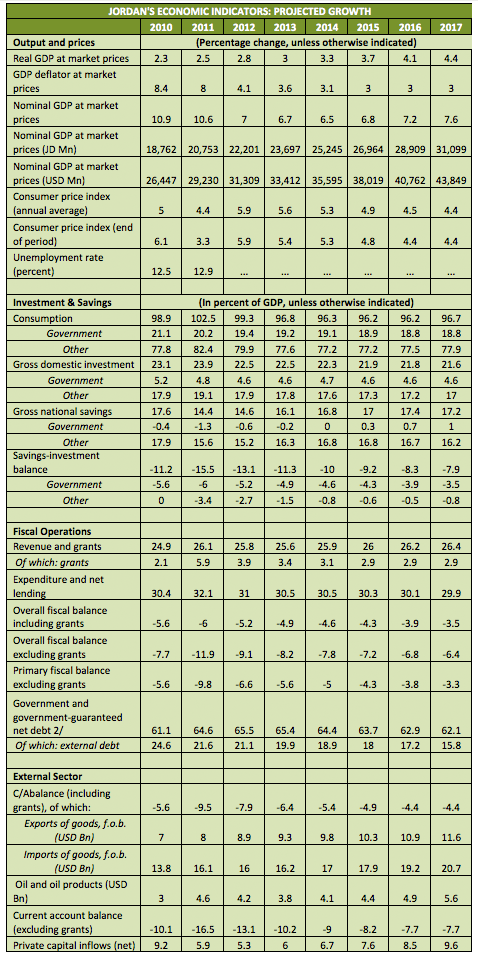
Food and fuel subsidies account for more than 8% of the country's GDP last year, and the IMF is calling for them to be replaced with cash transfers and social safety nets.
Even Umayya Toukan, Jordan's Minister of Finance agreed at an IMF summit on subsidies: "the current blanket system of subsidies does not serve its purpose as the majority of the subsidies go to the rich."
Still, it may be a tough task, given the government's tendency to procrastinate on reforms. But the subsidies burden is sprialling out of control:
The IMF warns that:
1 Energy price subsidies have risen from 1 1⁄3 percent of GDP in 2010 to nearly 6 1⁄4 percent of GDP in 2011, due to high crude prices and subsidy schemes. The government also froze fuel prices and has not adjusted prices. Fuel disruptions from Egypt have not helped either.
2 Energy price subsidies pose a serious fiscal risk in the present context of increasing and volatile international prices. Jordan is a net oil importer and a highly energy-dependent country.
If international prices continue their upward trend, keeping domestic prices unchanged could result in subsidies increasing to 18 percent of GDP by 2014. This would require a major fiscal adjustment, including substantial reductions in higher-priority public spending (e.g., on education, health, and public infrastructure).
3 Subsidies benefit the rich more than they trickle down to the poor: The richest one-fifth get 25% more of subsidies than the poorest 1/5th, especially as the rich enjoy subsidies on gasoline and diesel for their cars, which the rich can't afford in the first place.
4 Every dinar transferred to the bottom two income quintiles through gasoline subsidies costs the budget about JD 5. A simple cash distribution of these benefits to all households would have been less costly and more effective in assisting the poor, notes the IMF.
JOBS, JOBS, JOBS
The best way to keep unrest at bay is to keep them employed and reasonably well paid.
But the unpalatable truth for the government is that the labour force participation rate in Jordan is 40% which is among the lowest in the world.
The country needs to create 800,000 new jobs by 2020, which would still leave the working-age population ratio at 43% - still lower than anywhere else in the world.
"Even this is optimistic given that current projections over the period 2010-17 point to an average annual GDP growth rate of 3.3%, about 2.9 percentage points lower than that achieved over the last decade. In fact, if the 3.3% average annual GDP growth were to materialize for the current decade (2010-20), then a mere 0.2 million new jobs would be created."
An 800,000 job target would mean a GDP growth of 9.3%, which seems like a tall order, the IMF analysis.
Jordan will need to create small cottage industries which are labour incentives to keep the economic engine humming and create jobs especially in the infrastructure sector.
"Policymakers can also provide tax incentives or credit guarantees to viable labor-intensive small-and medium-sized enterprises, as implemented in many emerging markets and transition economies during the global financial crisis," says the IMF.
Another key driver will be the USD15-billion big-ticket projects planned in the Kingdom.
These include massive power projects, a railway project that links Syria to Iraq to Saudi Arabia and a USD5-billion nuclear power project.
While these would improve Jordan's future economic prospects, it would place enormous burden on the country's public finances, long before these projects bear economic fruit.
"Even under a more optimistic economic growth assumption, the negative fiscal impact of the project would still be sizable," says the IMF. "If the real growth rate was 4 percent per year from 2016 onward, public debt ratios would be lower than in the baseline by only ½ of a percentage point of GDP in 2020 and 2 percentage points of GDP in 2030."
Qatar responded on Sunday by promising USD1.25-billion to Jordan for energy, infrastructure, healthcare and development projects, as part of the USD5-billion pledged by the four richest Gulf states, which includes Saudi Arabia, UAE and Kuwait. The Jordanian economy would also benefit from joining the Gulf Co-operation Council, but its membership application appears to be on the backburner for now as the GCC is itself divided on the future path of the union.
CONCLUSION
The Jordanian authorities have limited economic ammunition to fight the economic and social crises they face. It's possible that financial and moral aid from the West and the Gulf may give Jordan some room, but there is an urgent need to act and initiate real reforms.
There is always the temptation for the regime to wait and to postpone, notes the ICG. "But the gradual disaffection of the monarchy's core constituency coupled with efforts to unify opposition ranks by transcending debilitating divisions could portend a new chapter in the Arab uprisings' unfolding drama. And by then, it would be too late."
© alifarabia.com 2012