Regional banks had the lowest cost-to-income ratios in the world. The Banker magazine's data shows Middle Eastern banks average cost-to-income ratio was 39.69%, down from 41.37% last year.
"By contrast, North American banks recorded the highest ratio in our Top 1000 World Bank's ranking of 64.63%," said The Banker in a report.
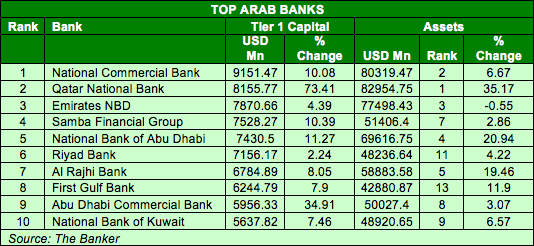
National Commercial Bank emerged as The Banker's Top Arab bank based on Tier 1 Capital.
Tier 1 Capital benchmarks the bank's financial strength from a regulatory viewpoint and consists of shareholders' equity and disclosed reserves.
Qatar National Bank was as the second largest bank in terms of Tier 1 Capital, while Emirates NBD rounded up the top three in the region.
In all, four Saudi banks and four UAE banks dominate the top 10 list.
Although Saudi bank stock prices have suffered, most analysts feel their poor valuation is unjustified.
Ratings agency Moody's says Saudi banks have low problem loan levels, operating in a fundamentally strong economy and enjoys strong loss-absorption capacity, underpinned by high capital buffers and solid profitability.
"However, Moody's says that asset quality remains exposed to event risks, due to the continued high, albeit declining, single-party exposures in the banks' loan books," the ratings agency notes.
"Over the outlook period, the corporate sector will also remain susceptible to vulnerabilities, including the relatively low transparency of family-owned conglomerates and the frequent intermingling of risky investment activities with operating activities that are typically more stable."
This was evident in the financial difficulties facing Saudi construction and contracting company Mohammad Al Mojil Group (MMG).
Shuaa Capital data shows MMG's total exposure to Saudi banks stood at around SAR1.16-billion as of FY 11-end in terms of short-term loans, the largest exposure with SABB (SAR310-million) and Riyad (SAR250-million). ANB follows closely with a total exposure of SAR189-million, Samba at SAR155-million and NCB at SAR109-million. Their total exposure to the company makes up around 0.2% of system loans.
"Some of these exposures are material and would pose pressure on provisioning in H2 12 and 2013, namely in SABB, ANB and Riyad," wrote Taher Safieddine, analyst at Shuaa Capital, in a note to clients.
"However, we point out to the fact that MMG's financial situation has been deteriorating since 2011 which could imply that Saudi banks have already taken some measures on loan loss provisions."
SAFE HAVENS IN GLOBAL CRISIS
While growth across the region is far from uniform, Gulf banks are on far more stable footing than their global counterparts. While European and American financial institutions retrench amid weakened balance sheets, most Arab banks, particularly in the Gulf enjoy solid support from government and are well-capitalised.
Not surprisingly, Gulf banks occupied the top 10 positions in The Banker's regional list.
"The aggregate Tier 1 capital of the 100 Arab banks in this year's ranking has grown by an impressive 15.3% from USD166.9 billion at the end of 2010 to USD192.5 billion at the end of 2011," said the bank.
"This is almost double the 8.7% growth seen last year. Simultaneously, the banks grew their assets by 8.36% from USD1587 billion in 2010 to USD1739 billion in 2011, while their aggregate pre-tax profits rose by 13% year-on-year to USD29.27 billion."
Gulf countries also dominated the returns on asset list. Qatari banks collectively saw return-on-assets of 2.52% the best in the region. Saudi Arabian banks were second with 2.13%, while Moroccan banks third with 1.88%.
Moroccan banks also had the best return on capital in the region, with 23.52%. Qatari banks were second with 21.54% and Egypt was the surprise third best country with 20.49%, despite its troubles over the past 20 months.
Going forward, the banking sectors of key regional economies have their own challenges to confront.
Qatar banks, for example, are reaching the upper limits of their development.
"Qatari banks' balance sheets are already well leveraged with a loan-to-deposit ratio of 110% as of 1H12, but we believe that the banks will find it difficult to sustain a lending CAGR of 18-20% over the next five years," SICO says in a report.
UAE banks continue to struggle with slow credit growth, but their worst economic condition, appears to be behind them.
Bahraini banks are laggards within the region as the economy struggles to recover from the political crisis. Meanwhile, Kuwaiti banks are recovering from the global financial crisis but their exposure to the country's troubled investment banking industry and real estate sector. Omani banks are also enjoying growth thanks to a resurgent economy.
Despite their exceptional performance for the most part, Gulf bank stocks have lagged behind regional markets, and have also underperformed emerging markets.
Most analysts expect the banking sector to catch up with the rest of the regional indices.
EFG-Hermes expects loan growth to accelerate, net interest spreads to bottom out and asset quality concerns to dissipate.
"Indeed, aggregate earnings growth for MENA banks under our coverage has accelerated to c18% year on year in 1H2012, from 10% year on year in 2011. We expect the earnings recovery to accelerate further in 2H2012 due to bottoming spreads and falling provisioning costs."
© alifarabia.com 2012