In its latest report on new technologies that could dramatically alter the way businesses are run, Citibank identifies three technologies that could transform the global energy markets.
For the Middle East, the most poignant change is the extraction of fossil fuels in previously inaccessible rock formations and deep underwater. It is already impacting US energy markets, which is benefiting from a renaissance in domestic production.
Fracking and horizontal drilling
The Wall Street bank believes horizontal drilling, fracking and other exploring technologies could disrupt the world's energy markets.
The United States' proven reserves of crude oil and lease condensate have risen 13% to 25.2 billion barrels -- the largest annual increase since 1977 and the highest total level since 1991, according to the US Department of Energy.
US production rose by a million barrels per day in two years to reach 6.5 million barrels per day by the end of 2012. Some analysts believe the US could exceed Saudi and Russian production by the end of the decade.
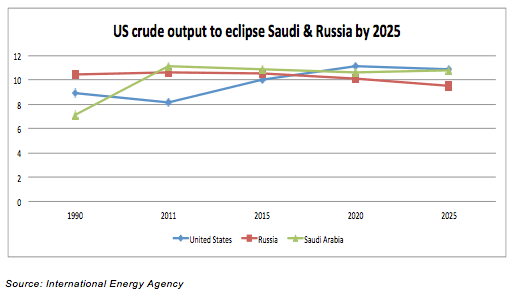
Algeria and Saudi Arabia are looking to tap into their shale gas and oil reserves, but some of the most powerful Middle East officials can see the writing on the wall.
Saudi oil minister Ali Al Naimi recently told an audience in Washington DC that the new glut of supply coming into the market, means there is limited demand for more Saudi oil.
"Based on what we see as projection and call on Saudi oil, we don't see anything like that, even 2030 or 2040," the minister told an audience. "So the need to build the facilities and drill wells to produce 15 million or have the capability for 15 million is not there. We will be lucky to go past nine (million) by 2020."
Great switch to gas
The switch from oil to gas in the transportation sector could emerge as another disruptive trend, according to Citibank. This is significant for Middle East oil exporters as 50% of oil is consumed by the transportation sector, including light vehicles, aviation and marine.
"The shift from oil to gas is already under way in the US," Seth Kleinman, the head of European energy research at Citigroup
Indeed the low price of natural gas is helping break oil's hold on the transportation sector. Natural gas is emerging as a viable alternative for all types of road freight vehicles. Liquefied natural gas (LNG), for example, is emerging as a practical alternative for heavy freight, such as long-haul trucks.
"CNG is a viable option for light commercial vehicles and can be an option for trucks in densely populated countries, where range is less of an issue," said the International Energy Agency. "The use of LNG in road freight has so far been constrained by its high cost, compared with diesel, though this might change if there is sustained fall in the price of natural gas, relative to that of oil."
Compressed natural gas (CNG) already powers more than a million vehicles each in three BRIC countries, apart from Pakistan, Iran and Argentina. New Delhi is already home to the largest fleet of CNG public transportation vehicles in the world, according to an industry site.
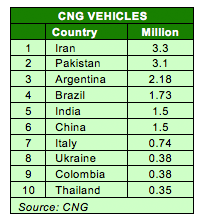
"The global CNG vehicle market stood at 15.8 million units in 2012 and it is expected to reach 19.8 million units by 2016," according to a Research and Markets study.
"This increasing demand for CNG vehicles is expected to propel the demand for bi-fuel injection systems and thus lead to the growth of the global automotive fuel injection systems market."
Natural gas is also making inroads in oil and coal-fuelled power plants. In the Middle East, regional governments are aggressively moving away from oil-generated electricity.
"Between 2000 and 2011, Saudi oil consumption almost doubled to 2.8 million barrels per day, partly because of surging use of oil for power generation," the IEA noted in its annual report. "Demand for electricity, much of it for air-conditioning, has been growing by more than 7% per year since 2000, outstripping capacity to generate power from natural gas."
The development could reduce Saudi Arabia's oil exports as domestic consumption takes precedence. The kingdom is looking to increase gas production and also switch to other alternative fuels such as solar and nuclear to free up more oil for exports.
Extracting the sun's power
Solar could attract as much as USD 1.3 trillion in investments over the next two decades, according to Citibank estimates, much higher than investments in natural gas and coal.
Royal Dutch Shell Plc. recently forecast that solar could exceed investments in oil and become the world's largest energy source within the next 40 years.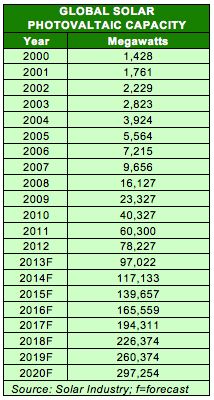
Demand for new solar photovoltaic (PV) is expected to rise a whopping 625% alone this year from 136 megawatt to 1 million MW in the Middle East and Africa region, according to NPD Solarbuzz.
"PV funding in Saudi Arabia is based on a renewable purchase program that targets a PV capacity of 16 GW by 2032," the report noted. "Saudi Arabia accounted for just 5% of total PV demand in the MEA region during 2013, but the country is forecast to become the region's largest PV market by 2017."
These three technological trends could change global energy markets and in the Middle East could have a huge impact on petrochemicals and other heavy industries reliant on fossil fuel raw materials, such as the aluminum and steel sectors.
© alifarabia.com 2013