Middle East and North Africa region has some of the most dismal financial inclusion rates in the world, according to new data from the World Bank.
Financial "inclusion" refers to the proportion of people and firms that use formal financial services in a country.
Just over 18% of adults have an account at a formal financial institution in the Middle East and North Africa region, compared to 55% in comparable developing countries in East Asia and Pacific and 45% in Europe and Central Asian countries. MENA inclusion rates fare even lower than those in the Sub-Saharan Africa region.
More than 2.5 billion people - or half the world's adult population - do not have an account at a formal financial institution. And while that may appear to be due to high poverty levels, the reality is only 30% of people cite lack of money as a reason for not having a bank account.
Around 70% of people who responded to the survey said they did not have a bank account due to lack of trust of institutions, lack of documentation, distance to bank, religious reasons or other family members had an account.
But access to financial institutions can serve as a key to unlocking wealth and alleviating the lives of people. The proliferation of microfinance institutions has already allowed many poverty-stricken regions in places like India, Bangladesh and Africa to flourish.
UNCHARTED TERRITORY
While the richer Gulf states have strong participation of individuals in the formal financial services infrastructure, many parts of the Middle East North Africa region remain largely uncharted territory for financial institutions.
Only 9.72% of Egyptians have an account at a formal financial institution, compared to nearly 87% in, for example, Kuwait. Not surprisingly, it is Yemen - the poorest MENA country - that has the region's lowest rate of participation in the formal financial services sector of 3.7%.
The lack of access to banking services has also translated into poor access to credit. Middle East and Sub-Saharan Africa has some of the lowest rates of loans from a financial institution, of nearly 5% of the bankable population. The figure is between 8-9% in regions such as South Asia, Latin America and Central Asia.
In countries like Egypt, Algeria and Tunisia, under 4% of the bankable population has sought a loan over the past year.
The figure is also quite low in Saudi Arabia at 2.1%, which shows that even some of the more developed economies in the region have pockets of growth that can be leveraged and unlocked.
In comparable G20-nations such as South Africa, Brazil and Mexico, the figure stands at 8.9%, 6.3% and 7.6% respectively. Even other Gulf nations such as UAE (10.8%) and Qatar (12.6%) have much higher - perhaps even slightly excessive - loans rates.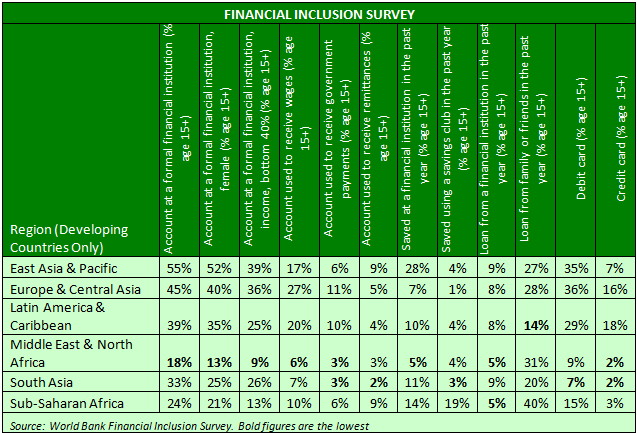
SME CONSTRAINTS
Access to financial services is not just limited to individuals in the MENA region - it is also a relevant issue for many small-to-medium enterprises.
More than 90% of firms in Eastern Europe have bank accounts and 44% have loans, but while 76% of firms in the Middle East report they have accounts, only 27% report they have loans.
Egypt, once again, is a laggard in the region, with 74.3% of firms with bank accounts, although it fares better than global peers Mexico (61.8%) and Indonesia (51.5%).
But most MENA companies don't have a line of credit or loan from their bank, which is crucial to fuelling business growth. Only a quarter of the companies in Jordan have a line of credit, while only 17% Egyptian companies have a similar facility. In contrast, companies in Brazil, Malaysia and Thailand are thriving on bank loans and credit facilities.
"The increased emphasis on financial inclusion reflects a growing realization of its potentially transformative power to accelerate development gains," said Jim Yong Kim, president of World Bank Group in a foreword to the report. "Inclusive financial systems provide individuals and firms with greater access to resources to meet their financial needs, such as saving for retirement, investing in education, capitalizing on business opportunities, and confronting shocks."
The report makes a direct link between financial inclusion and unlocking wealth, as is evident in countries like India and Mexico where the arrival of mass-banking lifted millions out of poverty, decreased unemployment and increased the number of informal businesses.
"Overall, there is plenty of evidence that access to finance is important for firms, especially for the smaller and younger ones. Economic growth would come to a halt if firms could not get credit," the bank said.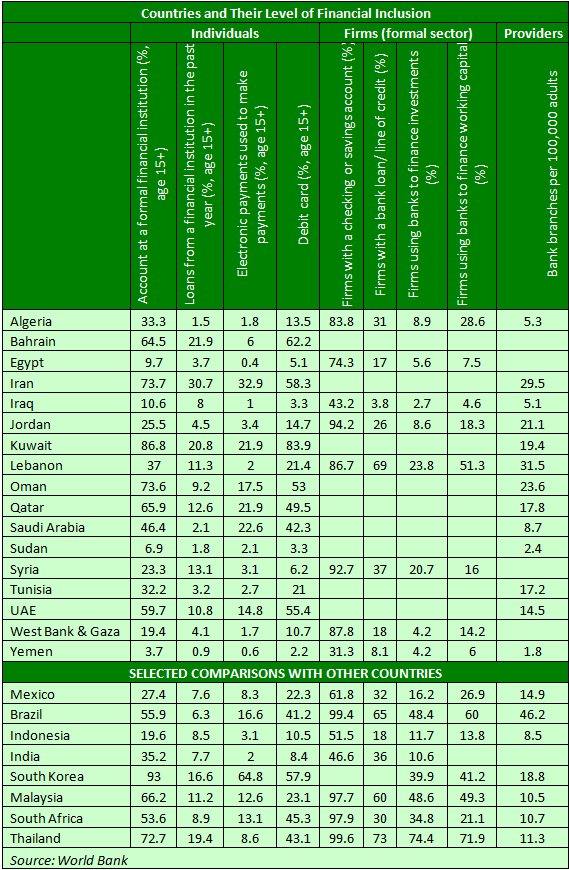
REGULATORY CONTROLS
Of course, financial inclusion should come with a heavy cover of robust regulations that ensure that borrowing limits are managed and individuals and firms understand their contracts and agreements with their financial institutions.
"Evidence points to the role of government in setting standards for disclosure and transparency, regulating aspects of business conduct, and overseeing effective recourse mechanisms to protect consumers," the bank said.
In addition, governments should invest in the development of financial infrastructure to help rural communities raise their living standards.
"Second, strengthening property rights and contract enforcement can open up access to important financial products to farmers and SMEs, for instance, by allowing the development of value chain finance."
Finally, governments should largely refrain from dominating the financial services and allow private institutions to take a leading role, the bank recommends.
Competition, more than anything else, will bring costs of financing down and lead to the creation of products and service that will encourage the "unbanked" to enter the fold.
© alifarabia.com 2013