Inflation rates are rising in most of Africa's biggest economies such as Nigeria, Angola, Ghana and Mozambique, which may force the region's central banks to tighten monetary policy.
March inflation rates in 13 Sub-Saharan Africa (SSA) countries showed inflation averaged 6.4% in March, compared with 6.2% in December 2013.
The most notable rise was in Ghana, where inflation is up 1% from end- 2013, at 14.5% year-on-year in March. In South Africa, core consumer price index rate (CPI) is set to rise to 5.5% from 5.3%, where it had sat for six consecutive months. Nigeria reported a marginally higher inflation rate of 7.8% year-on-year.
A variety of factors have played a role in cost escalation, including food prices, transportation, taxation and -- most crucially -- foreign exchange rates.
Most emerging markets, including those in SSA, have seen the value of their currencies erode this year, especially on concerns that the U.S. Federal Reserve has started to tighten monetary policy, strengthening the U.S. dollar.
Ghana's cedi has borne the brunt of the strengthening American greenback, but other countries are also feeling the heat. The South African rand is also down nearly 19% against the American dollar this year, although much of the weakness is due to domestic issues.
Some countries have also delayed their bond programs as the global financing environment remains volatile.
MONETARY POLICY
Barclays Capital expects nearly half of the countries that it covers to tighten monetary policy further as weaker exchange rates have affected inflation. It expects 10 of the 13 SSA countries it covers to have higher inflation in 2015.
"With a broad uptrend in inflation expected in the region over the rest of 2014, we believe the bias for monetary policy in most countries remains towards tightening," said Barclay in a new report.
Expect South Africa, Nigeria and Ghana to also tighten monetary policy screws.
"While Ghana and Zambia have tightened policy significantly further in Q1, FX pressures remain and their year-end inflation targets appear unlikely to be met. We think Nigeria's inflation reached a cyclical trough with the six-year low of 7.7% in February and project it to rise above the Central Bank of Nigeria's indicative target of 6-9% in the months ahead," Barclays noted.
In South Africa, the South Africa Reserve Bank's monetary policy committee delivered a surprise 50bp hike in January and most analysts expect the policy rate to be raised a further 100bp this year, although the timing will likely be highly data dependent.
FOOD INFLATION
Food comprises a major chunk of SSA's inflation basket, and it has been driving rates upwards. Droughts in South Africa, Uganda and Namibia have pushed agriculture prices upwards in those countries. Indeed, Uganda's food inflation of 12.7% year-on-year in March - was the highest in east Africa.
Meanwhile, farmers have been displaced in Nigeria due to security concerns, while flooding in Mozambique has affected that country's food stocks.
Global food inflation index jumped 2.4% in March, its highest level in 11 months.
"Last month's increase was largely driven by unfavourable weather conditions affecting some crops," said the United Nations' Food and Agriculture Organisation (FAO), which tracks food prices.
"Overall, except for the FAO Dairy Price Index, which fell for the first time in four months, all the other commodity price indices registered gains, with sugar and cereals increasing the most."
Many SSA countries such as Nigeria and Mozambique are also heading into election season, which suggests governments are likely to start splurging to appease undecided voters.
Rising petrol prices is also pushing prices upward.
"Nigeria has maintained that no fuel subsidy reductions are forthcoming, at least this year, while Ghana and Zambia continue to face potential fuel price adjustments owing to FX weaknesses," Barclays noted.
"In Botswana, the risk of a significant fuel price increase remains. Meanwhile, recent rand stability in South Africa, where fuel prices (5.7% of the CPI basket) are adjusted automatically each month, seems likely to lead to some small price cuts, after petrol hit a record high in April."
GROWTH THREATENED
Creeping inflation could dampen sentiment in a region that's expected to grow 5.4% this year - equal to growth in Asia, according to the latest World Economic Outlook report by the International Monetary Fund.
While the IMF believes overall SSA inflation may shrink 6.1% in 2014 to 6.3%, key markets such as South Africa, Ghana, Cameroon, Senegal, Kenya and Uganda will see inflation creep up.
"Monetary policies should remain focused on consolidating the gains on the inflation front. In some countries, sustained exchange rate depreciations may pose risks to the inflation outlook," warned the IMF.
The Fund recommends SSA countries prepare to weather further tightening of global financing conditions by preserving their budget flexibility and, where vulnerabilities are of particular importance, by tightening policies.
"These countries should be ready to adjust their financing plans in a scenario of greatly reduced access to external funding, while allowing their exchange rates to respond to changes in capital flows."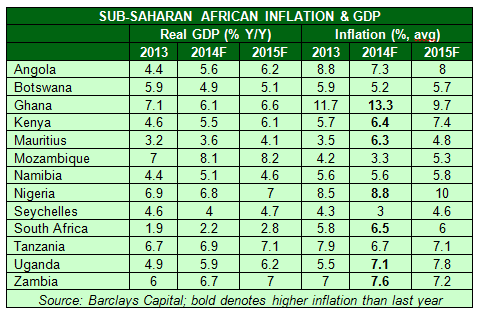
The feature was produced by alifarabia.com exclusively for zawya.com.
© Zawya 2014