Sub-Saharan Africa conjures up images of starving children, famine and corrupt regimes presiding over poor infrastructure.
But that is changing. Fast.
Sub-Saharan is the region south of the Sahara desert does not include Middle East Arab countries such as Algeria, Egypt, Libya, Morocco and Tunisia. According to the World Bank, this is an USD1.246-trillion economy region, with a population of nearly 900 million at the end of 2011.
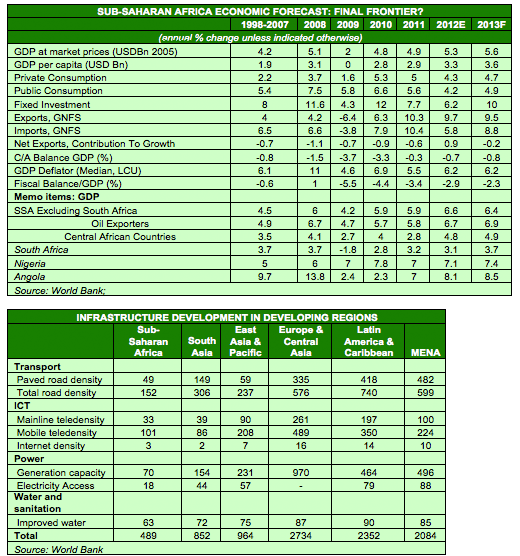
Collectively, the Sub-Saharan region posted a 4.9% growth in 2011, and with gross national income per capita is at a mere $1,255, there is great head room to grow.
The World Bank expects the region to grow at a robust 5.4% this year and even higher 5.6% in 2013, as economic hindrances melt away in the global economy. Nigeria, one the region's largest economy is set to growth well over 7% over the next few years, while Angola - another African powerhouse - will clock an even more impressive 8% in the next two years.
Compare this to the global economy of 2.6% and 3.1% in 2012 and 2013 respectively, and the case for the region as a new investment opportunity is compelling.
Notwithstanding the recent perturbations in the global economy, as well as the drought in the Horn of Africa, growth prospects in Sub Saharan Africa remain healthy over the forecast horizon, notes the World Bank.
Recent economic developments have, however, reduced the growth momentum in Sub-Saharan Africa and shaved off between 0.1% and 0.5% of GDP growth in the region.
"Thus, GDP is now estimated to have expanded 4.9% in 2011--about 0.2 percentage points slower than had been expected in June, and output is projected to expand 5.3% and 5.65 in 2012 and 2013, respectively, assuming no further significant downward spiral in the global economy."
However, the uncertain global environment means that downside risks are significant. In the event of a deterioration of conditions in Europe, growth in Sub-Saharan Africa could decline by 1.6-4.2% compared with the current forecasts for 2012, with oil and metal prices falling by as much as 18% and food prices by 4.5%. The fiscal impact of commodity price declines could be as high as 1.7% of regional GDP, the World Bank notes.
TRANSFORMATIVE GROWTH
Citibank says the region is in the midst of 'transformative growth.' The Wall Street bank believes that Africa could move from accounting for only 4% of world GDP in 2010 to 7% by 2040 and 12% by 2050.
"Clearly the rise in global commodity prices has played an important role in the growth pick-up throughout the 2000s in SSA, but ... commodities have only made up about a third of the overall increase," says David Cowan, Managing Director at Citi and the economist responsible for the bank's economic research on Africa.
"In order to continue the growth trajectory of the past, a focus on the other two thirds of the growth story -- improved political stability, better economic policy and a new wave of investment into SSA by corporates -- is required."
Indeed, commodities are driving growth.
Sub-Saharan African oil exporters saw the biggest increase in their trade globally (8.5% of GDP), while oil importers in every region except Sub-Saharan Africa experienced a decline in their terms of trade, says the World Ban. Many of the oil importers in Sub-Saharan Africa are exporters of metals and minerals, which also have seen increases in international prices.
Commodity growth was driven not just by oil and gas, but greater exploration activity in minerals.
"Ghana, the region's fastest growing economy in 2011, benefitted from the commencement of oil exports," says the World Bank. "Mozambique also began exporting coal from its large Moatize mine, and Liberia and Sierra Leone commenced iron-ore exports."
WHY SSA NOW?
What's different about Sub-Saharan Africa now? For all its promise, the region remains rife with instability, poverty and poor infrastructure. Is the growth driven merely by commodities that are masking fundamental weaknesses?
The political dynamics of the region are also changing. In its own way, SSA countries are experimenting with democracy, or at least with elections that are taking place with increased frequency - close to a sixth of the SSA countries had elections this year.
Political upheavals are rife with reformists at war with those who wish to keep the status quo of corruption and authoritarianism.
For example, while Cote d'Ivoire - or Ivory Coast -- has taken a long time to emerge from its civil war, it has remained intact and not been labelled as a failed state, notes the Bank.
"More pertinently, Nigeria overcame the death of the incumbent president, Umara Yar'Adua, without the military re-involving itself in politics even if the transfer of power did not follow the exact procedures outlined in the constitution. A similar tale occurred in Gabon on the death of Omar Bongo. Although at the other end of the scale, facing a crucial election to define its democratic credentials, Senegal passed with flying colours in 2012 when it went through a peaceful and democratic presidential transition."
South Africa, the largest African economy, is also on a far-from-perfect democratic drive and has the most outward-looking economy in the region with strong corporations and a robust commodity and financial services sector.
However, the growth trajectory of the region is far from certain. Africa has disappointed before, despite its demographic dynamics, natural resources and economic potential.
The region is vulnerable to a continued debt crisis in Europe which could decrease aids and loans, commodity prices and tourism figures for the region.
"While external risks are most prominent - a number of domestic challenges could also cause outturns to sour," says the World Bank. Indeed, disruptions to productive activity in the aftermath of elections are important potential downside risks, as investment, merchandise trade and tourism receipts, all important growth drivers, are likely to suffer."
Africa is also especially vulnerable to poor weather, especially in light of climate change, which could shave off GDP growth in the medium-term.
Despite these challenges, the region offers a promise that many market observers believe it can live up to.
No wonder, many believe that sub-Saharan Africa is the final frontier of investing.
© alifarabia.com 2012