As widely expected, the South African Reserve Bank (SARB) left repo rates unchanged at 5% last week as the country counters the threat of stagflation.
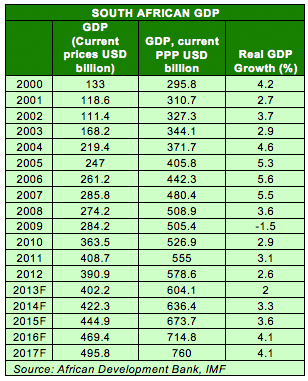
SARB also struck a cautious tone and revised GDP growth rate down from 2.4% to 2% this year and from 3.5% to 3.3% in 2014.
"South Africa's MPC [Monetary Policy Committee] left the policy rate unchanged at this week's meeting, as it faces the uncomfortable prospect of higher inflation and weaker economic growth," said Peter Worthington, analyst at Absa Capital. "We believe the statement was more hawkish than dovish, but we retain the view of the first rate hike coming only in H2 13."
The risks to the outlook are still assessed to be on the downside, particularly in the face of further delays in overcoming electricity supply constraints, said SARB governor Gill Marcus.
"In line with these subdued growth prospects, the RMB/BER Business Confidence Index declined from 52 in the first quarter of 2013 to 48 in the second quarter, consistent with the continued sideways movement of the bank's leading indicator of economic activity."
Gross fixed capital formation - a key indicator of economic growth - grew 2.5% in the first quarter, compared to 4.3% in the last quarter of 2012.
"Private sector fixed investment growth slowed from 3.8% to 2.8% over this period, and reflected lower outlays in all sectors apart from agriculture, construction and finance," the governor said.
Work stoppages at South African electricity company Eskom's Medupi plant also impacted negatively on investment by state-owned enterprises in the quarter. Fixed investment expenditure is likely to remain affected by low business confidence and prolonged electricity supply constraints, the governor noted.
And there is bound to be more troubled ahead.
"On the plus side, economic growth in 2Q is likely to be significantly better than the 0.9% recorded in 1Q as manufacturing rebounds from a 2.0% qoq 1Q slump," said Matthew Sharratt, analyst at Bank of America Merrill Lynch.
"Output is currently run-rating at a quarter-over-quarter pace of +4.6% over April/May relative to 1Q. With mining output over April/May also up 0.9% versus 1Q, we raise our 2Q GDP forecast from 2.6% to 3.7%. However, we do not believe the 2Q pace can last and have lowered our 3Q call from 3.5% to 2.3%. On balance, this has left our 2013 call unchanged at 2.2%."
THREE REASONS
On the plus side, Africa's largest economy avoided a downgrade from Moody's Ratings Service, thanks to three key drivers. The ratings agency said it affirmed its Baa1 debt rating amid speculation that a downgrade was imminent.
"The first driver underlying Moody's decision to affirm South Africa's Baa1/(P)P-2 sovereign ratings is the government's renewed commitment to spending restraint, which was evidenced in the last two major budget statements in October 2012 and February 2013," the agency said.
The second driver was the implementation of the National Development Plan (NDP) - a long-term program that aims to reduce poverty and inequality in the country.
The third driver "takes into account the introduction of two new macro-prudential policy initiatives that are designed to strengthen financial and labor market stability."
Labor disputes and strikes resulted in a 1.4% contraction in the sector in the past three months, to add to massive upheavals the industry faced last year.
But mining companies, unions, labor federations and government are involved in contract negotiations in the industry, which could help resolve the spate of issues hurting investment sentiment and business confidence in the country.
"If employers and workers were to abide by the agreement, Moody's would expect the mining industry to experience fewer labor disputes resulting in work stoppages and increased dialogue over grievances. Already this year, strikes have been of relatively shorter duration, with violence mostly being contained. A continuation of this trend would gradually ease some of the societal divisions that emerged after last year's violent wildcat strikes in the sector."
UNEMPLOYMENT CRISIS
Among the spate of bad news from the SARB governor - the one that really stood out was depressing data on youth unemployment.
Unemployment rate has risen from 24.9% in the last quarter of 2012 to 25.2% in the first quarter of 2013 - of particular concern is the rise in youth unemployment rate to 52.9% in the first quarter, the SARB statement noted.
"South Africa continues to face the triple challenge of chronic high unemployment, poverty and inequality amid a slow and volatile domestic and global economic environment," said the African Development Bank (AfDB) in its report on the country.
Quite simply, South Africa will have to post much higher economic growth to reduce youth unemployment.
"To further deepen the inclusiveness of growth, consideration could be given to use the institutional frameworks to introduce innovative social partnerships in critical areas such as skills development and job creation for youths," AfDB said. "Strong partnerships with the manufacturing and energy sectors would also boost growth and create employment opportunities in green growth technologies."
South Africa is piloting a new National Health Insurance which will give all citizens access to essential health care, regardless of their employment status and ability to pay. In parallel, the country is also extending old-age, disability and child benefits.
While South Africa is one of the most developed economies in the continent - and a G20-nation - there are still many ways it can unlock growth and generate employment.
The country needs to relax labor law rigidities while easing trade across borders could also improve trade and generate employment.
"Labor laws are characterized by a considerable degree of rigidity in hiring and firing workers, while minimum wage demanded by new entrants is considered to be three times the average for the other BRICS countries," said the World Bank in a report.
Close to 4.5 million people in South Africa are unemployed and analysts say the government will have to move away from export-oriented policies focused on mining and other mineral developments, and focus on local industries, services and local businesses.
"Apart from these, historical and new barriers to growth and formalization of microenterprises remain high, exacerbating the unemployment problem," the World Bank noted.
© alifarabia.com 2013