Less than 20% of Sub-Saharan Africa roads are paved, compared to a global average of nearly 65%.
The region is stifled by poor infrastructure and low-income levels that make transport ownership prohibitive, but as the regional economies soar, there is a clear opportunity to pave the roads of Africa, forge railway connections within and across countries, develop the airport infrastructure and pepper the coast with seaports.
"Africa might be the last to the finish line, but this does not mean that there are no lucrative investment opportunities," said management consultants KPMG.
"Indeed, international companies are falling over their feet to invest in Africa's infrastructure. There is still massive scope for development; combining this fact with improvements in the business climate over the last few years makes a strong case for investing in Africa's infrastructure. In turn, this will be beneficial for the development of other sectors."
The region has made a start by pouring billions to improve the country's infrastructure. The African Development Bank (AfDB) aims to issue bonds to the tune of USD 22 billion to fund infrastructure projects in the continent.
Management consultant PricewaterhouseCoopers notes that the vastly different Africa terrains from desert to rain forest means there are multiple challenges in building the infrastructure.
"That has a big impact on critical transport infrastructure in countries like Algeria and the Democratic Republic of Congo, making it more challenging to build road and rail networks, not to mention much needed bridges and tunnels," PwC said in its report.
"But even without extreme geographic conditions, there's a huge range of maturity in terms of infrastructure. Angola has just 4 kilometers of roads per 100 square kilometers of land; Ghana's road density is more than 10 times as high, while the leader, South Africa, has 62 kilometers of roads per 100 square kilometers."
To put this in perspective, Ghana's road density is similar to the level in China, while South Africa comes close to matching the US's road density of 67 kilometers of roads per 100 square kilometers.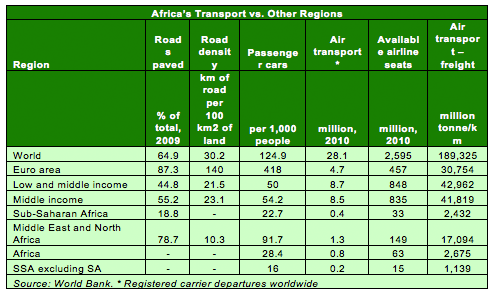
TRANSPORTING RESOURCES
Hydrocarbon and mineral-rich African countries are getting the help from mining and oil and gas companies to help develop their infrastructure.
For example, Brazilian mining giant Vale SA intends to revamp an existing railway line that runs from Malawi to the Port of Nacala in Mozambique, covering an estimated 900-kilometer distance.
Kazakhstan's Eurasian Natural Resources Corporation (ENRC) is looking to build a new railway and port in Mozambique for the transport of coal, while Egypt's Citadel Capital and the International Finance Corporation are investing USD 110 million to build Rift Valleys Railway in Uganda.
China is also funding the development of rail, ports and roads to access the continent's prized natural resources.
"China needs resources, and it's willing to help build the infrastructure needed to access them," noted PwC.
In the Democratic Republic of Congo, two Chinese state construction companies and the DRC's state copper company have signed a contract worth more than the DRC's state budget.
"Another, more direct case of China's interest in Africa's resources is in Angola, where infrastructure is rapidly expanding as part of an 'infrastructure for oil' trade agreement with China. In Angola, China is funding not only transport infrastructure, but also infrastructure for everyday life like the large housing area of the city of Kilamba Kiaxi."
UNLOCKING TRADE
Developing transportation is crucial to unlocking trade, and even more vitally, intra-regional trade in Africa. Many African countries trade more with the European Union, China or the United States rather than the cluster of equally-thriving economies across their borders.
The poor intra-regional trade is due to closed borders, poor trade transit routes and political tensions between neighboring states. But such avenues are mandatory if local economies are to thrive and domestic producers are to expand their offerings.
Indeed, lack of proper transportation has made Africa among the costliest place to export. The World Bank's Doing Business report pegs the cost to export at USD 1,990 per container in Africa, second highest in the world after Eastern Europe and Central Asia.
In places like Ghana, transport bottlenecks are hampering growth. The country's Port of Tema has been handling 420,000 TEUs in recent years, even though it has a design capacity of 375,000 TEUs.
"That said, the Ghana ports and harbors authority (Gpha) has major expansion plans for the two harbors and aims to make them the most efficient in the region," said KPMG. "Apart from capacity increases, the Gpha plans to refurbish and modernize dry docks and mineral loading systems, and building new facilities to handle Ghana's oil exports. Railways and roads to the ports will also be improved to handle the increasing volumes of goods."
In Kenya, a rail corridor linking the port of Mombasa in Nairobi to Uganda, is seen as a vital artery to transport bulk freight, easing pressure and providing additional capacity along the northern corridor.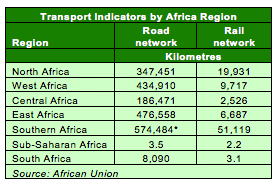
According to the World Bank, poor rail infrastructure has led to the decline in freight traffic to less than one million tons per annum, handling less than 6% of cargo passing through the northern corridor linking Kenya with Uganda, Rwanda, Burundi, and the Democratic Republic of Congo. The East African railway master plan aims to improve railway infrastructure.
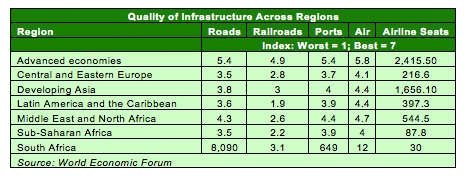
"There are only six African countries with better railroad infrastructure than the global average," said the KPMG. "Three of them (Morocco, Tunisia and Egypt) are in North Africa, while the remaining three (Namibia, South Africa and Swaziland) are from Southern Africa."
While Africa needs investment in virtually all sectors of the economy, transport infrastructure is especially crucial to link remote regions and lift the standard of living of millions who are isolated due to poor road and rail networks.
© alifarabia.com 2014