The latest report from the US Energy Department's statistical arm validates what OPEC members have been saying all along: the North American shale gale will blow away, and OPEC will weather that storm to emerge stronger than ever.
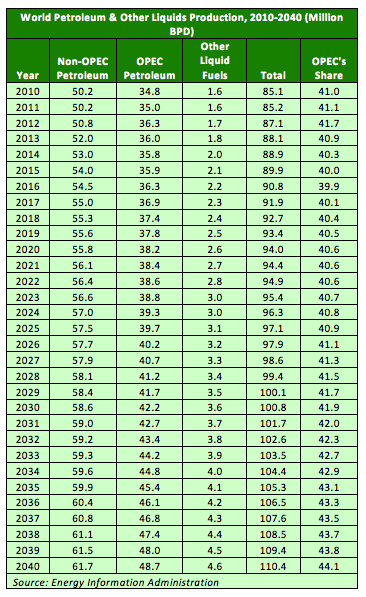
The US Energy Information Administration seems to agree: OPEC, which controls 41.7% of the global oil supply, will actually increase its market share to 44.1% by 2040, the influential EIA said in its latest international forecast.
The US oil and natural gas revolution has riveted analysts who have been claiming the decline of OPEC. But EIA data shows that not only will OPEC remain a dominant player, overall oil production is set to soar - benefitting all producers.
Overall, global energy consumption is set to rise 56% over the 30-year time horizon, with fossil fuels (i.e. oil, natural gas and coal) accounting for 80% of the energy mix.
Oil will remain the dominant source of energy with 28% of the market share by 2040, although that is much lower than the 34% it enjoyed in 2010. Coal will remain resilient with 27% of the energy mix (2010: 28%), while natural gas will account for 23% (2010:22%).
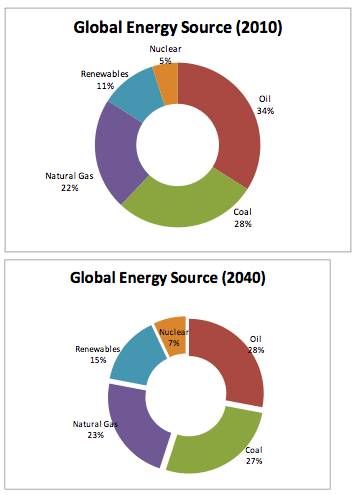
The much-touted renewables will account for 15% of global energy mix by 2040.
Global demand for oil production will rise from 85.1 million bpd in 2010 to 110.4 million bpd by 2040. OPEC production will grow at around 1.1% per annum over the next 30 years, beating non-OPEC growth of 0.7%, EIA data shows.
OIL OUTPUT
"Countries in the OPEC will invest in incremental production capacity in order to maintain a 39-43% share of total world liquids production through 2040, consistent with their share over the past 15 years," said the EIA in its latest International Energy Outlook series.
"Increasing volumes of petroleum from OPEC producers contribute 13.8 million barrels per day to the total increase in world liquids production, and petroleum supplies from non-OPEC countries add another 11.5 million barrels per day."
However, not everybody will be a winner within OPEC. According to EIA projections, Saudi Arabia, Iran and Iraq will compete for dominance over the next three decades.
Saudi Arabia's projections could vary between 6 million bpd to 15.5 million depending on the success of Iran and Iraq (see table below). On a base case scenario, Saudi oil production could fall to 9.5 million bpd by 2040, with Iraq 7.7 million bpd and Iran at 4.2 million bpd during the period.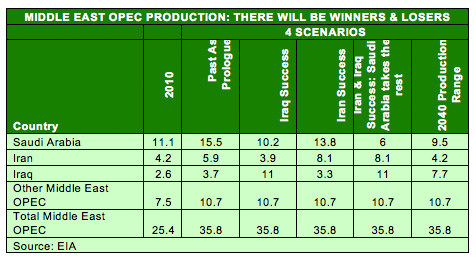
"There is an upside and downside within this scenario for Saudi Arabia of almost 10 million bpd, 4 million bpd for Iran and almost 8 million bpd for Iraq," said Adam Sieminski, Administrator, at the EIA.
HIGH PRICES
The EIA expects Brent crude oil spot price to average from USD 112 per barrel in 2012 to reach USD 106 per barrel in 2020 and USD 163 per barrel in 2040.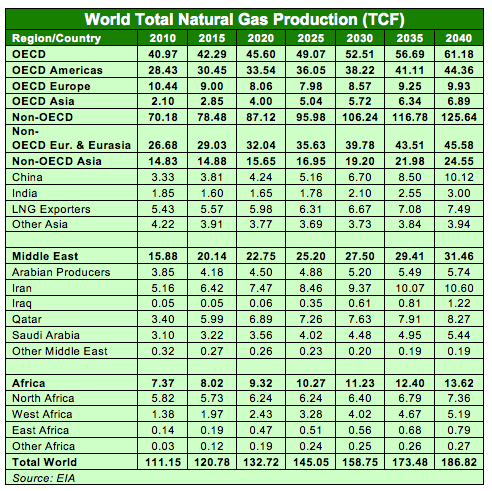
The high prices could be a double-edged sword for OPEC as that would encourage the development of currently commercial unviable projects such as the Arctic, and deep water resources around Africa and Latin America.
"High sustained oil prices can affect consumer demand for liquid fuels, encouraging the use of less energy or alternative forms of energy, but also encouraging more efficient use of energy," said the EIA.
"Energy efficiency improvements are anticipated in every end-use sector, with global liquids intensity--liquid fuels consumed per dollar of GDP--declining (improving) by 2.6% per year from 2010 to 2040."
The high prices will especially benefit natural gas which would see its production rise 1.7% per annum over the next 30 years.
CHINA UNCERTAINTY
China, which is estimated to have the world's largest shale gas reserves and is investing billions to reduce its dependence on global imports of the commodity, is expected to raise natural gas production at a fast clip of 3.8%.
Increased Chinese natural gas production may allow Beijing to move away from expensive oil, spelling spell trouble for many Middle East and African states that are betting heavily on continued Chinese demand for their supplies.
The Middle East's increased dependence on China and Asia as a destination for their oil and natural gas is a risky proposition, according to three analysts Yuhji Matsuo, Akira Yanagisawa and Yukari Yamashita, of the Environment Research and Technology Development Fund of the Ministry of the Environment in Japan.
The authors note that while Middle East-Asian trade will rise, the Middle East's share of Asian total imports will fall from 77% in 2010 to 65% in 2035 for oil, and from 52% to 30% for natural gas.
"In this context, the Middle Eastern countries should recognize the great economic risk of their high dependence on fossil fuels export revenue and measures should be taken to alleviate it," the authors said.
"Maximum efforts to diversify the economic structure are indispensable for the Middle East hydrocarbon exporting countries. This is especially true for the LNG exporting countries such as Qatar and Oman, because of the risks related to LNG exports."
Interestingly, Middle East producers will nearly double their natural gas production from 15.88 trillion cubic feet (tcf) in 2010 to 31.46 tcf by 2040.
Middle East states will also boost their nuclear power capacity from zero to 15 gigawatts by 2040.
ASIAN CONSUMERS
"Rising prosperity in China and India is a major factor in the outlook for global energy demand. These two countries combined account for half the world's total increase in energy use through 2040," said Sieminski. "This will have a profound effect on the development of world energy markets."
Meanwhile, the transportation sector will increase its consumption of oil and petroleum products from 55% in 2010 to 57% in 2040, according to the EIA.
China will lead the global demand for transportation fuel, more than tripling its consumption from 8 quadrillion Btu in 2010 to 26 quadrillion Btu by 2040
"In 2010, China's transportation energy use was only one-third of that in the United States; in 2040, China is projected to consume about the same amount of energy for transportation as the United States."
© alifarabia.com 2013