Regional investors looking for a safe haven as the US Federal Reserve begins tapering, should look no further than Saudi Arabia.
Global markets are concerned about the impact of US Federal Reserve rolling back -- or tapering -- its USD 85 billion monthly stimulus package.
While the Fed is unlikely to taper any time soon given the political dysfunction in Washington, which has led to a government shutdown and impasse over the debt ceiling issues, analysts expect the Fed to take action at some point either later this year or early next year.
Emerging markets policymakers are especially vary of the impact of the retrenchment of the Fed stimulus program, and the end of low interest rates.
Given the prospect of higher interest rates and greater volatility, investors will naturally adjust their portfolios by reducing their fixed income holdings. But there is a risk that by selling too much too fast, long-term interest rates could rise more sharply than presently anticipated, according to analysts.
"There may be bumps in the road to monetary normalization," said Jose Viñals, financial counselor and head of the IMF's Monetary and Capital Markets Department. "The question is whether the bumps will make the trip merely uncomfortable, or whether some of them are likely to lead to accidents."
As emerging market investors look for cover, Riyadh-based NCB Capital says regional and Saudi investors can take shelter in Saudi markets for four key reasons:
1. Fixed exchange rate system: The dollar peg has been held for the past few decades.
2. Mortgage penetration: Saudi mortgage penetration is low while consumer financing is a small proportion of the household income. Also mortgage rates are fixed and hence no impact on disposable income from higher rates.
3. Foreign ownership: Fed tapering will have limited impact due to low foreign ownership and hence limited impact on any outflow.
4: Oil hedge: Saudi Arabia is an oil-exporting nation and recorded 24% current account surplus in 2012 due to the high oil prices. In addition, foreign exchange reserves of more than 90% of GDP are crucial to financing any potential current account deficit.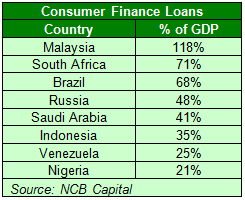
A key advantage is the limited foreign exposure, which is under 3%. While Saudi Arabia is slowly opening up to foreign investors, the market remains dominated by regional and domestic investors.
NCB Capital estimates foreign funds have poured in around SAR 10 billion over the past few years.
"Although we expect foreign institutional buying to increase going forward, it is unlikely to significantly alter the local-dominated trading," said NCB.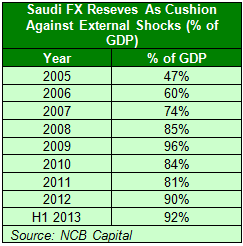
STRONG FUNDAMENTALS
Compared to other emerging economies such as China, India and South Africa, which have seen their growth trajectory falter, Saudi Arabia has strong macroeconomic fundamentals and with clear line of sight on a number of non-oil sector projects that are set to keep the economic momentum going.
Al Rajhi Bank expects oil revenues to reach SAR 960 billion, and cross SAR 1 trillion next year, as Saudi Arabia continues to make up for lost production from other OPEC countries such as Venezuela, Iraq and Libya.
"We believe the government expenditure will continue to grow and next year being the final year of the 9th five-year plan, many government projects could be fast-tracked," the bank said. 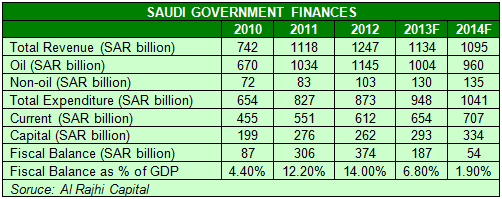
"Therefore, we expect the spending to be higher at SAR 1,041 billion in 2014, which will translate into a lower budget surplus of SAR 54 billion."
Business and consumer confidence also remains high in Saudi Arabia. A Mastercard survey in August showed elevated levels of confidence in the economy, although marginally lower than at the start of the year.
"Consumer confidence has remained consistently high in Saudi Arabia for a number of years, and once again respondents have indicated that they are extremely optimistic in their outlook for the coming months," said Khalid Hariry, market manager, KSA, Bahrain and Yemen, MasterCard.
"Respondents are most positive about the prospects for the economy and employment, reflecting their confidence in the development and opportunities of this ever-developing market."
UPBEAT SPENDING
Spending and credit has also risen on the back of rising wages over the past two years.
"Credit from the commercial banks to the private sector has been growing at a strong pace. The credit has grown at 15.7% during the January-August period of 2013 as compared to the year-ago period," Al Rajhi said.
Total credit outstanding has shot up from SAR 99.3 billion to SAR 1098.4 billion, growing at 9.9% in the first eight months of 2013 mainly driven by consumer loans.
Interestingly, Saudis who responded to the Mastercard survey were less optimistic about the stock market, perhaps due to the rise in the fortunes of regional markets.
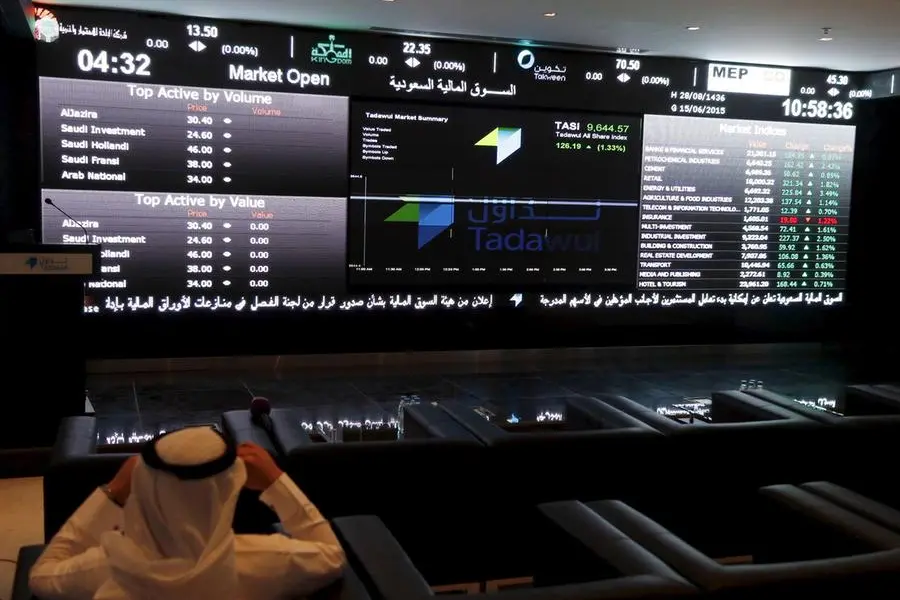
More than half of the 16 fund managers surveyed by Reuters said they will increase their allocation to the region, with special emphasis on Saudi Arabia. Compared to other regional markets like Dubai which has posted record growth of 71% this year, the Saudi Tadawul index has only grown 17%.
Twelve out of the 16 fund managers said they would increase allocation to Saudis and none said they would reduce it.
NCB says that the strong macroeconomic environment and near-zero government debt means that the risk perception of Saudi is very limited compared to emerging market economies.
"We expect this to continue with relatively high oil prices. Although geopolitical events in the region have led to a spike in CDS [credit default swaps] spreads - and hence higher risk perception - oil prices act as a 'hedge' as higher oil prices improve government revenues. We believe this relationship creates a buffer for the government to absorb economic external shocks."
© alifarabia.com 2013