Saudi inflation edged up in July as strong domestic factors pushed prices upwards.
The Saudi Central Department of Statistics and Information showed the consumer price index (CPI) inflation data rose to 3.7% in July, compared to 3.5% in June.
Food inflation hit a 4% high in July due to the Ramadan season, but housing rents were the primary reason for the rise in prices.
Rent and housing-related services inflation rose 4.2% year-on-year in July, compared to 3.6% in June.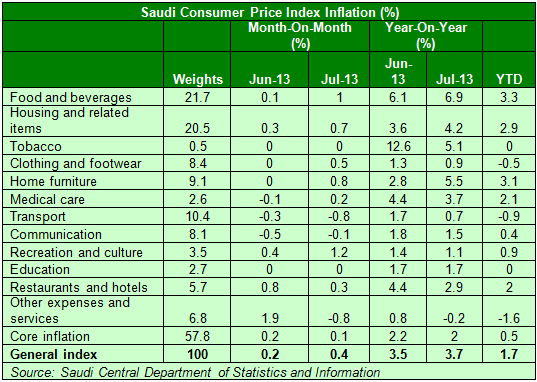
"An expanded supply of housing is needed to meet demographic trends and reduce pressure on rents," said the International Monetary Fund (IMF) in its recent report on the country, noting that inflation will need careful monitoring in the period ahead.
"Urbanization, population growth, and smaller average sized households have boosted demand for housing. The lack of affordable housing saw a sharp increase in rents during 2007-11, which was one of the main drivers of inflation."
The trend will likely persist as the population continues to rise at a fast clip.
Real estate consultants Jones Lang LaSalle says villa rents in Riyadh rose 8% in the first quarter compared to the same period last year, with villas in expatriate compounds showing a larger increase due to long waiting lists.
"Rents in residential areas such as Olaya, Sulemania in the center and Hiteen and Nakheel in the west and Shumaisi in the south are higher than those in the surrounding neighborhoods," JLL said.
Apartment rents in the capital also rose 6% during the period.
In Jeddah, villa rents have also shot up 4%, although apartment rents were stable.
BANKING SECTOR TO THE RESCUE
Saudi authorities have made a concerted effort to improve the housing situation in the kingdom.
The government has unveiled a massive investment program to meet rising real estate demand and set up a real estate refinancing company to improve access to funding. The approval of a landmark mortgage law has also encouraged the banking sector to enter the fray.
Despite these commendable efforts to raise housing ownership levels in Saudi Arabia, the sector is hamstrung by logistical issues.
The sheer pent-up demand from a rising population means annual housing demand is set to increase 186,000 per year to 265,000 units by 2020, according to local market estimates.
The IMF expects the young Saudi population to grow rapidly over the coming years.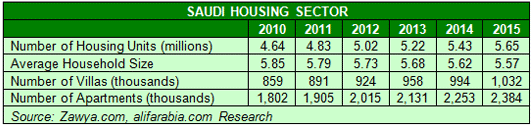
"Assuming rising labor force participation in line with past trends, the Saudi labor force is projected to increase by 3.5% a year over the course of the next decade," said the IMF. "As this young and increasingly well-educated population enters into its working-age years, there is a tremendous opportunity to boost growth and raise living standards further."
Housing will be a central demand for the rising population and a great vehicle to foster inclusive growth.
And while the arrival of the long-awaited mortgage law is a great incentive, market observers believe it will take years for the market to find equilibrium.
LOGISTICAL CHALLENGES
While the government and a number of public and private companies have unveiled plans to build a number of residential projects across the country, logistical infrastructure have hindered the surge of new housing stocks.
Issues like labor costs and availability and prices of raw materials such as cement have forced the private sector to push back on some of their ambitious plans.
"The affordability of housing remains a major concern for lower income purchasers," notes management consultant Deloitte in a study on Saudi mortgage law.
"As a result, Saudi Arabia's flourishing economy, and subsequent real estate market growth and development may also serve to further decrease the number of properties available to these purchasers as property prices continue to rise."
In addition, real estate financing also needs to be fine-tuned to stimulate growth.
Although real-estate financing has grown 25% over the past two years, it accounts for a mere 5% of total credit.
"The new mortgage legislation addresses issues in the legal framework with respect to foreclosure procedures and should make banks more willing to accept real estate as collateral," the IMF said.
"It also lays the foundation for the creation of non-deposit mortgage finance companies. Going forward, this is expected to help improve access to housing while broadening the availability of investment instruments for financial institutions."
With rising population, a robust economy with strong macroeconomic fundamentals and the desire by the authorities to encourage home ownership, Saudi Arabia's real estate market is set for long-term growth.
The kingdom's non-oil economy sector has grown 7.5% over the past few years, and huge government funds pouring into the economy will ensure the sector will continue to post an average of 3% growth over the medium term.
The rising investment and government spending will lift most sectors, including the housing sector.
However, this surge will need to be managed, lest the rapid unplanned growth leads to overheating and credit concerns.
© alifarabia.com 2013