Despite cuts in its oil output, and the generally nervous economic sentiment globally, the Saudi economy continues to race ahead.
Saudi production has fallen from a high of 9.91 million barrels per day in the second quarter of 2012, to 9.07 million by January 2013, according to OPEC data.
Saudi and other Gulf states are reining in output as the global economy falters and demand for crude remains subdued.
But these shallow cuts come at the back of record oil production and triple-digit Brent crude prices last year. According to the US Department of Energy, the four Gulf states, namely Saudi Arabia, UAE, Kuwait and Qatar raked in USD 438 billion in oil export revenues in the first 11 months of last year, which gives them a fair amount of flexibility to adjust output.
"Growth performance in the key GCC countries was stronger than expected in 2012 on the back of elevated oil production and accelerated non-hydrocarbon sector activity," said Alia Moubayed, analyst at Barclays Capital.
"The key driver continues to be Saudi Arabia's higher-than-projected GDP growth, which registered 6.8% year-on-year on the back of 30-year-high daily oil production and buoyant growth of the non-hydrocarbon private sector (7.5% year-on-year)."
The economy was driven by strong optimism and business confidence in the region as the regional governments' spending plans boosted corporate bottom lines.
The PMI (Purchasing Managers Index) survey in Saudi Arabia rose four percentage points to 58.5 points in February from the previous month.
"Economic data for January was strong," noted Jadwa Investment in its latest report on the kingdom. "Consumer spending remained robust, with both the cash withdrawals from ATMs and value of point of sales transactions hitting record high levels. Cement sales were also at their largest level on record."
Confidence boosts lending
Bank claims on private sector rose by 1.2% in January taking the total outstanding claims to above SAR 1 trillion, wrote Fahad Alturki, senior economist at Jadwa. "Most of the new credit was allocated to commerce and services sectors. Banks holding of treasury bills also picked up in January.
In a sign that business lending improved significantly, the commerce sector received the largest share of new lending in 2012 followed by the services sector, accounting for 21% of credit to the private sector.
The growth is likely to continue. The kingdom's new budget marks a 2% increase in spending over 2012, which was already at an elevated level.
"Assuming that spending overruns in 2013 come to almost half of last year's, the overall fiscal impulse would likely significantly boost non-hydrocarbon growth, and keep overall growth at 4% y/y, on our estimates. Much of the 16% y/y increase in spending is concentrated in the infrastructure space," said Barclays' Moubuayed.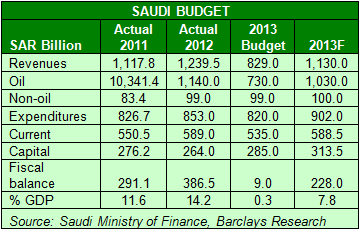
In addition, Saudi oil minister Ali Naimi is expecting a jump in oil exports as the global economic sentiment improves.
While Barclays expects Saudi hydrocarbon GDP to rise a mere 0.3% this year, the kingdom is still expected to post a 4% rise in overall GDP on the back of strong non-hydrocarbons growth.
Bearish Samba
Saudi American Bank (Samba) forecast is far more bearish, as it expects oil GDP to contract 3% on output cuts.
"The authorities insist that this is a response merely to seasonal domestic demand, which falls in the winter months," said James Reeves and Andrew Gilmour, deputy chief economists at the bank. "Yet some doubt that this explains the scale of the cut, and think that it might be more of a response to increased supply from both Iraq and, more significantly, North America."
The Saudi government is also hoping that the kingdom's infrastructure projects remain on track and don't suffer from the delays they saw in 2012.
"We think that projects delayed in 2012 will be released this year, and this will keep activity fairly firm," said Samba economists. "However, new fiscal realities (encapsulated by the cut in oil production) might weigh on non-oil activity in 2014-15."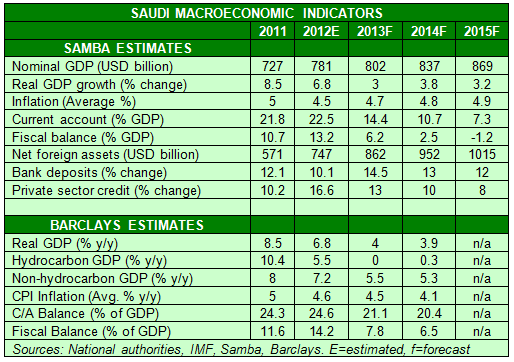
Most of the delays stemmed from personnel changes in ministries.
"Certainly, there are still challenges, not least on the financing side. The withdrawal of most French banks from the regional project finance market has left a hole that has not been adequately filled. In addition, new capital rules are likely to crimp further the ability and willingness of international banks to lend, particularly long term."
The contracting sector is also facing intense competition from Chinese companies who import labor and materials, leaving local companies little subcontracting business.
While most economists believe the kingdom's economy will rise on the hundreds of billions of dollars being unleashed in the economy, there are long-term concerns, especially as global oil sector is being turned on its head to the US shale gas and oil revolution.
"The Saudi economy remains in fairly good shape, and some key sectors, such as petrochemicals, should benefit from an improving global environment," said the Samba economists. "Yet there are headwinds, not least on the fiscal side, and these might begin to impinge on growth as we move through the forecast period."
As the only OPEC member-country with significant spare oil production capacity, Saudi Arabia is in a unique position to help balance the market in times of dislocation, but there are limits to what the kingdom can -- and is willing to -- do, notes the Centre for Global Energy Studies.
"Saudi Arabia's oil minister Ali Naimi has added his calming voice to the forces
of stability, suggesting that USD 100/bbl seems a reasonable price for oil. If current factors persist, it would appear that oil markets could enjoy a period of stability not seen since the mid-1990s -- but that is a big 'if'," said CGES in its monthly report.
"Despite the current appearance of oil market stability, pressures are building and they could become uncomfortable for the world's biggest oil exporters."
Which is why the Saudis are keen to invest heavily in the non-oil economy while oil revenues can still support it.
© alifarabia.com 2013