Mining companies across the world are in retreat, which is set to adversely impact the South African economy.
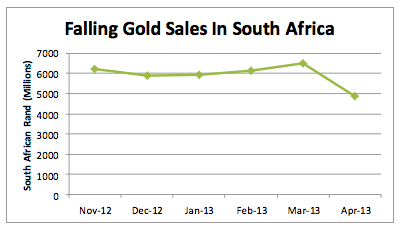
Johannesburg-based AngloGold Ashanti's second quarter results highlighted the torrid time facing the mining industry as gold prices have declined 23% this year.
"In light of the lower and more volatile gold price, capital expenditure is also being rationalized with a view of focusing expenditure on higher quality assets and curtailing expenditure or suspending operations on other projects," said AngloGold, as Africa's largest producer posted a loss of USD 135 million in the second quarter.
The company has already postponed South African project Zaaiplaats at the Moab Khotsong mine while alternative development options for the project are being evaluated.
AngloGold has cut capital expenditure by USD 150 million and postponed dividend as it seeks cost-cutting measures. The company has blamed an increase in net debt due to strikes in South Africa and a decline in gold prices, as key reasons for its poor performance.
The company and its South African peers are also in the midst of wage negotiations with employees on wages.
NO SALARY HIKE
"The South African gold industry finds itself in a challenging operating environment, given sharply lower gold prices, lower productivity levels and rising costs and has shed a significant number of jobs over the past decade as these pressures have mounted," AngloGold Group chief executive Srinivasan Venkatakrishnan said in his second quarter announcement. "Against this backdrop, it is difficult to contemplate wage increases of any kind in the current round of wage talks."
While the industry has offered South African labor unions a 5% increase in salaries, it has not yielded any results to date. The company is also concerned about the impact of annual power tariff increases and winter power tariffs in South Africa.
"Both cost and production estimates may be impacted by work stoppages in South Africa," the company warned.
Harmony Gold Mining, another major South Africa producer also pledged to cut costs in May after production fell 15%.
"Our aim is to reduce services and corporate costs in South Africa by ZAR 400 million and overall capital expenditure in both South Africa and Papua New Guinea by ZAR 1.4 billion for the financial year 2014," the company had said.
The company is expected to announce second quarter results on August 14.
Randgold Resources, another African company, is also cutting costs and raising production to offset falling gold prices.
MINING FOR GROWTH
South Africa's mining sector accounts for 5% of its GDP directly, and 18% indirectly, according to research. Much of the decline is due to gold production, which has fallen as reserves have been exhausted.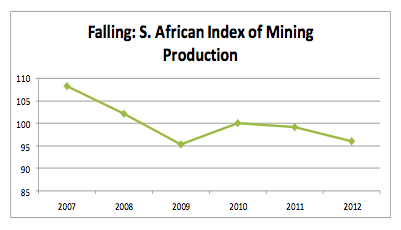
"Since the 1990s, gold output has fallen by roughly three-quarters, from about 50,000 kilograms per month to about 12,000 kilograms a month currently," said Peter Worthington, analyst at Absa Capital.
"There is little prospect of a material reversal of this trend, especially given current prices and cost structures. The current average cost of production is roughly about USD 1,100 per ounce on an operating cost base, and USD 1,300 per ounce when sustaining capex is included."
While gold has suffered, other metals and natural resources have stepped up. Gold still accounts for 21% of the country's mining sector, but others such as platinum group metals (19%) and coal (26%) are now just as important resources, offsetting the natural decline faced by the South Africa's gold sector.
While commodity prices rose 12% each year over the past decade, the South Africa mining sector contracted -0.3%, as structural deficiencies held back the gold and wider resource sectors.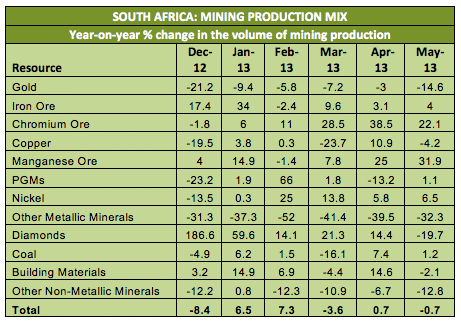
4 REASONS FOR DECLINE
Absa Capital identifies four key reasons for the decline:
1. Regulatory and policy uncertainty: The South African Mineral and Petroleum Resources Development Act (MPRDA), enacted in late 2002 has numerous ambiguities. Even the government's proposed new amendments have not satisfied the industry which believes the government will continue to wield wide discretionary powers.
2. Infrastructure constraints: The country suffers from market access issues and clogged railways and ports that have slowed down the sector. Electricity shortages have also hurt the industry's prospects.
"Despite the subsequent burst of investment, supplies remain tight even as the cost of electricity rose sharply," Absa Capital's Worthington noted.
3. Labor issues: Relationship between South Africa's labor union and the mining industry are at rock bottom. Canada's Fraser Institute recently ranked South Africa 93rd among 96 countries in labor cooperation.
Last year, 44 people tragically lost their lives as violence rocked the mining sector. The industry also lost 1.8 million man hours hurting productivity and production.
4. Higher costs: The gold mining industry has seen electricity prices jump 238% over the past five years. In addition diesel costs have risen 16% per year while salaries have also risen 12% per annum, hurting the industry.
"The government has brought stakeholders together in the "Framework for a Sustainable Mining Industry", but it is unlikely to solve all the problems," said Absa analyst.
South Africa is losing its prominence as the premier mining investment destination in Africa as the country faces a number of structural challenges and a less-than-conducive business environment.
With a number of newer African jurisdictions seeking investor attention, the South African mining industry will need to work through its issues fast.
© alifarabia.com 2013