Saudi Arabia's power needs have taken centre stage in recent years as the kingdom's economy expands and the population rises at a fast clip.
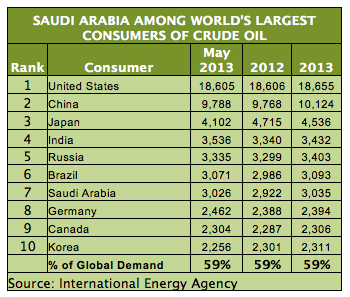
While Saudi Arabia is the world's largest exporter of crude oil, analysts often forget that it is also the world's seventh largest consumer of crude. The country is also increasingly using a lot more of its own hydrocarbons, leaving fewer barrels available for export purposes.
Given that Saudi Arabia has no coal and no viable sources of hydro generation, officials have identified solar and nuclear energy as major pillars of their energy strategy going forward.
The country is planning to build 17,600 megawatts (MW) of nuclear capacity by 2023, at an estimated cost of USD 100 billion over the next two decades.
The kingdom has also earmarked an additional USD 109 billion to build a solar industry to generate a third of its electricity by 2032 -- or 41,000 MW.
King Abdullah City For Atomic and Renewable Energy (KA CARE), which is charged with overseeing the country's alternative energy drive, is set to install 70 stations across the country to assess the viability of producing electricity from the sun and wind, together with geothermal and waste sources.
The government has already poured massive investment into expanding its installed power capacity.
The Saudi Electricity Company notes that installed power capacity has more than doubled to 54,000 MW over the past 12 years. Close to 12,450 towns and cities now have access to electricity, compared to 7,400 in the year 2000.
Indeed, the kingdom is planning to more than double capacity to 120,000 MW by 2030, from its current level of 54,000 MW via a mix of alternatives, including nuclear, conventional and renewable resources.
Yet that may not be enough to meet the country's soaring demand.
Massive public- and private-sector investments in virtually all sectors of the economy will require access to running water, utilities and electricity. The development of new cities in remote areas will require greenfield investments, while expansion of real estate, healthcare and education sectors across the country will also make huge demands on the electricity sector.
In addition, the kingdom's plan to boost industrial production adds another dimension to surging power requirements in one of the world's 20 largest economies.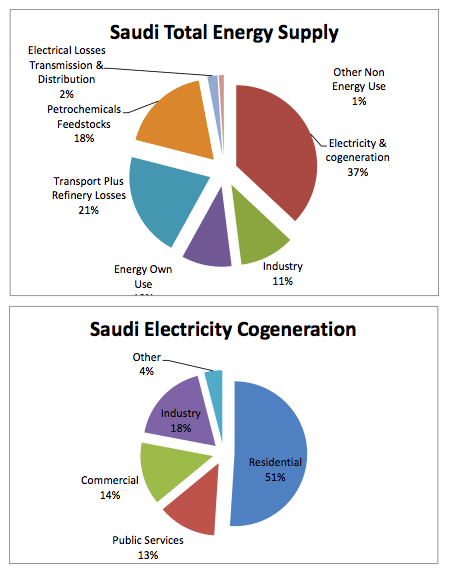
RESIDENTIAL CONSUMPTION
Saudi energy consumption has risen a little more than 6% per annum from 1990 to 2010, with the residential sector accounting for 82% of consumption.
Industry estimates show the Kingdom typically consumes 800,000 barrels of oil per day during the summer for domestic cooling needs alone.
Saudi Arabia can save 43% in oil savings, compared to places like China if it switches to solar, according to an analyst.
Saudi Arabia spends USD0.16 per kilowatt per hour through its existing on-grid power infrastructure, compared to USD0.091 per kilowatt per hour via solar, according to Bernstein Research.
"Saudi Arabia currently meets all of its energy needs through gas and oil. Coal, hydro, nuclear, solar and wind power generation in 2011 in Saudi Arabia amounted to... zero," Michael Parker, analyst at Bernstein Research, wrote in a report. "For a country that consumed 254TWh of power in 2011, means that there is a lot of oil and gas being burned to produce power."
Falling solar installation costs also offer compelling reasons to make the switch. The cost of installing a watt of solar energy has dropped from USD7.5 per watt in 2007 to USD1-- or USD0.08 kilowatt per hour, assuming 2,200 hours of sunshine per year.
"At USD100 per barrel for oil, that means that Saudi Arabia is effectively paying USD0.16 per kilowatt per hour to burn oil to generate electricity rather than selling that oil," Mr. Parker noted. "Any available source of power that costs less than USD0.16 per kilowatt per hour is economic. Falling oil prices reduce the incentive, but don't kill it until oil hits USD50 per barrel."
EFFICIENT APPLIANCES
While expanding the energy mix is a vital component of the strategy, energy efficiency can also go a long way in cutting the consumption of oil barrels.
"The average efficiency of air-conditioners in Saudi Arabia is estimated to be 18% below the current global average, so around one-fifth of total energy supply devoted to air conditioning could theoretically be cut through a mandatory replacement programme to bring units up to the global average," said Chatham House analysts Glada Lahn, Paul Stevens and Felix Preston, in a new report.
"Over time, the saving justifies significant investment in standards and well-thought-out replacement programmes."
The analysts estimate that if all appliances are replaced with energy-efficient units by 2025, it would cut consumption by 130 million barrels of oil equivalent.
"This is equivalent to a saving of USD10-billion a year at USD80 per barrel, or some 5% of the projected Saudi government budget for 2013."
The development of a renewable energy industry will also help create much-needed jobs. According to the KA Care, the renewable energy programme will create 155,000 jobs in the future, of which 75,000 will be created in the nuclear industry and 80,0000 in the renewables sector.
The Kingdom's economic imperative of reducing oil consumption and focusing on renewable energy will have global implications - a Saudi Arabia with enough spare capacity is crucial for the stability of oil markets.
© alifarabia.com 2013