01 May 2014
The prime minister of Tunisia recently called his country a "democracy startup".
But all good startups need to be nurtured and fed, and despite the country's laudatory pursuit of governance by consensus, the economy remains vulnerable.
Tunisia's deputy minister of economy, Nidhal Ouerfelli, warned earlier this month that the economic outlook remained difficult. "After July, things will remain tough. In 2015, it will be tougher because we have borrowed money to pay salaries, consumption, and subsidies," he told local media.
The country's new prime minister has admitted that economic vulnerability is linked to an excessive public debt, hovering around 50% of GDP, a downturn in investments, and budget, commercial, and fiscal disequilibrium.
After Tunisia's ruler of thirty years fled to exile in Saudi Arabia following the first revolution of the Arab Spring in the region, the security situation in the North African country has deteriorated as secular and religious groups vie for power.
Tunisia could have gone the way of Egypt or Libya, but its politicians, army, labor unions and civil society have allowed the country to find balance and veer away from disaster. In the latest episode of political compromise the country has adopted a democratic constitution and formed a consensus government.
"The significant progress made at the political level opens the way for clearer prospects, which could help reduce investors' 'wait-and-see' attitude. However, the economic situation remains very fragile, with a growth rate that is too low to meet the population's high social aspirations," the IMF said in a report in March.
Deterioration in security conditions ahead of or following elections scheduled in the second half of 2014 would limit recovery in tourism and private investment, the Institute of International Finance (IIF) said in a report.
"A weaker economic outlook in the Eurozone would delay any improvement in external demand," it added.
Data from the country's National Institute of Statistics shows that the trade gap has widened to TN 3.29 billion, with imports rising nearly 8% and exports declining by 1.8% during the first three months of 2014.
NO PEACE DIVIDENDS-YET
Moderate FDI inflows (2.8% of GDP on average over the past three years) have contributed to an increase in external debt, and international reserves, at 3.2 months of current account payment cover at end-2013, are weak, notes Fitch Ratings which affirmed a negative outlook on the country on April 25.
Fiscal deficit is expected to widen to 8.3% of GDP in 2014 from 4.3% of GDP in 2013 due to weak exports of phosphates and low tourism revenues, which, along with weak external demand for Tunisian goods, is expected to keep the deficit at 7.2% of GDP in 2014, the International Monetary Fund estimates.
The government is reining in spending, including reduction in the subsidies bill of up to 1.8% of GDP. But more adjustments are needed, include capping the wage bill, which amounted to 12.4% of GDP in 2013.
The IFF estimates that public debt would rise to 48.4% of GDP in 2014 from 45.6% in 2013, with external debt accounting for about 70% of total debt stock.
"The weak banking sector weighs on the ratings," Fitch said. "Given public banks' NPL ratio of 21% at end-June 2013, fragile capital buffers and large exposures to vulnerable state-owned companies, Fitch expects the government will provide public banks with support for their recapitalisation and restructuring. Fitch expects a 2%-3% of GDP recapitalisation cost for 2014-2015."
INTERNATIONAL SUPPORT
Still, GDP growth is projected to grow at 3.7% this year, compared to 2.6% last year, driven primarily by public and private sector investment.
Funds have been pouring in to help stabilize the country. In January, the IMF approved a USD 506.7 million stand-by arrangement to assist during the protracted political transition and challenging domestic and regional environment.
The World Bank also released USD 1.2 billion in February. Nearly two-thirds, or USD 750 million, of the funds will be to improve government reforms and create jobs, while a USD100 million credit facility is extended to banks that give small and medium enterprises much needed access to credit.
The World Bank said that with 99.7% of the total number of enterprises in Tunisia employing around 1.2 million workers (about 44% of the private sector workforce), micros, small and medium enterprises were the engine of private sector economic growth and employment.
"In light of the alarming economic situation and in the absence of a real public budget for the current year, the purchasing power of middle and poor classes should be protected," wrote Mohamed Kerrou, non-resident fellow at Carnegie Middle East Centre.
He said that while Tunisia's "bumpy" democratic transition remains to be consolidated, the country could still serve as a model of an Arab Spring country well on its way to becoming a democracy.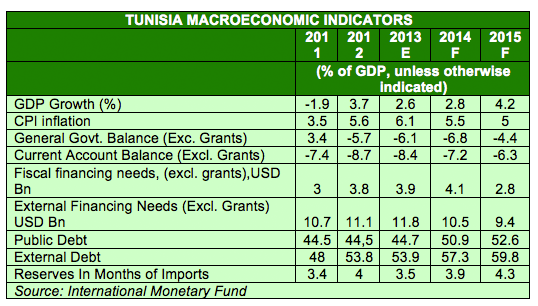
The feature was produced by alifarabia.com exclusively for zawya.com.
Zawya 2014