While policymakers across North Africa look to revamp political structures in the region, unemployment is reaching alarming proportions. More than 10 million people will be unemployed by 2018 as lethargic economies fail to create enough jobs for rising populations, according to International Labour Organization data.
The labor market landscape in North Africa (Algeria, Egypt, Libya, Morocco and Tunisia) was already dire in 2010 with six million unemployed. And the social unrest that upended at least three regimes (Tunisia, Egypt and Libya) in the region has further exacerbated the employment challenge in the region.
Authorities have been unable to address a key driver of social unrest: stable jobs. In Egypt, the region's most populous country, more than 3.6 million people were unemployed by the end of 2013.
"Across the region, the labor market is characterized by low labor force participation rates (at below 50%), together with high levels of unemployment," wrote Mthuli Ncube, chief economist and vice president of the African Development Bank (AfDB) in a new report.
"North Africa has the second highest unemployment rates in the world, close to 10% in most of the countries. The population is unevenly affected by this phenomenon, with some categories of workers more at risk than others."
As a region, North Africa will have the world's highest unemployment rate of 12.1% by 2016, ILO data shows.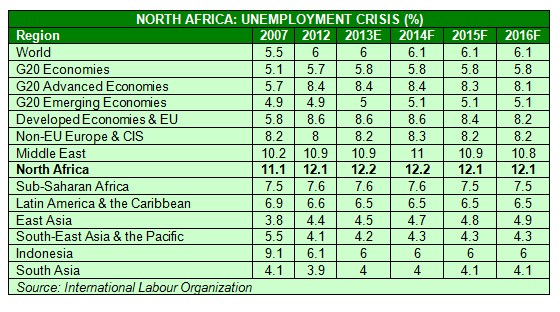
YOUNG AND RESTLESS
Young North Africans between the ages of 15-24 are three times more likely to be affected by unemployment than adults aged 25 and above.
"Unemployment increases with education level, and well-educated youth suffer higher rates of unemployment than their less educated counterparts," Ncube said, adding that underemployment was also a problem. "There is a high incidence of working poverty in the region, and young people's transition to adulthood is often blocked because of income issues."
Unemployment among young people has reached around 19% in Morocco, over 22% in Algeria, 25% in Egypt and over 42% in Tunisia.
Regional governments have responded to the crisis with a knee-jerk reaction that has done little to resolve structural challenges. Egypt recruited more than one million employees in the public sector since 2011, raising the wage bill by 15%. In Tunisia, authorities expanded the public sector and ordered state-owned enterprises such as Tunisair to hire more people.
DEMOGRAPHIC DIVIDENDS
India and China both faced monumental population challenges a couple of decades ago, but by investing in education and demand-driven training, the Chinese and Indians have turned their weakness into their greatest strength.
As such, the rise of middle-class in China and India has already turned both these countries into formidable economic powerhouses that are not just dependent on exports but also self-sustaining domestic consumption.
Similarly, North Africa is at an important historical juncture, where a rare confluence of events could place them on the path to more rapid, sustained and inclusive growth.
"The region's youth bulge is expected to last until 2020; so if countries are able to implement effective measures to correct skills mismatches and generate enough high-quality jobs to utilize the skills of their educated youth population before that time, then they can enjoy significant 'demographic dividends' in the form of rising per capita output and enhanced savings and investment," Ncube said.
North Africa has a high literacy to build on while countries like Egypt, Libya and Algeria offer ready opportunities in resources, consumer, housing, technology and financial services sector.
Egypt was emerging as a promising outsourcing center and had earned revenues of just over USD 1 billion by 2011, before the industry's rise was cut short by political upheaval. The sector employs 43,000 people and, given the high number of graduates armed with degrees suited for outsourcing, the sector could emerge as a great job generator.
SME INITIATIVES
North African governments have launched some initiatives to stimulate job creation, but more needs to be done.
Egypt's National Programme for Training for Employment (NPTE), which has been in the pilot stage since 2012, aims to improve skills of industrial workers by setting up a labor market information system (LMIS), through training and qualifications, and by matching jobseekers to decent jobs.
In Algeria, the government has created 1.1 million jobs since 2008 through a national agency to support youth employment, which helps young entrepreneurs (19-35 years old) to expand their goods-and-services production activities.
Morocco has initiated programs such as Taehil (training) and Moukawalati (entrepreneurship) to help individuals gain new skills or start their own business.
Since the demise of Muammar Gaddafi's regime, Libya has launched three programs that target ex-fighters to retrain them. A LYD 1 billion (USD 817 million) Warriors Affairs Commission aims to send 18,000 Libyans abroad for a five-year period for training. The KADER program works aims to send 28,000 Libyans abroad for training while TAMOUH hopes to turn fighters into entrepreneurs.
These efforts have had mixed result. More crucially, they have not brought about transformative changes that move the needle on unemployment in the region.
Instead of recruiting more citizens in the creaking public sector, authorities must focus on creating an environment that encourages private and foreign investment in areas as diverse as housing, consumer, services and financial services.
AfDB recommends that labor market policies be viewed as part of a comprehensive reform and investment package. During the transition period, decision makers need to bear in mind that they are constantly dealing with two time horizons: a short-term horizon characterized by multiple social demands for particular measures and outcomes; and a long-term horizon.
"They must take care that policies implemented in the short-term do not detrimentally affect long-term development objectives," the bank noted. "The long-term objective must be to reduce inequalities and strengthen the private sector's capacity to create 'decent' and sustainable jobs."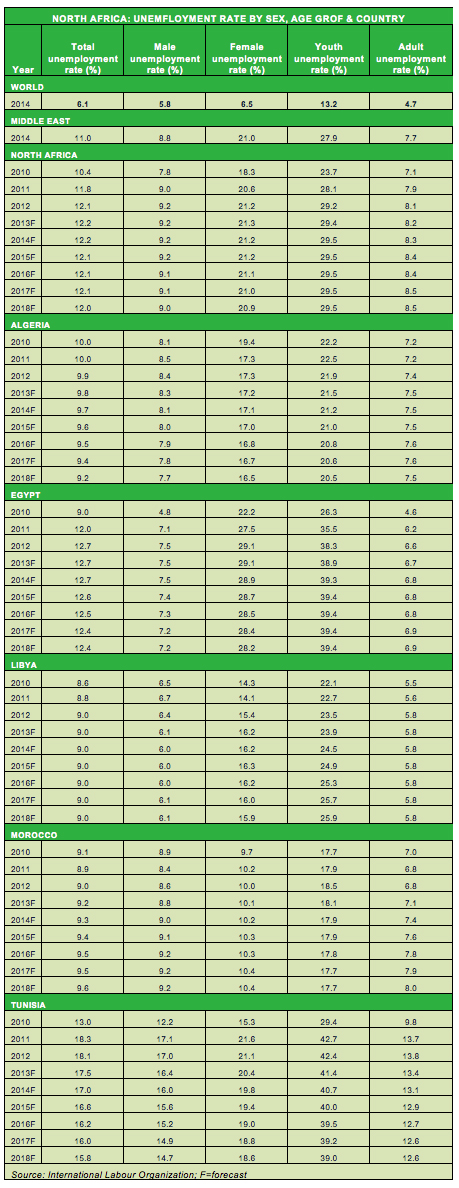
The feature was produced by alifarabia.com exclusively for zawya.com.
© Zawya 2014