Resource-rich African and Middle East countries are failing to manage their natural riches effectively and are governing their resource companies poorly, according to the Research Watch Institute (RWI).
The institute surveyed 58 countries, which account for 85% of global oil production, 90% of diamonds and 80% of copper output. Resources accounted for a third of gross domestic product for 41 of the countries studied by the institute over a 10-month period.
The research was based around four key criteria: institutional and legal framework, reporting practices, safeguards and quality controls and enabling environment.
The results are startling the survey concluded that 32 of the countries do not meet basic standards of resource governance, performing weakly or simply failing.
Among the 15 failing countries, seven score below 30 [out of 100]: Cambodia, Iran, Qatar, Libya, Equatorial Guinea, Turkmenistan and Myanmar, the report noted.
As of 2012, when the data collection took place, these countries failed to disclose any meaningful information about the extractive sector and lacked basic governance standards.
Equatorial Guinea was the worst performing African country, ranked 56th among 58 countries. The West African state is the third largest producer of oil in Sub-Saharan Africa with just over 300,000 barrels of oil that makes up 60% of its revenues.
Despite its dependence on oil revenues, the countrys hydrocarbons law does not contain specific rules, regulations and contract terms.
Extremely poor government oversight and a general lack of reporting requirement is how the RWI characterizes the countrys management of its resources.
While a sovereign wealth fund receives a small portion of Equatorial Guineas oil revenues, the institution has not realized any information on its investment plans or details of any assets it may hold.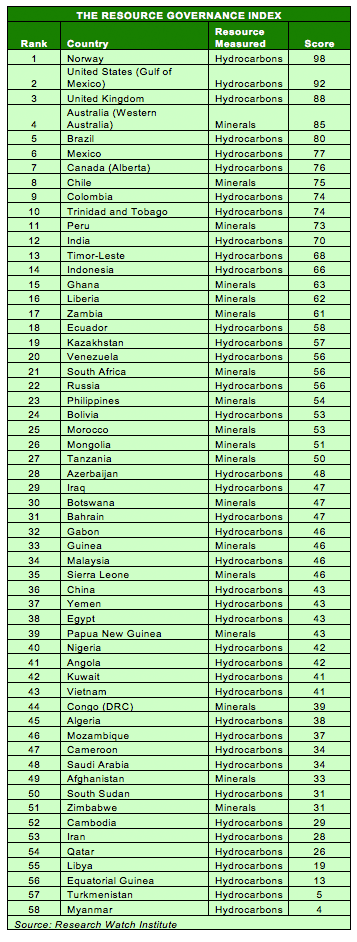
Poor regulations negative for top players
More worryingly, some established and new resource-rich stars find themselves in the bottom-half of the table. Nigeria (ranked 40th), Angola, (41st) and Mozambique (46th), show African governments are unable to effectively manage their natural resources.
Nigeria, Africas largest oil producer with revenues exceeding USD 50.3 billion, does not quite have a handle on its immense bounty.
The Nigerian Petroleum Resources Ministry publishes little information on the upstream licensing process, fiscal and production arrangements, contracts, environmental impact assessments or operational data. It publishes no reports on revenues.
Meanwhile, the minister of petroleum resources exercises wide discretion in awarding licenses, despite a policy of open bidding, and the legislative branch has limited oversight of the process.
Angola, the second largest African crude producer, is rife with corruption and has little regard for rule of law, according to RWI.
State-owned Sonangols finances are excluded from the public sector as Angola has not adopted any rules requiring disclosure of information in the sector.
Mozambique, which recently saw the discovery of large natural gas reserves, has also been opaque about its revenues, reserves and general contracting terms.
The lack of transparency, timely data and clarity on contract terms highlights these countries poor records in broader national governance areas including corruption, civil and political liberties and democratic accountability, the RWI noted.
Other African laggards
The Zimbabwean government has also fared poorly in the survey, as the 8th worst custodian of its natural resources.
Widely considered as one of the poorest countries in the world, with president Robert Mugabe reigning supreme over all that he surveys.
Mineral exploitation rights are vested in the president, RWI noted. The president has wide discretion in licensing, allowing favored applicants to bypass the bidding process.
Taxes that are collected rarely make it to the ministry while there is little public information on the terms of contracts with mining companies.
South Sudans presence among the worst resource managers is no surprise either. The oil sector accounts for 98% of government revenues, but state-owned Nilepet offers no data on oil contracts.
Cameroon has also watched its oil production drop from 185,000 barrels per day (bpd) to 60,000 bpd within 15 years. But the countrys mineral and natural gas sector has seen substantial foreign investment recently, which makes it even more important for the authorities to make a greater effort at transparency.
But Cameroon is ranked 47th among the 58 countries on poor data and general lack of oversight.
The report echoes a recent Global Petroleum Survey by The Fraser Institute.
Thirteen African jurisdictions fell in the surveys bottom-end of the table and many fell in ranking from previous years survey.
The deterioration was greatest in the case of Cte dIvoire (Ivory Coast) where increased concern over trading agreement requirements [and] the availability of skilled labor, Fraser Institute noted.
Africa will always attract a larger risk premium. Stability of rulers and rules could lead to tremendous opportunities. Until then, I will not invest, was the response of one of the petroleum company surveyed by the Institute.
Ethiopia, Niger and Ghana were the highest ranked African jurisdictions, while Nigeria, Chad and Mali were the lowest.
Stars of Africa and the Middle East
The RWI also highlighted some rising African stars: at the top-end of its table, Ghana (15th), Liberia (16th) and Zambia (17th), emerged as the governance stars of Africa with South Africa coming in at a respectable 21st.
These countries show healthy signs of being accountable and transparent and have been willing to share timely data that would attract foreign investors.
Ghana a gold and oil producer ensures taxes are collected, and shares details on investments in the mineral sectors. A new set of reforms introduced last year ensure greater transparency.
Ghana also fared reasonably well in a Fraser Institute Global Petroleum Survey. The country was ranked the third most desirable African country to operate in after Ethiopia and Niger, and ranked 80th of 159 jurisdictions.
Meanwhile, Middle East oil giants Saudi Arabia, Libya, Iran and Qatar also fared quite poorly in the survey on account of the high secrecy towards contract deals and utilization of funds. The study did not include the United Arab Emirates.
The regions sovereign wealth fund got failing grades, with RWI awarding the Libyan Investment Authority zero for governance. Qatar Investment Authority which has a stake in some of the worlds biggest blue-chip companies could only muster two points out of a possible 100.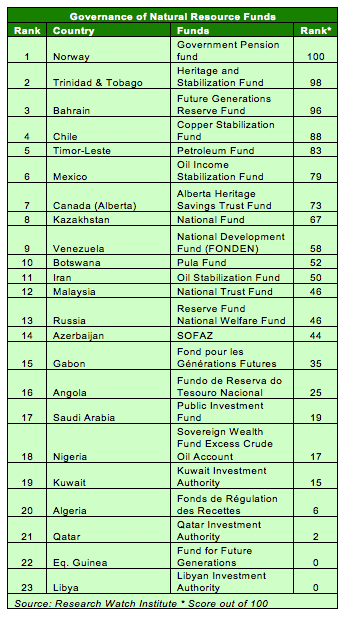
Kuwaiti, Algerian and Saudi funds failed to meet the institutes criteria of transparency. However, the outlier was Bahrains Future Generation Reserve Fund, which received a strong 96 points.
Saudi Arabias Aramco the worlds largest producer of oil also got fair-to-middling grade for its management and governance. RWI ranked Aramco at 21st in a separate survey of 45 state-owned resource companies.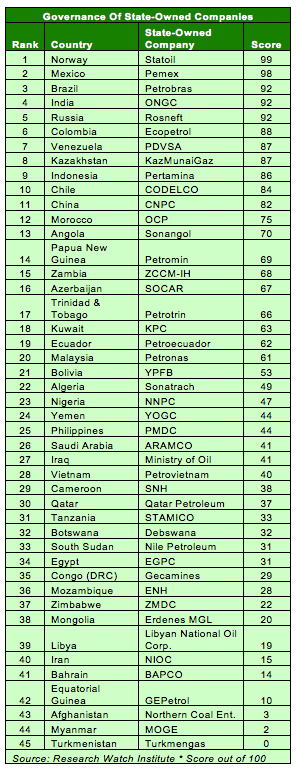
Why manage resources?
The 58 countries depend heavily on their natural resources and the management of their riches directly impacts their ability to meet the needs of their people.
But the institutes study shows a striking governance deficit in natural resource management worldwide.
Often, countries dont negotiate properly with mineral and energy companies, and in some cases revenues dont end up in the government coffers.
Too often, governments keep citizens and civil society leaders in the dark regarding government contracts and resource revenues, RWI said. This opacity deprives the public of a voice or even representation in basic decisions on natural resources.
alifarabia.com 2013