Will Kuwaitis head for the polls rather than take to the streets? The emir certainly hopes so.
November 22, 2012
22 November 2012 Kuwaitis have seen a fair number of elections in recent years, but the one being held on December 1 may turn out to be the most significant for the country's political and economic well-being.
"We believe there could be an improvement in Kuwait's policy environment and government stability with opposition groups boycotting the upcoming parliamentary elections, to be held on 1 December," wrote Monica Malik, analyst at EFG-Hermes.
Certainly, the Kuwaiti Emir is hoping that his citizens will head to the polls rather than take to the streets.
"It is a great tragedy to have calls to take to the street," the Emir Sheikh Sabah Al-Ahmad al-Sabah said in a statement to news ageny KUNA. "Why the chaos and riots? Why the screaming and wailing and disrupting the business of the state and harming the interests of the people?"
Clearly much is at stake.
Kuwait has been rocked in recent months by protests that have taken a more menacing turn. Opposition groups have been emboldened and many are planning to boycott the latest elections.
Fitch Ratings warns that a "worsening political climate could hit economic performance in Kuwait."
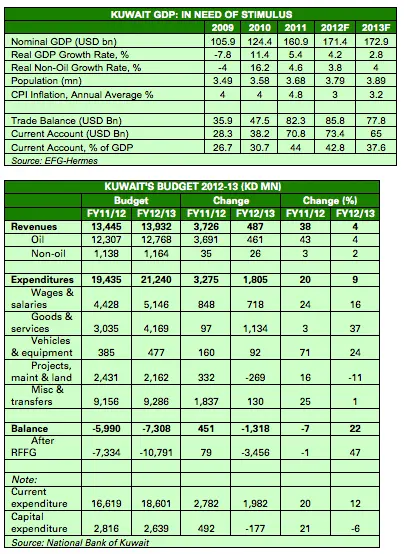
Kuwait has been the laggard in the Gulf, with its oil revenues masking a wider economic malaise. Kuwait's non-oil GDP is expected to reach 5.3% this year, according to Barclays Capital, and forecast to grow by 4.6% in 2013.
The latest political tensions were sparked when the Emir issued a decree revamping electoral law which was met with fierce opposition and reportedly the biggest protest in the country's history.
Labelled as the March of Dignity, the protests also saw rare criticism of the ruling family, suggesting some Kuwaiti are extremely frustrated by the country's lack of progress. In turn, the government's aggressive use of tear gas and arrests of opposition figures, also took many observers aback.
The events were set off when the Emir changed an electoral rule whereby Kuwaitis can only vote for one MP in each of the five constituencies, instead of the five they were allowed earlier.
The Emir believes it is his constitutional right but the opposition says it will make it difficult for its candidates to win seats in the parliament.
Another opposition demand is to nominate a non-Sabah as the prime minister, which places the Emir in a very tough position.
"Since 2006, an unruly legislature and contentious civil society have compelled the emir to dissolve his appointed government (dominated by his al-Sabah relations) no fewer than ten times and to hold new legislative elections five times--a stop-and-start cycle of street protests and royal concessions that continued during the Arab Spring," wrote Sean L. Yom, assistant professor of political science at Temple University and F. Gregory Gause III, professor of political science at the University of Vermont and non-resident senior fellow at the Brookings Doha Center.
"Allowingparliament to name a commoner as prime minister, instead of the currentpractice of the emir appointing a relative, would satisfy a wide swath ofdemocratic activists. But the emir cannot overcome fierce opposition tosuch a step within the royal family. Even lesser moves, such as enhancingpublic transparency, would financially harm untold numbers of Al-Sabah relatives. Here, as elsewhere in the Gulf, the same blood ties thatunite a regime around a monarch now form a serious obstacle to reform."