The UAE and Saudi Arabia are set to join their Gulf peer Qatar in participating in the shale oil and gas revolution unfolding in North America.
In January, Sabic - the Middle East's largest company by market capitalization and one of the world's biggest petrochemical producers - said it intends to invest in shale gas in the United States.
"We're currently in talks with a few big names in the US for investment in shale gas. We expect to enter the market sometime this year. This will be great for SABIC and will globalize our operations," chief executive Mohamed Al-Mady told Thomson Reuters recently.
A senior UAE official echoed that sentiment, noting that the country could consider following China, Japan and South Korea in investing in Canadian and American shale gas assets.
"We may follow the same trend of considering investments in the United States and Canada to bring some of that gas back home," UAE oil minister Suhail bin Mohammed Al-Mazroui told a conference in London.
The comments by officials of two of the world's largest hydrocarbon producers underscore the Middle East's changing attitudes towards North American energy renaissance.
Until recently, OPEC producers were dismissive of North American companies' revolutionary hydraulic fracturing and horizontal drilling techniques that had unlocked huge pockets of natural gas and crude oil reserves in the continent.
SHIFTING ENERGY TRADING TRENDS
But North America's energy sector is already disrupting global energy markets, and changing trading patterns.
The Energy Information Administration (EIA), the US Department of Energy' statistical arm, estimates that the United States and Canada together are expected to account for almost 70% of total non-OPEC supply growth in 2014.
"Forecast production increases from an estimated 7.5 million bpd in 2013 to 8.5 million bpd in 2014 and 9.3 million bpd in 2015. The highest historical annual average US production level was 9.6 million bpd in 1970," said the EIA in its January report. US production stood just under 6 million bpd in early 2000.
The country's crude oil imports have also fallen from 60% of total demand in 2005 to 33% at the end of 2013. Indeed, US oil producers are now calling for the scrapping of a crude oil export ban from the United States which was put in place at the height of the Arab oil embargo in the 1970s, as the US feared running out of oil.
Meanwhile, natural gas production in the United States had soared to 70 bcf by November last year, leading to a dozen LNG project proposals from the Gulf Coast.
"[US] LNG imports have declined over the past several years because higher prices in Europe and Asia are more attractive to sellers than the relatively low prices in the United States," the EIA said. "Several companies are planning to build liquefaction capacity to export LNG from the United States. The first of the new facilities to liquefy gas produced in the lower-48 states for export is expected to partially come online in the fourth quarter of 2015.
The production surge has had its consequences. American oil benchmark West Texas Intermediate has been trading at a USD 15-10 per barrel discount to Brent crude for a few years now.
Meanwhile, natural gas prices in North America trade around USD 3-5 per million British thermal units (Btu) compared to USD 11 per mBtu in Europe and around USD 17 in Asian countries such as Japan.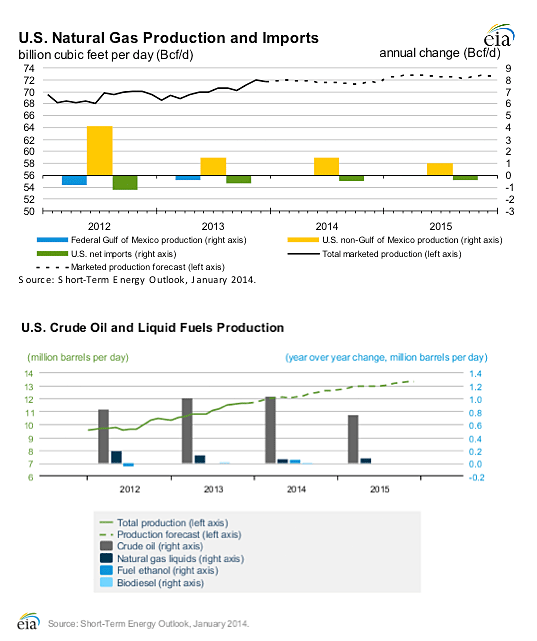
INVESTING IN NORTH AMERICA
As oil and natural gas prices slide, many North American producers are shedding non-core assets. Royal Dutch Shell recently said it plans to dispose its US shale gas assets, while other companies including ConocoPhillips and Chevron in the United States, and Talisman Energy and Devon in Canada are looking to shed their assets.
Middle East investors looking for North American assets may be spoilt for choice.
The United States' energy sector was the most active in the world for mergers and acquisitions, accounting for 31% of total M&A last year, according to management consultants EY (formerly known as Ernst & Young).
"In general, 2013 was characterized by a fairly steady flow of US oil and gas M&A activity in each of the first three quarters of the year with a drop-off in the fourth quarter," EY said in a report.
In the US, the Eagle Ford shale basin saw USD 8.8 billion of deals, while unconventional Permian (USD 7.5 billion), Rockies conventional (USD 5.5 billion), Gulf of Mexico shelf (USD 4.2 billion) and Bakken (USD 2.9 billion) basins, were all in high demand, according to PLS Inc., a Houston-based research house.
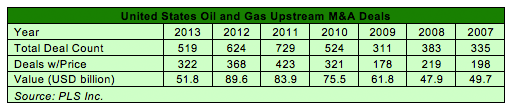
"This compares to a 2012 ranking led by the unconventional Permian USD 7.7
billion) followed by the deepwater Gulf (USD 7.2 billion), the Bakken (USD 7.0 billion), the Gulf of Mexico shelf (USD 6.3 billion) and the conventional Permian (USD 5.6 billion)," PLS said.
Canadian transaction activity was down 32% from the year before, but that's primarily because of two major deals struck in 2012, namely the USD 15.1 billion CNOOC Ltd's acquisition of Nexen Inc. and USD 5.8 billion purchase by Malaysia's Petronas of Alberta-based Progress Energy Resources.
But China's outright purchase of Alberta-based Nexen raised fears of control by state-owned enterprises in Canada, and since then the government has enforced stricter policies around oil sands development.
Indeed, Kuwait Oil Corporation was reportedly in talks with troubled Athabasca Oil Corp., but the plans were scuttled amid a backlash against sovereign wealth funds of non-western states.
COURTING FOREIGN INVESTORS
Canada has been far more welcoming of foreign investor control in its nascent LNG sector. Some of the biggest LNG projects on the country's West Coast are being planned by Malaysia's Petronas, Anglo-Dutch company Shell, American giant Chevron and China's CNOOC.
While some of the projects have secured export licenses, a final investment decision has not been taken on any of them by the project sponsors.
While the North American energy renaissance has turned the industry on its head, companies are still grappling to understand its true significance.
"It is still difficult to fully comprehend the massive impact unconventional technology is having on the industry," Andy Brogan, EY's Global Oil and Gas Transaction Advisory Services Leader, said in a report published in January.
"From a breaking of the previous decade's consensus on oil price trajectory, to the ongoing debate about the viability of shale gas basins in different parts of the world, to the potential restructuring of the entire global LNG market, its impact is everywhere. As always with new technologies, each wave of innovation will bring with it winners, losers and M&A activity."
The uncertainty has wrong-footed Middle Eastern producers, and they have lagged behind Asian producers who have already poured USD 200 billion in so-called unconventional hydrocarbons - a catch-all phrase for shale oil, shale gas and oil sands - over the past few years.
While they have missed the first wave, Middle East producers are keen to ensure that they are strategic participants in the second wave of M&A.
Private equity investors, which often work in tandem with their Middle East clients, are also getting increasingly active in the Canadian energy space, which could lead to greater ME participation in future energy M&A deals.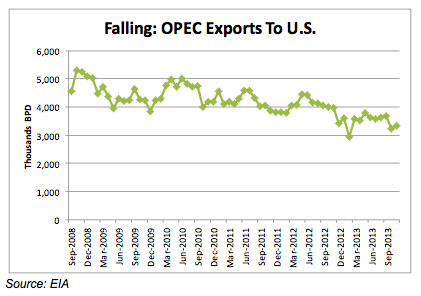
MIDEAST NO STRANGER TO NORTH AMERICA
Middle East energy investors are no stranger to North America's oil and gas sector. Last year, Qatar bought a USD 1 billion stake in Suncor Energy Inc.'s natural gas assets along with UK partner Centrica. Qatar already has plans to ship LNG via its Golden Pass Project from Texas.
Saudi Aramco and Shell are equal partners in Motiva Enterprises, which operates the US's biggest oil refinery, while UAE's Taqa has energy assets in Canada, and Abu Dhabi's International Petroleum Investment Company's own Nova Chemicals - one of Canada's largest petrochemical companies.
Still, the political winds in both the United States and Canada have been blowing differently, especially when it comes to Middle East enterprises. There is a strong focus in North America on achieving the elusive "energy security" in a few years and to wean itself off "foreign oil".
Similarly, Canada is positioning itself as an alternative "ethical oil" producer to the United States - in sharp contrast to what's perceived as "unethical oil" by undemocratic regimes in the Middle East region.
In such a political climate, Middle East investments in North America may suffer a backlash, especially as US environmental groups are already making life difficult for energy-intensive Canadian oil sands and natural gas derived from controversial fracking methods.
If Middle East energy investors can overcome the political challenges, they may be able to pick up stakes in Canadian and US LNG projects and shale plays that may require long-term, patient capital.
The feature was produced by alifarabia.com exclusively for zawya.com.
© Zawya 2014