Although many new pockets of oil and gas reserves are bubbling all over the world, international oil companies consider Iraqi natural resources as one of the most prized assets.
But exploiting these reserves has been a source of great frustration as well.
"Over the past 10 years forecasting Iraqi production levels has, while a central obsession for oil analysts, become something of a moving target," says Paul Horsnell, analyst at Barclays Capital. "The problem has been that, while Iraq has vast reserves, the political and economic ability to develop those reserves has been lacking. That has produced a huge difference between how much extra Iraq could produce if reserves were efficiently exploited, and what extra it can actually produce given the (often self-imposed) constraints."
The Iraqi government needs higher oil revenues to meet its rising spending needs. The country's planning ministry is hoping to spend USD250-billion to USD275-billion over the next five years on infrastructure projects to reduce unemployment which stands at 15%.
"This investment, coupled with high growth in a number of other sectors, has made Iraq an increasingly attractive 'frontier' economy for global investors," said Oxford Analytica in a note to clients.
According to Iraq's Ministry of Construction and Housing, the government has a budget of USD120-billion in 2013, which it hopes to ramp up to USD200-billion by 2015.
Minister Mohammed Darraji says the government is working on projects worth USD10-billion over the next five years, USD4-billion to develop a highway connecting the south of Iraq with the middle and USD37-billion of infrastructure projects focused on power generation, sewage, education, housing and healthcare.
"Due to ongoing business trends and the transition to a market economy after 2003, Iraq has seen significant changes to regulations and the governing of economic activities," said Mr. Darraji in a statement. "The new laws to promote fresh investment and drive economic growth are currently being implemented, and this transition will promote the rapid restructuring of our economy."
But there is a long way to realise these projects and much of the financing depends on the success of the country's oil and gas sector which has helped the economy but has yet to realise its full potential.
IEA Estimates
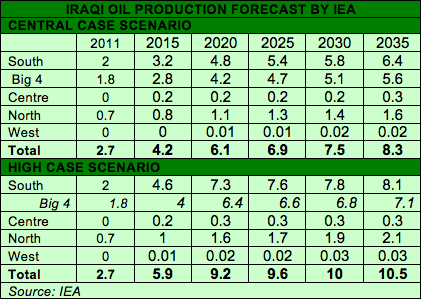
The International Energy Agency estimates that Iraq could double its existing production to 6.1-million barrels per day by 2020, in its central, or likely, case scenario.
In a high-case scenario, if all the various moving parts are aligned perfectly, it could crank up production to 9.1 million barrels per day by the end of this decade.
In a delayed case - which also is unlikely but could occur if the regional environment deteriorates and Iraq is engulfed in a larger regional conflict or oil prices crash - would see production rise marginally to 4-million bpd by 2020.
The central, more likely, case scenario, would assume investments of USD530-billion, equal to more than 10% of the projected revenue from oil and gas exports.
"The annual investment need is highest in the current decade, at more than USD25-billion per year on average, a significant step up from the estimated USD9-billion invested in Iraq's energy sector in 2011," said the IEA in a report published in October. "The anticipated increase could be at risk if the government's efforts to modernise and reform Iraq's legal framework and institutions are delayed or frustrated, or if fluctuations in prices and oil revenue feed through into irregular capital spending."
The country could generate around USD200-billion each year, or USD5-trillion till 2035 on these investments at an average price of USD115 per barrel.
While nobody denies the potential of Iraq's oil and gas reserves, it is the execution which has been often called into question. Iraq suffers from poor infrastructure, lack of logistical and transportation structures, and a number of other factors such as availability of skilled professionals to make it happen.
Achieving the required level of oil production and export will require rapid, co‐ordinated progress all along the energy supply chain, notes the IEA.
"Adequate rigs will need to be available at the right time. Early investment in a challenging project to bring up to 8 million bpd of water inland from the Gulf to Iraq's southern fields will be essential to support oil production and to reduce potential stress on scarce freshwater resources.
"Sufficient oil storage and transportation capacity will be needed to accommodate the expansion in output and diminish the risk of over‐reliance on the southern sea‐borne route. The infrastructure and investment requirements in our High Case, which anticipates oil production of 9.2 mb/d already in 2020, are even more demanding."
The Iraqi government, however, is sticking to its ambitious plan of producing 10 million barrels per day.
"Iraq is in a position to supply about half of global oil demand growth," Shahristani said at a conference in Baghdad according to media reports.
"The conclusions of our studies, and those of independent consultants engaged in the ministry of oil, are that it is feasible and desirable for Iraq to raise its oil production to about nine to 10 million barrels per day by 2020. And Iraq can sustain that production for at least 20 years."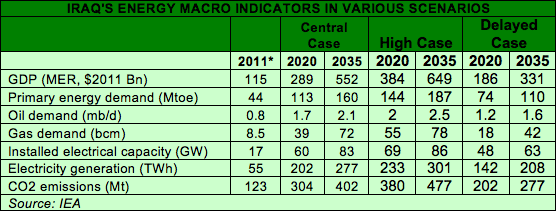
PASSING THE LAW
A pending hydrocarbons law has added uncertainty to the country's legal framework, making it harder for foreign companies to assess the investment environment in the country.
Foreign oil companies account for 70% of the country's oil and gas production, so reform of domestic laws is crucial in attracting precious foreign investment in the country.
"The delay in passing new hydrocarbon laws means that for the moment a federal system of resource development (based on technical service contracts) co-exists uneasily with the approach followed by the Kurdistan Regional Government (based on production-sharing contracts consistent with its own legislation from 2007), whose legitimacy has been contested by the federal government."
The autonomous Kurdistan Regional Government (KRG) greatly angered the federal government by signing agreements with ExxonMobil. Baghdad insists that it should have the final say in all hydrocarbon deals and any contract signed with the semi-autonomous Kurdistan Regional Government (KRG) will considered illegal under Iraqi law.
Since then Russia's Gazprom has bought rights to explore two blocks for $26-million in Kurdistan, according to news agency Interfax. The company estimates the two blocks collectively contain 3.6-billion barrels of crude.
Meanwhile, Total announced the signature of a farm-in agreement in two exploration blocks in Kurdistan Region of Iraq, which were previously held by Marathon Oil. Total will develop the blocks, which cover areas of respectively 705 and 424 square kilometres.
U.S. giant Chevron Corp. also purchased two blocks worth USD200-million with Indian oil giant Reliance for Sarta and Rovi blocks in Kurdistan.
Oil companies are drawn to KRG for its more inviting terms and agreements and relative stability. Within Iraq, KRG has emerged as a small but lucrative pocket of growth.
After the initial fallout, the KRG and the federal government appear to be working their way through their problems. As a goodwill gesture, Iraq has reportedly made payments of USD650-million for oil companies operating in the region, and KRG has pledged to resume exports, which it had stopped since April.
"After approaches made by friends of Iraq in political and diplomatic circles, the KRG has decided to resume exports from the Region to build confidence with the federal government with the purpose of squaring up all the oil and gas issues in Iraq," said KRG Minister of Natural Resources, Dr Ashti Hawrami, in a statement.
Some of the key issues that separates the two parties include the settling of outstanding export payments and committing to regular payments for future exports; restoring the supply of refined products to the Kurdistan Region; payment of the KRG petrodollar (a sum allocated federally to the producing governorates per barrel of oil produced by them); and the settlement of outstanding fuel import costs for power generation in the region.
In addition, the KRG is also reportedly received nearly 150,000 barrels of oil products each year.
Since then oil exports from KRG touched 170,000 bpd and could reach 200,000 soon according to the autonomous region's oil minister. That figure could rise to 250,000 bpd next year, if the federal government and KRG continue to move forward in resolving their dispute.
Apart from KRG, Iraq also has huge gas reserves which can be exported to markets across the region and the European Union. It would also help Iraq in replacing its own oil consumption as it switches to the cheaper natural gas powered plants.
"When one looks at the reserves alone and the contracts signed, one thinks in terms of rapid development of millions of extra barrels," said BarCap's Mr. Horsnell. "However, when one looks at the political backdrop and the performance of contracts to date, it seems an amazing achievement for Iraq to get any increase in output at all."
CONCLUSION
There is a lot riding on Iraq fulfilling its massive oil and gas production potential. While a steady and sustained ramp up in production would generate wealth for the beleaguered citizenry which has been ravaged by decades of war and conflict, the country could also emerge as a stable force in the midst of various instable regimes.
Equally important is Iraqi oil's impact on global markets. Its efforts to rival Saudi oil output will see a new dynamic emerging in OPEC, but also provide much need stability in oil output in world markets.
"Success in developing Iraq's hydrocarbon potential and effective management of the resulting revenues can fuel Iraq's social and economic development," said the IEA. "Failure will hinder Iraq's recovery and put global energy markets on course for troubled waters."
© alifarabia.com 2012