The Middle East is the only region that saw its High Net Worth Individuals' (HNWI) combined investable wealth rise in 2011, according to management consultants Capgemini, in their World Wealth Report 2012.
"That's right, the marginal wealth increase was mainly GDP growth related which was related to oil as the wealth increase was marginal," Mary-Ellen Harn, manager, financial services global business unit at Capgemini, told Alifarabia.com.
Even though the Middle East remained vulnerable to protests and demonstrations after the Arab Spring unleashed a wave of revolution, geopolitical tension in the region has helped to keep oil prices high, despite the slowdown in global economic growth.
However, the UAE witnessed a 3.7% HNWI numbers thinned due to the real estate crisis in Dubai and the impact of other factors such as the Eurozone meltdown, notes Capgemini.
The Middle East also had 4,000 ultra-HNWIs in 2011, making up 0.9% of the global HNWI population. The overall size of the HNWI population in the Middle East rose 2.7% to 0.45 million, and wealth edged up 0.7% to USD1.7-trillion.
However, other regions saw a larger increase in the number of new HNWIs. Led by Brazil, Latin America saw a 5.4% increase, while African HNWIs numbers also rose 3.9%, although from a much smaller base.
HNWIs are defined as investors with USD1-million or more at their disposal for investing. In addition, Capgemini also divided HNWIs into three wealth bands: those with USD1-million to USD5-million in investable assets; those with USD5-million to USD30-million and those with USD30-million or more (ultra-HNWIs).
Capgemini's data on Middle East millionaires is vastly different from that of Credit Suisse, which estimates around 146,000 millionaires currently residing in the region.
The Swiss bank expects the Middle East to add 109,000 new millionaires over the next five years to reach 255,000 millionaires.
Still, both reports do point to rising wealth in the region.
Read Credit Suisse Report Here: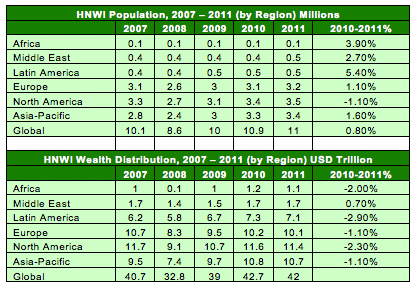
GLOBAL PICTURE DARKENS
The Middle East's rising investable wealth is in sharp contrast to the rest of the world, which declined 1.7%.
"After witnessing robust growth of 8.3% in 2010 and 17.1% in 2009, global HNWI population grew marginally by 0.8% to 11.0 million in 2011," notes Capgemini. "Most of this growth can be attributed to HNWIs in the $1-5 million wealth band which grew 1.1% and represents 90% of the global HNWI population."
HNWIs' aggregate investable wealth (as measured by asset values) declined 1.7% -- the second drop in the last four years. Investable wealth had gained 9.7% and 18.9% respectively in 2010 and 2009, when there had been a significant rebound from the hefty crisis-related losses of 2008.
In 2011, however, global HNWI investable wealth contracted to USD42-trillion amid high volatility in global markets and challenging macroeconomic conditions.
RISE OF ASIA
In another example of wealth shifting east, Asia-Pacific is now home to more HNWIs than North America. Asia-Pacific has 3.37 millionaires, compared to 3.3 millionaires in North America and 3.17 million in Europe.
While the United States, Japan, and Germany still account for 53.3% of the world's HNWI population in 2011, their share has been eroding very gradually (it was 54.7% in 2006) as the HNWI populations of emerging and developing markets, especially those in Asia-Pacific, continue to grow faster than those of developed markets.
However, Asia-Pacific HNWIs fell 1.9% to USD10.7-trillion, let down by a dramatic drop in the number of well-heeled investors in Hong Kong and India.
"Indian equity-market capitalization dropped 33.4% in 2011, after a gain of 24.9% in 2010," states Capgemini. "That decline, and domestic factors such as increasing budget/ fiscal deficit, contributed to a significant drop in India's HNWI population."
EU CRISIS? WHAT EU CRISIS?
Despite a crippling crisis, the number of HNWIs in Europe rose by 1.1% to 3.17 million, thanks to growing wealth in Russia, the Netherlands, and Switzerland. Germany, the EU stalwart, also saw a 3% rise in HNWIs, while the United Kingdom saw an almost equal decline, mirroring the contrasting economic performance of the two EU powerhouses.
Aggregate wealth of European HNWIs declined 1.1% to USD10.1 trillion, as Eurozone jitters made HNWIs in the continent more cautious and risk-averse in their investing strategies.
While the wealth is shifting east, the United States continues to be home to the largest number of HNWIs, with three million rich folk. Japan is a distant second with 1.8 million millionaires, and Germany is third with 950 millionaires. China is fourth with 562,000 millionaires.
CAPGEMINI'S ADVISE TO THE RICH
The rich may be different from you and me, as Scott Fitzgerald would say, but they have to keep a keen eye on fast-developing changes across the world, just like the rest of us.
Here are some gems from Capgemini:
Watch Europe: The story of the year so far. Investors are troubled by the lack of a clear path charting EU's economic health. Capgemini notes that wages in EU will need to drop for the region to remain competitive.
"Investors also need to understand there is no panacea for Europe's problems, which could take years to resolve, and could feature additional debt writedowns for the likes of Greece and Portugal."
U.S Fiscal Cliff: The 'fiscal cliff' in the U.S., so-called because of the tax cuts that are expected at the end of 2012, is a drag on investment. The U.S. Presidential election in November also makes it an increasingly tough investing environment.
"Arguably more important than the victor, is whether politicians will find a way to cooperate after the elections to address the near-term economic threat and the long-term need for fiscal austerity," notes Capgemini, adding that housing market remains a drag.
All About China: Investors are optimistic that China will keep a firm hand on the growth lever without letting inflation get out of control. Japan will also need to navigate through a tough investing environment.
Resource-Rich Latin America: South America is on solid footing because of its resources riches, but don't expect its stock markets to recoup its losses, especially as Europe continues to slow down.
Hopes For 2013: Capgemini expects many countries to show healthier growth rates by next year. However, those rates will still be very modest in developed nations, which still face a vicious cycle of high debt, austerity measures, and low investment in infrastructure.
Emerging Market Trade Corridor: With disappointing export flows to Europe and North America, emerging markets are finding growth avenues by trading with each other.
"To facilitate such trade, the development banks of Brazil, Russia, India, China, and South Africa (BRICS) signed two pacts in early-2012 meant to provide credit facilities in local currency and enable easier confirmation of multilateral letters of credit," states Capgemini.
© alifarabia.com 2012