The Middle East North Africa region welcomed 100 new ultra high networth individuals, as the region's nearly 5,000-richest individuals avoided the worst of the global economic crisis and regional turmoil, according to Wealth-X, a Singapore-based wealth consultancy.
There are a total of 4,950 UHNW individuals in the region, with a total net worth of USD732-billion. However, the combined wealth of the Middle East UHNW population saw a decrease of 1.3%, the consultancy noted.
UNHWs are individuals with more than USD30-million in investible assets, according to the consultancy.
Wealth-X data shows Saudi Arabia led the region with 1,265 UNHWs, gaining 30 new individuals in the year, as high oil prices and record crude production, combined with a USD130-billion stimulus package opened a bonanza of opportunities for the country's wealthiest businessmen and entrepreneurs.
There are 810 ultra-high net worth (UHNW) in the UAE and 300 in Qatar. Within that group of 810 of the UAE's richest, there are 35 billionaires. On average, these billionaires are worth USD1.1 billion each.
"The UHNW population in the UAE expanded by 4.5% and total wealth of the ultra affluent declined slightly by 1.4% to reach USD120-billion," the report noted.
Meanwhile, there are 20 Qatari billionaires. Wealth-X estimates that the UHNW population in Qatar expanded by 3.4% although total wealth of the ultra affluent contracted by 2.2% to reach USD45-billion. The country lost 10 UNHWs during the year.
In June, Capgemini's annual report on the world's richest individuals estimated that the Middle East had 4,000 ultra-high net worth individuals (HNWI) in 2011, making up 0.9% of the global HNWI population. The overall size of the HNWI population in the Middle East rose 2.7% to 450,000, and wealth edged up 0.7% to USD1.7-trillion. HNWI are individuals with investible assets of more than USD1-million.
Capgemini's data on Middle East millionaires was vastly different from that of Credit Suisse, which estimates around 146,000 millionaires currently residing in the region. The Swiss bank expects the Middle East to add 109,000 new millionaires over the next five years to reach 255,000 millionaires.
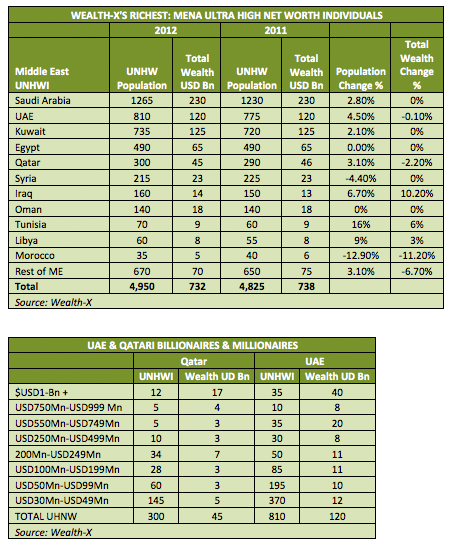
Interestingly, Syria is estimated to have at least 215 UNHWs, compared to 225 last year. The figure may soon be far worse as the political and economic situation in the country deteriorates.
Notably, Iraq has 160 UNHWs, which shows the latent potential of the country even though it is just getting started. The country recorded the fastest rate of UNHW population growth of 6.7%, according to the research.
The survey also shows that Egypt has 490 billionaires with a combined wealth of
USD65-billion, unchanged from last year.
Meanwhile, Tunisia added 10 new UNHW and Libya 5, as the two countries celebrated their new-found freedoms under democratic setups.
WORLD'S RICHEST
Wealth-X estimates that the world's UNHW population grew by a paltry 0.6%, although their combined wealth grew by 9.4%.
Data shows that while it was tough to break into the richest club, existing members found ways to generate even more wealth.
This chimes with the common theme that the world's richest are getting even richer, while the less well-off are finding it harder to create wealth. Wealth-X estimates that 2,160 billionaires this year who generated wealth of USD6,190-billion, compared to 1,975 last year who were worth USD5,430-billion - an astonishing 14% increase in their wealth.
Meanwhile, the lowest tier of the UNHW group of USD30-million to USD49-million grew by a mere 0.4% and increased their wealth by 0.6%.
This is especially true in the United States where President Barack Obama is fighting for the middle-class against challenger Mitt Romney who believes the wealthy need more tax breaks to create jobs.
"America's ultra affluent segment is growing at a rate that is faster than projected GDP for the country, boosted in part by the performance of equity markets," the report notes. "The wealth of the nation's richest expanded at a pace that outstripped the increase in UHNW population.. Despite the weakness in global markets and the tepid recovery within the U.S., the American UHNW market is one that captures attention. The number of billionaires in the country grew by 5.5% against a backdrop of resentment against the rich and those perceived to have exploited loopholes in the banking system, resulting in major protests and movements that spread round the world."
While America's richest extended their wealth even if the U.S. economy stuttered, China's richest did not share their country's impressive growth.
The Middle Kingdom reportedly lost nearly 265 UNHWs, and saw the wealth of the 11,245 richest Chinese contract by nearly 7%.
Japan, which is home to the largest concentration of rich individuals in Asia, also saw the combined wealth of its richest shrink by 8.6%.
Overall, Asia's population of UNHW declined by 2.1% and their combined wealth declined by nearly 7% during the year.
If Asia suffered, Europe was in a downward spiralled as the euro's debt crisis eroded wealth.
The European continent is home to 53,441 UHNW individuals with a combined net worth of close to USD7-trillion, but 1,054 individuals left the ranks of the ultra wealthy as the economy imploded last year.
Europe saw a 1.9% reduction in its ultra wealthy population.
"Spain, France and Italy suffered the largest absolute drop in terms of UHNW population. In contrast, Luxembourg and Denmark showed strong growth in UHNW populations, underlining the strength of Scandinavian countries in the region. Total wealth for the region declined by USD190 billion or 2.7%," the report concluded.
© alifarabia.com 2012