The Middle East will need to implement its own employment miracle to overcome double-digit unemployment rates.
"MENA countries that are on the hunt for employment miracles, defined by the World Bank as large and sustained reductions in unemployment, should invest in prudent macroeconomic management, sound business regulation and good governance, and associated improvements in regulatory frameworks and their enforcement," said the World Bank in its latest report on Arab economies.
Middle East and North Africa has youth unemployment rates exceeding 25%, far exceeding OECD rates of just under 19% -- and twice the world average.
"Unemployment, in particular among young people, is incontestably the main challenge facing Arab countries," the bank said.
However, if countries can transform into knowledge economy, it could create jobs for as many of 1.5 million people in Egypt, and 700,000 in Saudi Arabia, according to World Bank estimates.
Unemployment was a key instigator of violence and revolution during the Arab Spring that has swept the region since 2011, and the bank believes as young people clamor for jobs, a return of the same tensions is likely, especially as the regional population is growing at 1.5%.
In countries like Jordan, Algeria, Syria, Yemen and Bahrain, tensions continue to simmer partly driven by young people unable to find opportunities.
PRIVATE SECTOR PARTICIPATION
The employment miracle will have to come from the private sector. And even though the private sector is playing an increasingly greater role, it is nowhere near what it needs to be to make a dent in the unemployment numbers.
"Private investment has stagnated at less than 15% of GDP, insufficient to create the necessary jobs. Foreign investment had picked up significantly before the current downturn, but it was concentrated in energy, infrastructure, and real estate, with little investment in technology-intensive ventures."
Some regional governments have resorted to inducting the restless youth into their armed forces and the public sector, but that has done little to improve productivity levels and has inflated the government's wage bills.
Many Middle East countries have loaded their public sector with citizens in a bid to buy the peace. In Saudi Arabia more than 40% of employment is in the public sector, while Jordan, Algeria, Iraq and Kuwait public sector accounts for more than 30% of jobs.
In sharp contrast, public sector employment accounts for only 6% jobs in Indonesia, and between 12-20% in Turkey, Mexico and Brazil.
Corruption, policy uncertainty and lack of accountability of the authorities has also edged out the Middle East private sector and left governments as the dominant economic driver.
In many cases, government entities compete with the private sector, leading to a conflict of interest and rules and regulations skewed against private and foreign businesses.
A NEW ECONOMIC MODEL
Clearly the old model is not working. Even rich countries such as Saudi Arabia and Kuwait are facing social tensions from disaffected youth eager to participate in the social processes of the country and being active economic and social participants in their own countries.
"Although Arab countries differ widely in their political systems and practices, many governments now feel the need to adjust and redefine the rules of the game," the bank said. "The business community, historically not inclined to support reforms, may now be easing its claim to privileged access to markets and investments."
Despite their affluence, resource-exporting countries are in greater trouble than oil-importers who have been forced to be more productive to compete in the international world.
While countries like Egypt, Jordan and Lebanon have diversified trade ties with the wider world, resource rich countries are limited to exporting resources.
"Yet, Arab countries also must achieve greater diversification of their economies and improve their international competitiveness, particularly as rapidly growing trade in services could well result in a massive international migration of white-collar jobs, amplifying the risk of a global competition for jobs, especially good ones," said the bank.
As many Middle East countries are dependent on natural resources, water scarcity and climate change issues not only threaten the resources industry, but also the tourism sector.
"To address those threats and raise the productivity of natural assets (especially water), technology diffusion and innovation efforts will be required. That requirement is both an imperative and an opportunity for the region, where green energy remains underdeveloped, despite its huge growth potential," the bank said.
TURNING GREEN
Countries like Saudi Arabia and UAE are moving towards renewable energy to generate employment, and free their hydrocarbon resources for exports.
Taking advantage of this sector will require massive investments in skills, research and development (R&D) and clustering. Investing in green growth strategies could also contribute significantly to job creation in the region, the bank notes.
Finally, investment in knowledge could be a game changer that will generate employment. However, the mismatch of jobs needs and skillsets on offer has created a situation of disappointing both among the population and the business community.
If countries can overcome these issues and improve their Knowledge Economic Index even by 1% point the bank estimates it could unlock hundreds of thousands of growth.
"Tunisia would lead to some 300,000 new jobs, in Egypt to about 1.5 million new jobs, and in Saudi Arabia to some 700,000 new jobs (in addition to the jobs generated by pursuing current trends). Success in that endeavor would make a major contribution to shrinking the job problem, even if it would not eliminate it altogether."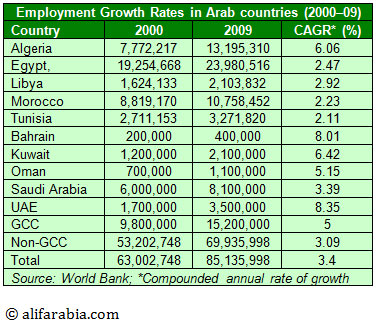
© alifarabia.com 2013