The number of foreign direct investment (FDI) projects into the Middle East and Africa (MEA) declined by 11.78% in 2012 to 1,370 projects, according to industry barometer, fDI Intelligence. Capital investment in the region fell by an estimated 43.31% and job creation by an estimated 23.32%, as the region saw tremendous volatility.
However, there are some bright spots.
"The number of FDI projects attracted by Oman increased by 48.98% and its market share of inward FDI in the region increased from 3.16% in 2011 to 5.33% in 2012," said fDI Intelligence.
"Egypt and Nigeria also experienced an increase in project numbers by 20% in 2012. Egypt experienced a large increase in capital investment in the country, rising by 64.67%. South Africa's market share of FDI into the region also increased to more than 10% in 2012."
South Africa saw the largest numbers of FDI projects in the African continent last year, at 147, but it was 5% less than the 2011 figure.
South Africa was also the largest African source of outward FDI, with investments rising 23.38%, as the country's corporations started to spread their reach across their immediate boundaries.
African intra-investment has risen 32.5% annually since 2007, according to data from global services provider, Ernst & Young (E&Y).
"South Africa has been at the forefront of growth in intra-African and broader emerging market investment and was, notably, the single largest investor in FDI projects in Africa outside South Africa itself in 2012," E&Y said.
"This underlines a broader trend of growing confidence and optimism among Africans themselves about the continent's progress and future."
South African banks have led the way, with a spate of pan-African investments and branch openings that have helped cultivate a more regional profile. However, blue-chip companies in other sectors are also going regional.
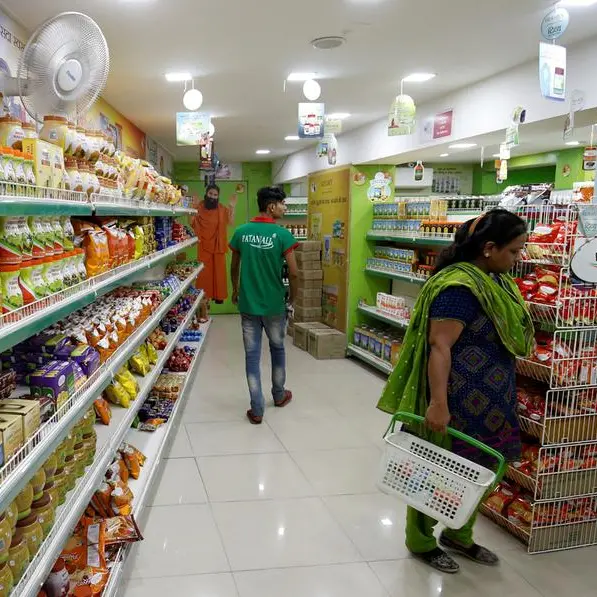
Shoprite, South Africa's largest grocer, is building on its regional strength and opening 47 new supermarkets across Africa, with the majority in Nigeria and Angola.
However, a recent report by the United Nations Conference On Trade and Development (UNCTAD) decried the lack of intra-trade in the region, which it believes is hampering organic development of the continent's economy.
UNCTAD's latest report on Africa trade notes that intra-African trade has fallen from 22.4% in 1997 to 11.3% in 2011.
"Over the 2007-2011 period, the average share of intra-regional exports in total exports was 11% in Africa, compared with 50% in Asia and 70% in Europe," UNCTAD reported.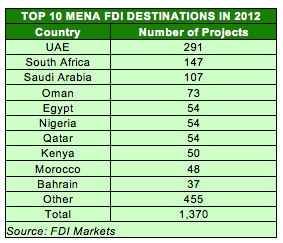
While North Africa and Middle East troubles may have dampened the region's FDI figures, Sub-Saharan Africa is making a huge effort to attract investments.
Kenya and China recently signed multi-lateral deals encompassing infrastructure and financial services for USD 5 billion in investments.
More crucially for Africa, the investments are moving away from the mining and hydrocarbons industries.
"In 2007, extractive activities represented 8.1% of FDI projects and 26.1% of capital invested in Africa. In 2012, it was a mere 1.8% of projects and 12% of capital," noted E&Y.
"In comparison, services accounted for 70.2% of projects in 2012 (up from 45.2% in 2007) and manufacturing activities accounted for 43.1% of capital invested in 2012 (up from 22.4% in 2007)."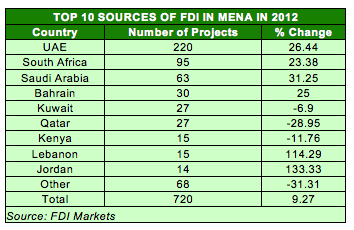
Indeed, fDI Intelligence says business and financial services accounted for 468 of the 1,370 projects - or roughly a third of all foreign investments in the region last year.
This was followed by 226 projects in the information, communication and technology space, while 91 projects were focused on industrial machinery.
"The life sciences sector saw the largest increase in project numbers in MEA in 2012, with FDI projects increasing by 34.09%, although the sector's market share of FDI in MEA remains low," said fDI Intelligence. "FDI in the transportation, warehouse and storage sector experienced strong growth in 2012, with project numbers increasing to 73, a 21.67% increase from 2011."
GLOBAL TRENDS
Global investment trends suggest we will be in a slow-go environment for some time as a number of global mining companies retrench. This would especially hurt African countries. In addition, European companies continue to repair their balance sheets before they can embark on another round of investments.
In addition, news from China, India and Brazil - key investors in Africa - is far from promising, suggesting that there might be a lull before investment patterns tick up again.
"In terms of our FDI forecast for 2013, the picture is pretty grim," said fDI Investment. "World economic growth is expected to slow in 2013 and, with continued political and economic uncertainty around the world, a substantial decline in FDI can be expected in 2013 of the magnitude of 20%."
© alifarabia.com 2013