Saudi Arabia has one of the world's highest concentrations of large companies, according to McKinsey & Company.
The country is ranked 14th in the headquarters density (HQD) index, according to McKinsey, which calculated the ratio of the sum of global consolidated revenue of all large companies headquartered in a jurisdiction compared to the country's GDP.
Riyadh city alone is home to 19 large companies with revenues of more than USD 1 billion a year, making it the Middle East's powerhouse.
"HQD enables us to compare the density of global consolidated revenue of large companies based in the nation relative to the size of the economy and to make comparisons between regions," McKinsey said in a report on the rise of large companies in emerging economies.
Saudi Arabia fared better than other countries such as China, Sweden, Denmark.
Switzerland led the HQD ranking, with Netherlands, Hong Kong, Taiwan and Singapore completing the top five.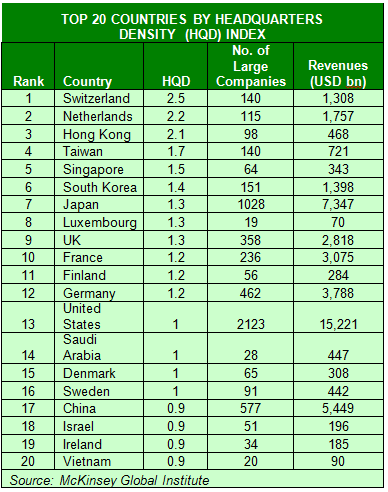
Expect Saudi Arabia and other emerging markets to raise their HQD density, as global businesses make an inexorable shift towards the developing world.
"That's because while three-quarters of the world's 8,000 companies with annual revenue of USD 1 billion or more are today based in developed economies, we forecast that an additional 7,000 could reach that size in little more than a decade--and 70% of them will most likely come from emerging markets," the global management consultancy said.
"To put this dramatic shift in the balance of global corporate power in perspective, remember that many of the world's largest companies have maintained their current status for generations: more than 40% of the 150 Western European companies in last year's Fortune Global 500 had been founded before 1900."
McKinsey's estimates shows that more than 45% of Fortune Global 500 companies will be based in emerging economies by 2025 - up from 5% in 2000.
By 2025, emerging regions are expected to be home to almost 230 companies in the Fortune Global 500, up from 85 in 2010. Roughly 10% or 26 of those companies will come from the Middle East and Africa region, according to estimates.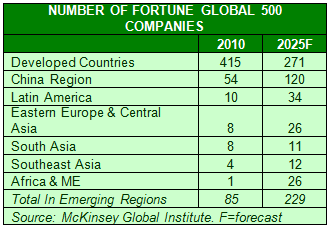
DEVELOPED CITIES REIGN SUPREME - FOR NOW
But at the moment, cities of the developed world are home to some of the world's largest companies.
The McKinsey data shows Tokyo has the biggest concentration of companies that have annual revenues of USD 1 billion a year, with 613 large companies generating USD 5.231 trillion in revenues.
New York is a distant second with 217 companies generating total revenues of USD 1.96 trillion, while London is predictably third with 193 companies amassing USD 1.924 trillion in sales.
Of the top 20 cities with the largest concentration of large companies, only five are from emerging markets - Beijing, Moscow, Hong Kong, Taipei and Singapore.
Around 8,000 large companies worldwide with revenue of USD 1 billion or more, and three out of four are based in developed regions, McKinsey said. That situation will reverse when 7,000 new companies grow to that size by 2025 -- and seven out of 10 of these new entrants are likely to be based in emerging regions.
"In emerging regions, the leading cities for business today are likely to capture a disproportionate share of company growth in the future," McKinsey said. "The number of large companies based in São Paolo, for instance, could more than triple by 2025. Beijing and Istanbul could have more than twice as many head offices as they do today. Yet company headquarters will become more dispersed across the emerging world: about 280 of its up-and-coming cities could host a large company for the first time, thus becoming new hubs in global industry networks."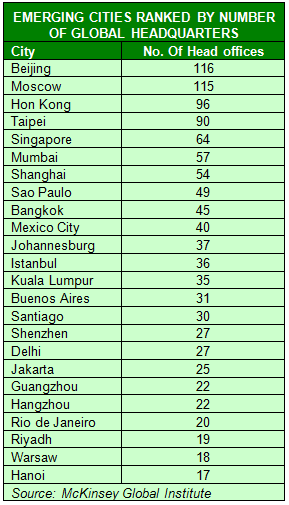
BATTLE OF THE HUBS
As new emerging markets raise their profile, it will be increasingly difficult for existing investment destinations like New York, London and Tokyo to keep their position.
Apart from emerging stalwarts like Beijing, Hong Kong, Singapore and Bombay, a number of other, smaller cities are looking to attract investors.
Places like Riyadh, Doha and Dubai are increasingly competing with Nairobi, Lagos and Johannesburg for the attention of large companies.
The number of large companies that reside in Middle East Africa will rise from 3% currently to 5% by 2025, McKinsey's estimates show.
McKinsey says 850 cities area home to headquarters of large companies, with 20 cities accounting for one-third of all large companies.
"The emergence of thousands of next-generation companies will allow hundreds of new locations to host large companies for the first time by 2025. This presents an opportunity for cities to strengthen their local economic base and capture part of the next great wave of growth, assuming a role as hubs in global industry networks and supply chains."
© alifarabia.com 2013