Jordan's economy is hoping for fresh impetus after a new Cabinet was sworn in on August 21 by the reform-minded government led by prime minister Abdullah Ensour.
The Middle East state's economy has weathered many storms over the years, but the prolonged and escalating civil war in neighboring Syria and political instability in Egypt, Iraq and Lebanon have taken their toll on meager finances.
Domestic social unrest and sporadic street protests have also weighed down the economy and slowed the government's drive to implement austerity measures and painful economic reforms.
The government is looking to address a number of these issues with the new-look 23-member technocratic Cabinet.
The International Monetary Fund (IMF) estimates Jordan's economy grew by 2.8% last year and is projected to grow at 3.5% in 2013. Real GDP rebounded in the first quarter of 2013 after falling for the past four quarters, with construction, transportation and telecommunications sectors registering some growth.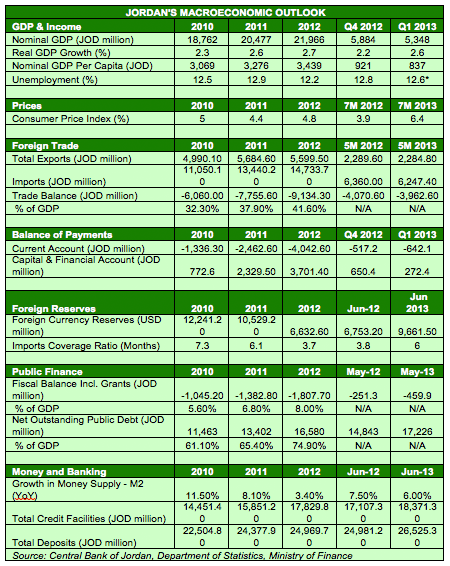
Thanks to foreign grants, the country's budget deficit in the first half of the year fell 26%, compared to the same period last year, according to the Ministry of Finance.
Foreign grants shot up USD 612 million in the first half, compared to USD 35.6 million during the corresponding period last year. If foreign grants are excluded, the budget deficit stood at USD 1.04 billion during the period, compared to USD 624.33 million last year.
To address some of the shortfall, the authorities are reportedly seeking more financing, including a USD 1-1.5 billion Eurobond by the third quarter, the Jordanian government said.
"We fully expect that the programed grants of USD 1,420 million and loans of USD 1,516 million (including the Eurobond) in 2013 will be received in line with discussions with our development partners, who have provided us with financing assurances," the government said in a briefing to the IMF.
ECONOMY HIT ON MANY FRONTS
Signs that the economy has been hit by regional turmoil were evident in tourism revenues which were down to USD 1.88 billion by the end of July, compared to the USD 2.05 billion during the same period last year.
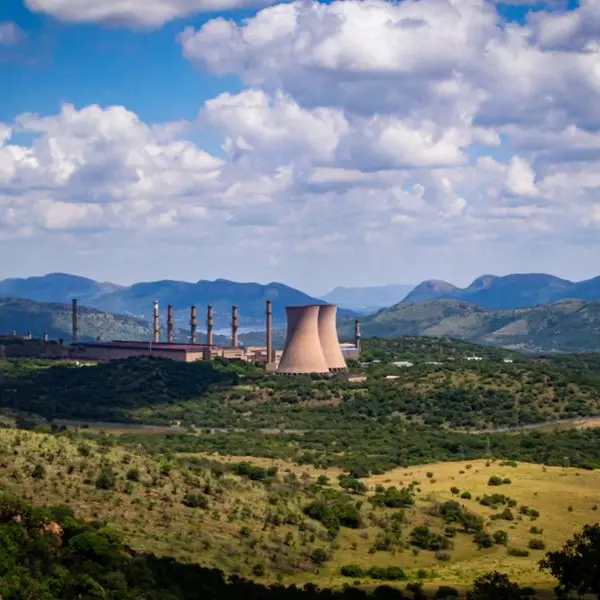
Agriculture and mining have been declining while worker strikes in the potash and phosphate producing plants has added to the economic woes. In addition, the Syrian conflict has hurt the transportation sector and raised the food import bill.
The subdued economic growth and political uncertainty, has hit the private sector, which grew 6.25% last year, down from 9.6% in 2011.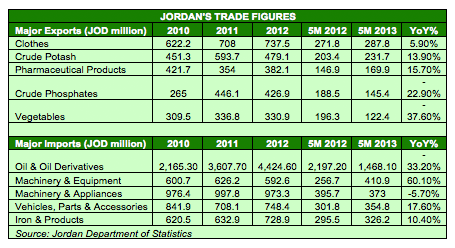
COST OF HOSPITALITY
Another drain on the economy is the influx of Syrian refugees crossing the border.
Jordan's humanitarian effort to manage the Syrian refugee situation is commendable and deserves applause. But spending on the refugee problem now accounts for 0.7% of Jordan's GDP - a figure it can ill-afford.
"The Hashemite Kingdom of Jordan has a tradition of hospitality towards asylum-seekers and refugees, but this favorable environment is under duress as the country confronts its own socio-economic challenges and growing number of refugees," said United Nations High Commissioner For Refugees (UNHCR).
The organization estimates Jordan would accommodate more than 430,000 Syrian refugees by the end of the year if the conflict in that country persists.
While the host country has generously helped the new wave of refugees with shelter, food, water, sanitation and other basic services, "resources of host communities are limited and may be exhausted in the coming months," UNCHR warns.
Donor help will be crucial to ensure that Syrian refugees get adequate support without putting further burden on Jordan.
Despite the external headwinds, the Jordan Investment Board reported that investors injected USD 887 million in the first half of the year, up 21% from last year, with industrial and tourism sector's emerging as the biggest investment magnets.
STRENGTH FROM WITHIN
While Jordan's economy has been hostage to external factors, the authorities can look within to push forward with domestic reforms.
The country has done well over the years to create a knowledge-based economy, but it has not necessarily translated into higher job-creation.
"Jordan has developed a valuable knowledge economy; further reforms are needed for the sector to fulfill its potential, not least in terms of quantity and quality of jobs," said the World Bank in its latest report on the country.
Unemployment stands at 12.5%, and the figure could go higher as young Jordanians enter the structurally-weak economy.
In addition, the country also ranks poorly in the World Bank's Doing Business survey, and is placed at 106th out of 185 countries.
The World Bank notes that the country's research and development infrastructure is robust with high output, but its links to the wider economy remain weak.
"ICT-based industries such as business process outsourcing and call centers are also areas in which Jordan has a comparative advantage owing to the widespread use of English and a history of links with foreign investors," the bank said.
But a government proposal to raise tax on IT and telecom companies has created uncertainty.
Telecom contributes 14% to the country's GDP and employs 60,000 people, but ICT companies are warning they would either move out or challenge the tax hike.
"The increased financial burden on the telecoms companies could have a potentially harmful effect on the information and communications technology (ICT) sector overall," said the Economist Intelligence Unit.
It could also hurt the country's Information and Communications Technology Association's plans to raise revenues from the industry to USD 3.15 billion and achieve an Internet penetration of 85% over the next four years.
"A key element of the [ICTA] strategy is to attract investment of USD 450 million annually, compared with just USD 200 million in 2012, with a good share of it expected to come from the region," the EIU said.
TAPPING PRIVATE INVESTORS
The country is also planning public-private partnerships to develop its infrastructure and has negotiated USD 5 billion with Gulf states to fund investment projects over the next three years.
Addressing its massive energy and food bills are other key points in the government's long priority list.
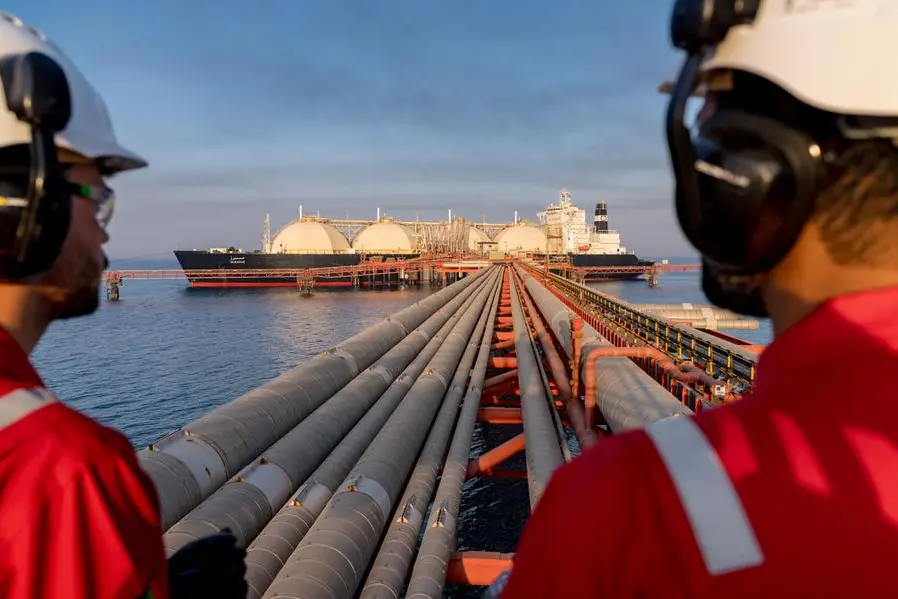
The development of an LNG terminal in Aqaba, and exploration of shale oil in the country could lead to investments and jobs in a new area for the country. Ongoing development of solar and wind farms would also help cut Jordan's energy import bill and generate employment.
Looking forward, the Jordanian authorities have the tough task of addressing multiple areas of concerns with few resources and simmering internal and external unrest.
"Government attempts to liberalize the economy, including reducing the scope of the state, are likely to be impeded by continued nervousness about fomenting further public discontent," said the EIU.
"However, as part of a USD 2 billion IMF stand-by arrangement (SBA), the government has agreed to introduce 'socially acceptable' fiscal retrenchment and a number of structural reforms, which should prevent any wholesale policy reversals."
© alifarabia.com 2013