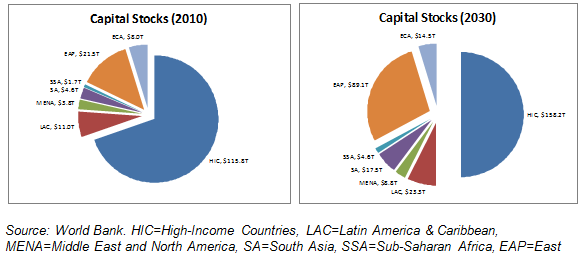
Middle East capital stocks will more than double from USD 3.8 trillion in 2010 to USD 8.8 trillion over the next 20 years, according to the latest study by World Bank. By 2030, global capital stocks will rise to USD 316 trillion, nearly double from current levels.
"By 2030, half the global stock of capital, totaling USD 158 trillion (in 2010 dollars), will reside in the developing world, compared to less than one-third today, with countries in East Asia and Latin America accounting for the largest shares of this stock," the bank said.
Meanwhile, global investments will reach USD 25 trillion by 2030, with developing countries accounting for about two-thirds (USD 15 trillion) of the total, as the world sees a third age of financial globalization.
The first age began in the 19th century when Europeans directed capital to the New World in the United States and the second began after the First World War.
"Investment in developing countries will overtake that in high-income countries by the middle of the 2010s," said the World Bank in a new report on future global investment patterns and the tectonic shift in global financial markets.
Developing countries led by China and other BRIC nations, but also including the fast-growing economies of the Middle East and Sub-Saharan Africa, will be in the ascendancy.
Fast growing populations, rising standard of living and greater infrastructure needs will propel developing economies forward, and help them attract greater investment via the financial markets.
By 2030, half of all capital stocks will reside in developing nations, with countries in East Asia and Latin America accounting for the largest shares of these stocks (56% and 15% of the developing world total, respectively), according to the World Bank.
"Sub-Saharan Africa will see the third-fastest growth in its capital stock among developing regions (after East and South Asia), albeit from a low base; by 2030, its capital stock will more than double to USD 4.6 trillion (in 2010 dollars). As a group, developing countries' capital stocks will grow by 212% by 2030, compared with a 37% increase in high-income countries."
Sectoral changes
In the Middle East and North Africa (MENA), as elsewhere, the services sector will attract the bulk of the investment. The sector will account for 46% of investments by 2030, a 5% increase, with manufacturing (16%) and agriculture (39%) over the next 20 years.
Compared to other markets, the services sector still does not constitute the lion's share of investment. Data shows regions like Latin America (71% investments in services), South Asia (69%) and even Sub-Saharan Africa (57%) are focused on the services industry.
The MENA's manufacturing will make up 16% of total investments in the region - the lowest in the world.
"The Middle East and North Africa has significant scope for financial market development, which has the potential to sustain investment but also, along with aging, to reduce saving," said the bank. "The region has the lowest use of formal financial institutions for saving by low-income households, and scope for financial markets to play a significantly greater role in household saving."
Infrastructure needs
MENA region will also need a little more than USD 50 billion a year in infrastructure investment alone. The telecoms and power sectors will make up the bulk of infrastructure investments, as population and economic activity surges.
The Doha-based Gulf Organization for Industrial Consulting noted that the GCCs power sector alone is estimated to attract USD 300 billion by 2020.
The infrastructure developments will also require globalization corporate financing structures.
"Such bond market maturation will ultimately lead to lower credit spreads and hence the cost of capital. There is evidence that this is already under way: emerging market corporate bonds carried spreads over comparable US treasury securities of about 450 basis points in the early 1990s, but the average spread narrowed to 392 basis points in 2011."
Standard Chartered notes Gulf bond issuances will reach USD 34 billion this year alone, and a number of companies across the region have unveiled plans to issue bonds and sukuk to meet rising infrastructure needs.
In one of the scenarios envisioned by the World Bank, financial markets in economies like Brazil, India, and those of the Middle East will develop considerably, with these countries attaining, by 2030, a level of financial development comparable to the United States in the early 1980s.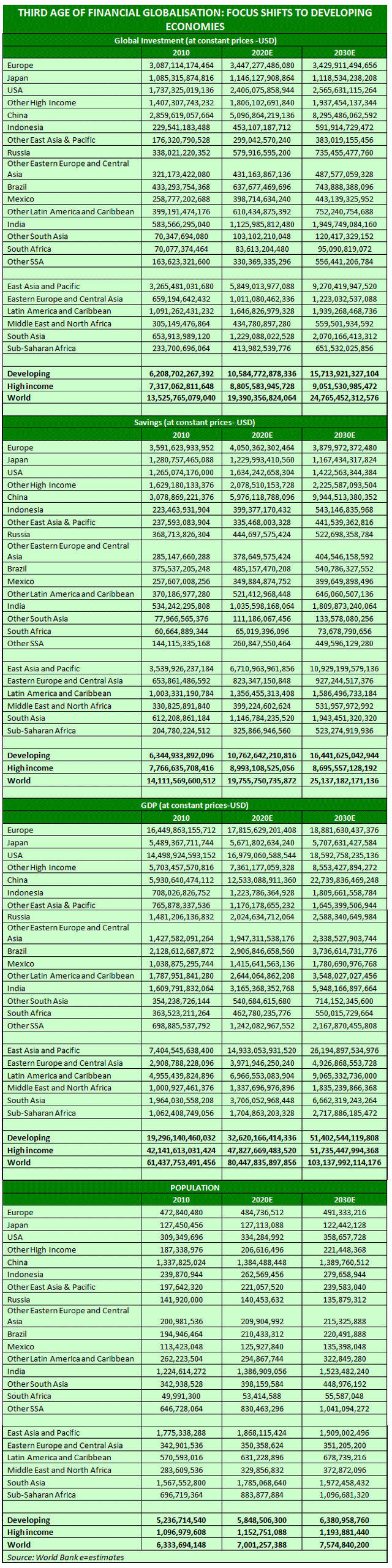
Global investment trends
Here is a look at key trends shaping investment patterns across the world:
* Developing market accounted for 18.5% of investment flows in 1999, but by 2009 that figure had jumped to 40%.
* The global financial crisis has narrowed the gap between investments in developing and developed world. China and India accounted for most of the changes in investment patterns.
"But even in the absence of these two developing-country giants, the share of global investment accounted for by developing countries has risen steadily since 2000, and currently stands at the highest level since the mid-1960s," said World Bank.
* China, the Gulf Cooperation Council, Brazil and India lead the financing of infrastructure projects in Africa - a trend that will only accelerate in the future.
* Middle East has the lowest worker efficiency in the world. According to data capital per effective worker in the region stands at between USD 14,000- USD 16,000, compared to around USD 12,000 in Latin America and Eastern Europe and around USD 8,000 in Asia Pacific.
* Indeed, Sub-Saharan Africa will see its investment rate rise to average 24% between 2010 and 2030--a rate higher than its 2005-09 average of 21%.
* Infrastructure needs of developing countries will rise to USD 864 billion by 2030, with power and transportation accounting for more than half of all investments. East Asia and South Asia will account for the bulk of investments.
* Demographics will play a key role in investment patterns. Developed economies will see investment taper off as it finds itself with an ageing population. Over the next 20 years, only Sub-Saharan African region will have a rising population while other regions, including Asia and the Middle East see falling population growths and ageing populations.
* Public pension costs will rise as % of GDP in virtually all countries. China will see pension costs from 3.4% to 2010 to 77% of GDP by 2030. Places like Brazil, Indonesia, Malaysia and Russia will jump significantly as well.
* In MENA, "changes in household structure may also impact saving patterns, with a transition from intergenerational households and family-based old age support to smaller households and greater reliance on asset income in old age."
* Global savings will be around USD 25-USD 27 trillion according to the World Bank.
* Savings will be dominated by Asia and the Middle East. In the gradual convergence scenario, in 2030, China will save far more than any other developing country - USD 9 trillion in 2010 dollars - with India a distant second with USD 1.7 trillion, surpassing the levels of Japan and the United States in the 2020s, the bank said.
© alifarabia.com 2013