As the Middle East gears up for yet another potential war, Bank of America Merrill Lynch is telling clients to buy Gulf bonds on regional weakness.
The benchmark HSBC/Nasdaq Dubai GCC Conventional US Dollar Bond Index (GCBI) fell from a month-high of 158.344 on August 12 to 157.076 by August 23, as the prospects of an escalation in the Syrian conflict sent shivers down investors' spine.
But that might be a buying opportunity in the relatively-insulated Gulf debt.
"GCC credits remain direct (oil) and indirect (diverted financial and tourism flows) beneficiaries of regional instability," said Jean-Michel Saliba, analyst at BAML, noting that Lebanese debt is especially vulnerable.
"While the security situation is vulnerable to destabilization and the macro fundamentals have weakened, large domestic ownership provides a backstop to Lebanese EXD [ex Dividend]," said Saliba.
"While Jordan's stability, paramount to Western interests, remains fragile, it is anchored by promises of GCC financial aid, an ongoing IMF program and the US guarantee for a dollar bond issuance to help plug twin deficits."
Saudi Arabia, Abu Dhabi and Qatar are among the safest sovereigns in the world, according to Standard & Poor's Capital IQ credit default swaps data.
But their proximity to three of the world's riskiest sovereigns - Egypt, Lebanon and Iraq - means there might be short-term dips, as regional confidence wobbles on new political threats facing the region and global macroeconomic uncertainty.
"US Treasury volatility favors the cushion of higher-yielding, higher-beta Dubai EXD and we view short-end Dubai sukuk as the most defensive. We expect Abu Dhabi and Qatar EXD to adjust with a lag to higher UST[reasury] yields."
While global bond markets have been volatile on account of mixed news from the global economic environment, Gulf bonds have been largely insulated from US Treasury upheavals.

Regional bonds had also outperformed other emerging markets in July, with the HSBC Nasdaq‐Dubai GCC Conventional USD Bond TR Index rising 0.68%, compared to the 0.36% gain for the JPMorgan EM Bond Index.
"In the CDS [credit default swaps] sovereign space, spreads tightened across the space," said Gulf Investment Corporation in its latest monthly bond report.
"Saudi was the biggest gainer with spreads tightening by 15bps (‐20.21%) followed by Abu Dhabi 14bps (‐18.18%) and Qatar 12bps (‐14.63%)."
GCC ISSUANCE
More than USD 30 billion worth of debt has been issued in the first six months of the year in the GCC. The UAE led the issuances, racking up new debt of USD 11.6 billion, while Saudi Arabia was second with USD 8 billion and Qatar third with USD 4.7 billion.
"The non-financial sector (NFS) saw issuance increase threefold in 1H13, jumping USD 6.7 billion to USD 10.1 billion, its highest level ever," wrote Chaker El Mostage and Nemr Kanafani, analysts at NBK Capital.
"Coupled with issuance by the financial sector, the private sector experienced its strongest half yet, with gross issuance totaling USD 19 billion."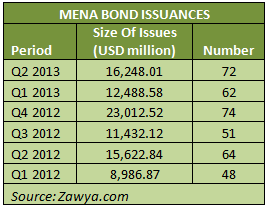
The UAE's financial sector has issued the largest debt with combined value of USD 9.3 billion on prospects of increased economic recovery.
The Gulf's private sector is also stepping up and has issued more debt than the public sector in the past 12 months, suggesting strong growth in the region's non-government driven economy.
The regional private sector accounted for 63% of new issuances over the past six months, beatings its average market share of 30% over the past three years.
SAUDI SUKUKS
Zawya Sukuk Monitor data shows Saudi Arabia issued USD 8.2 billion of sukuk in the first seven months of the year, while the UAE sold USD 5.16 billion.
Gulf bonds are also set to enter the mainstream as the MSCI upgrade of the UAE and Qatar markets to emerging market status alerts global investors to the strength of other investment vehicles in the region.
S&P believes sukuk will play an increasingly major role in new debt issuances in the Gulf economies.
"Yields in the region have been declining, and even fell under those on conventional debt. Add to that strong domestic appetite for Islamic finance and sound liquidity, as well as greater political willingness to move ahead with sizable infrastructure projects," according to a report published earlier this year.
"We believe that a number of banks, particularly, will come to market, needing to refinance their existing debt and seeking larger amounts to match the credit needs of their corporate clients, especially in project finance."
IMPROVED MACRO OUTLOOK
Dubai's successful handling of its debt issue has increased investor confidence but while most Dubai corporations are seeking debt, caution is still the order of the day.
In June, Dubail retail giant Majid Al Futtaim delayed raising at least USD 500 million in a hybrid bond, citing market volatility as the primary reason for its postponement.
"Dubai credits have performed strongly over the last one year, in line with improvement in their credit fundamentals," said SJS Markets Credit Research in a report. "The recent correction offers relatively better upside potential for bonds issued by Dubai-based issuers compared to other issuers in the GCC."
Gulf Investment Corporation says recent corrections in the quasi-sovereign space make a number of bonds attractive, namely Qatar's RasGas, Abu Dhabi's International Petroleum Investment Corporation (IPIC), Dubai Electricity Water Authority (DEWA) and Emirates airline.
GIC also remains "positive" in the corporate space due to better yields especially among Dubai companies.
"We like stable names with good cash. Emaar, Majid Al Futtain, Dubai Holding, QTel and Taqa are our preferred bets."
In the financial space, GIC has a preference for Abu Dhabi's National Bank of Abu Dhabi and First Gulf Bank.
"Leading Dubai banks also look good due to improvement financials. It also offers higher yield."
© alifarabia.com 2013