Major international banks are in retreat. Cutting costs and packing up shop from non-core areas in the Middle East, most European banks are looking to cut back on their international ambitions as they focus on their own troubled home turf.
Barclays Bank is the latest to cut back on its Gulf operations, when it announced that it is selling its retail banking operations in the UAE last week.
"Following a strategic review, Barclays has decided to re-focus its efforts in the UAE on its key strengths in corporate and investment banking and wealth and investment management," the bank said.
Barclays is the latest in a long list of international bank exits in the region.
France's BNP Paribas sold its Egyptian operation to Dubai's Emirates NBD late last year. France's Societe Generale also sold its stake in Egypt's National Societe Generale Bank to Qatar National Bank.
Lloyd's TSB also sold its Middle East onshore assets and liabilities to HSBC.
HSBC itself is ending wealth management services in Bahrain, Jordan and Lebanon as part of a three-year global restructuring plan.
Other international banks from Europe and the United States have also reduced their exposure to the Middle East due to instability and poor prospects in some countries, but largely due to their own cost-cutting agendas.
GULF BANKS RISE
The international banks' retreat comes at a time when regional financial institutions are gaining in confidence and looking to expand their service offering.
Regional banks had their best results in 14 quarters as they posted double-digit profits in the second quarter.
Gulf banks saw their collective net profits rise 11.5% in the second quarter (year-on-year) to reach USD 4.8 billion.
On a year-on-year basis, net profits of banks in Kuwait soared 23.3%, while banks in the UAE, Qatar, and KSA saw profits jump 20.8%, 13.4%, and 3.5%, respectively, Global Investment House data shows.
Saudi banks are building on their performance this year, as the government and domestic corporation embark on an investment spree.
Saudi Hollandi led the proceedings, with its net profit rising nearly 13% year-on-year, while Saudi British Bank profit grew nearly 10%.
In the UAE, National Bank of Abu Dhabi saw net profits jump 16% year-on-year, although down 14% quarter-on-quarter.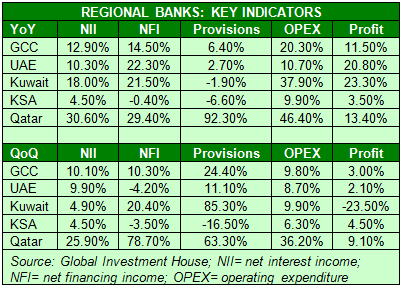
"Operating income benefited from a strong increase in net interest income and fee income while investment losses were a main drag. It is encouraging to see the loan growth back on track after nearly two years and improvement in the net interest margins, said NBK Capital in a note. "However, we need to keep in mind that the increase in loans was most probably driven by government-related entities (GREs)."
Meanwhile, Emirates NBD's net profit for the second quarter rose AED972 million - a 50% increase year-on-year. Net interest income jumped 17% during the year, while non-performing loans fell 13.9%, an improvement compared to 14.2% in the first quarter. Net loans and deposits grew 11% each during the quarter.
STRONG GROWTH
Gulf banks have seen strong asset growth, which suggests the fundamentals are returning after declining in the aftermath of the global financial crisis.
UAE, Kuwaiti, Saudi and Qatar banking sector collectively saw double-digit rise in net assets year-on-year, and - with the exception of the UAE - double-digit rise in assets and loans as well.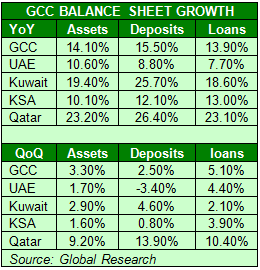
"However, on a QoQ basis, asset growth was sluggish due to marginal increase in loan book. Among the individual banks, Qatar National Bank led with a 30.4%YoY growth in asset base, followed by Burgan Bank (up 28.6%YoY), National Bank of Kuwait (25.3%YoY), Saudi Hollandi Bank (23.4%YoY), and National Bank of Abu Dhabi (21.0%YoY)," said Global.
"Asset growth of these banks was largely supported by increase in their respective loan books."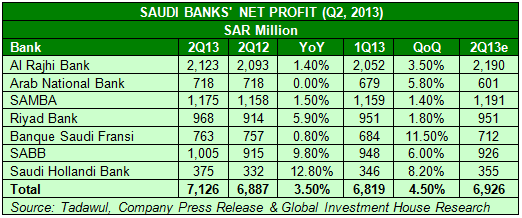
THE ROAD AHEAD
While regional banks have had a relatively good run, there are challenges ahead.
In Saudi Arabia, NCB capital warns that depressed net interest margins and a low interest rates environment could result in a relative deterioration in asset quality.
The bank also warns that the US Federal Reserve's expected move to scale back monetary stimulus could also impact the Saudi equity market, given its correlation to global financial markets.
"Even though... domestic banks' international exposure is limited, an assessment is needed of global debt instruments, especially fixed-income that are bound to incur losses with the recent move by the Fed to scale back monetary stimulus and normalize interest rates," said NCB Capital.
Elsewhere, some banks such as Emirates NBD and Qatar National Bank have exposure to troubled Middle East countries that could impact their bottom lines.
But regional banks are walking into the new regional and global uncertainty from a position of strength. With global banks distracted by their issues in their core markets of Europe, and North America, Gulf banks are well-positioned to take advantage of rising capital expenditure and financing needs of regional governments and corporations.
Nowhere is this most evident than in Qatar.
"The recent awarding of several infrastructure projects (worth USD 12 billion), which include four contracts awarded in June by Qatar Rail to Doha Metro for designing and building railway lines worth USD 8.2 billion, should provide grounds for ongoing loan expansion in the remainder of 2013," said NBK Capital. "According to some of the banks' managements, some of these awards were made earlier than expected."
Indeed, the Central Bank of Qatar recently set new limit on financial investments and even foreign investments by local banks. According to the CBQ ruling, financial investments cannot exceed 25% of capital and reserves.
"As for financial investments outside Qatar, these cannot exceed 15% of capital and reserves according to the circular.... We believe that the banks which are exceeding this limit are likely to reduce their foreign investment positions and redirect them into the Qatari market," said NBK Capital.
In the UAE, a successful bid by Dubai for the World Expo 2020, could lead to a massive windfall in fresh investment, while Saudi Arabia continues to invest heavily across virtually all sectors of the economy.
But international banks are likely to miss capitalizing on the regional growth, leaving the space wide open for local banks.
© alifarabia.com 2013