With growth stalling at home, South African banks are increasingly looking across the border for growth, but their ventures abroad could come at a price.
"Adding diversification by expanding in Africa could enhance South African banks' earnings prospects in the longer term," Fitch Ratings says. "But a significant increase in exposures to other African markets could weaken their credit profiles."
Despite the challenges facing the South African economy last year and the wider global economic lethargy, South African banks put up a good show.
"After two years of higher range double-digit profit growth, underlying earnings rose by 11.3% during 2012," said management consultant PricewaterhouseCoopers (PwC) in a recent report. "In contrast to prior years, the major banks' results varied significantly this year, as each bank faces its unique challenges and focused strategies begin to play out."
Total operating income of the four major banks - Standard Bank, ABSA, FirstRand Bank and Nedbank - grew by 12.4%, better than the figures posted in 2011 (5.7%) and 2010 (3.4%).
The Banking Association of South Africa says the banks face a number of challenges, including lower credit demand and rising cost of funding and new Basel III regulations that forces banks to hold more capital of higher quality.
"There are, however, a number of opportunities for the sector, which include investment in technology to improve efficiency; increased focus on mobile banking to expand reach; expansion into Africa for growth; and expanding access to finance to the low income market," the association noted.
South African-based banks operate in 16 countries in sub-Saharan Africa. In 11 of those countries, South African subsidiaries are among the five largest banks, the International Monetary Fund says.
"Most of these banks fund their operations with local deposits; cross-border loans are typically modest, with a few exceptions," the IMF said in its report on the importance of South African corporations in SSA growth.
"The scale of both cross-border lending to and deposit-taking from other sub-Saharan African countries by South Africa-based banks is small in relation both to South African GDP (about 0.5%) and to the assets and liabilities of the South African banking system."
Bridging trade with BRIC
South African banks also consider themselves as facilitators of trade between Africa and BRIC nations.
"South Africa has been an important beach-head in intra-African trade," wrote Simon Freemantle and Jeremy Stevens, analysts at Standard Bank in a report.
"Naturally, South Africa's geographical proximity plays a clear role in its relatively large share of BRICS-Africa trade: over 80% of South Africa's exports to Africa are absorbed by markets within the Southern African Development Community (SADC). Emphasizing South Africa's maturing role in Africa, around one-third of all non-mineral fuel goods produced by an African economy and sold inside Africa are produced in South Africa."
Standard Bank, Africa's largest financial institution, is already present in 17 African nations -- including Kenya, Botswana, Ghana, Tanzania, Nigeria and Angola -- and says its decision to divest from Russia, Turkey and Argentina to focus closer to home is paying off.
"Our focus on maintaining our position in South Africa and growing in our chosen markets in the rest of Africa paid off in 2012. Revenues from the group's banking activities increased by 17% and in the rest of Africa revenues were up an impressive 38%," chairman Fred Phaswana noted in the 2012 annual report.
Indeed, Standard Bank's newly installed co-chiefs have also pledged a greater focus on the continent.
"There is a wall of liquidity and capital coming through the African continent. But to win, we need to ramp up our Africanness," co-head Sim Tshabalala told a news conference.
Standard Bank is also hoping that Industrial and Commercial Bank of China's 20% stake in the bank will also help the bank emerge as a gateway to China-Africa trade.
Other banks disclose African plans
Meanwhile, Absa was recently bolstered after taking over parent company Barclays Bank's eight operations in the continent. Under the deal, Barclays swapped direct control of its African units for 129.5 million Absa shares valued at USD 2.1 billion.
"The combination of Absa with Barclays Africa operations will create a leading pan-African financial services business with a compelling platform for further growth," the bank said. "The transaction aims to accelerate Barclays and Absa's One Africa strategy for the benefit of shareholders, customers, colleagues and communities."
Nedbank's majority owner Old Mutual is also planning a massive USD 560 million Africa-wide expansion, and considers it a core part of its growth strategy.
FirstRand Bank is also growing its franchise in the broader African continent, and targeting countries that are set to benefit from the trade and investment flows between Africa, China and India.
FirstRand has earmarked Mozambique, Tanzania, Zambia, Nigeria, Ghana and Kenya for growth.
"FNB continues to invest in growing its infrastructure in the new territories of Mozambique, Zambia and Tanzania and is leveraging its South African developed products and solutions into these countries," the bank said.
Rand Merchant Bank (RMB), a subsidiary of FirstRand, is also said to be generating strong deal flow from its recently established Kenya representative office, and in February 2013 officially opened RMB Nigeria, with an initial capital investment of USD 100 million.
"RMB has been operating in Nigeria from a representative office since January 2010 and is already a meaningful player in the Nigerian investment banking sector. The establishment of a [full-fledged] investment banking operation will now allow RMB to rapidly build its franchise," the bank said.
While South African banks' regional operations remain a small proportion of their overall revenues, that is changing fast.
"We have observed a strong trading performance from the banks' African trading operations, given the strong economic growth being experienced in many of the remaining African countries," said PwC.
"While the relative contribution of these operations to the banks' bottom line currently remains low, it is expected to increase substantially as the banks execute on their African ambitions."
Expansion risks remain
However, Fitch cautions that the banks' aggressive push in newer markets risk building up asset-quality problems and costs.
"This could lead to diminishing returns, or even result in the impairment of goodwill. The operating environment is often more challenging than in South Africa; and the risks for retail banking can be magnified due to a lack of - or nascent - credit bureau," said Denzil De Bie, director of Financial Institutions at Fitch.
"The strong banking regulator in South Africa and the high corporate governance standards at the banks help to mitigate some of the expansion risks. The banks are also unlikely to have the appetite for a pan-African model that requires a significant investment in branch infrastructure to be credible. Instead, they are seeking high-growth markets with more attractive yields to supplement sluggish domestic growth. They also want to facilitate transactions with existing clients and within the trade corridors."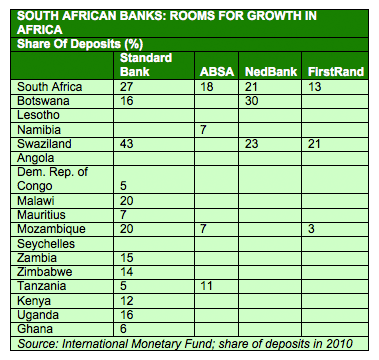
© alifarabia.com 2013