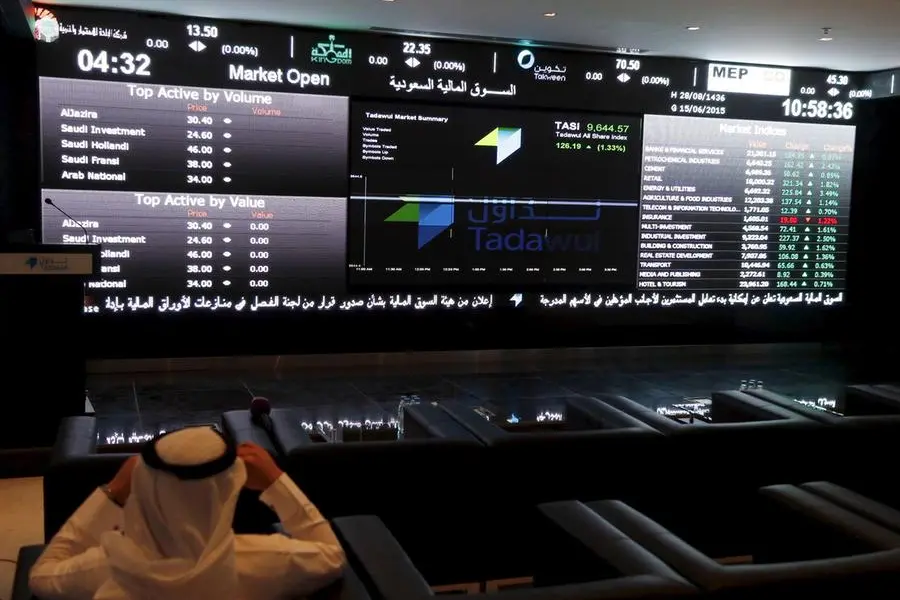
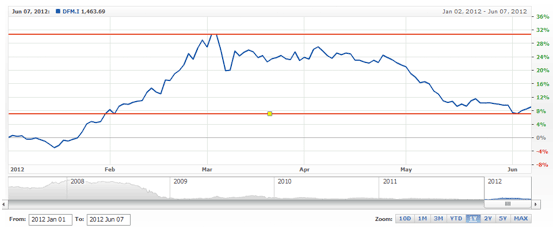
From a vertigo-inducing high earlier in the year, the Dubai Financial Market index has come crashing down. At its height this year, the market was up 31% but now stands at 9%. After reaching 1,754.27 on March 5, the index was down to 1,437 on June 4, flirting with bear territory - which typically occurs when markets fall 20% from their peak.
What triggered this collapse when the UAE and Dubai's own economic prospects haven't changed much in the space of three months?
The answer could well lie outside the region, according to the International Monetary Fund in a report published Saturday.
Dubai and the UAE's strong economies ties with global markets and especially Europe has meant that as the global economy suffers, the UAE will not remain immune.
In fact, an IMF study shows the UAE market is more correlated to the global S&P 500 than any other Gulf markets. Indeed, Dubai market's correlation to the American index stands at 0.57% while Abu Dhabi has a 0.23% correlation.
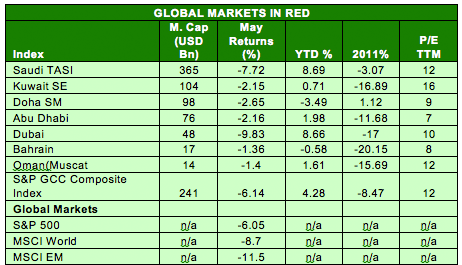
The global index fell 8.7% in May as investors sold-off equities and fled to the safety of cash and bonds. MSCI Europe led the rout, losing 12.5% last month, sending 10-year US Treasury yield to an all-time low of 1.642%.
"A marked spillover of the current crisis of peripheral Euro countries into the core euro area and global financial markets could have major financial repercussions for the UAE and the GCC region, with particular contagion risks for economies that depend on foreign financing and that have financial links to Europe," the IMF says.
The global economic downturn does not bode well for the UAE markets, especially as most analysts have slashed GDP growth estimates for much of the developed world.
Barclays Capital has downgraded its U.S. real GDP forecast on tightening financial conditions in recent weeks and a falling stock market.
"In addition, the business sector appears to have turned more cautious, with growth in both private payrolls and business investment spending slowing in recent months," said the bank.
Meanwhile, recapitalisation of Spanish banks means more worries for the EU which is already reeling from the crisis in Greece.
While the European Central Bank is keeping its powder dry for now, expect the bank to react if things go pear-shaped in EU.
EU governments are also working to strengthen their positions, while EU President Van Rompuy is expected to present his plan during the next EU summit on June 28-29. In a press statement, he said he was working on the building blocks to "strengthen the monetary union by more banking, fiscal, economic integration and enhanced governance and democratic accountability".
GLOBAL UNCERTAINTY DERAILS GULF RALLY
Such uncertainty has deeply affected investor sentiment in Gulf markets, especially the UAE.
Waylaid by global concerns, GCC markets fell 6.1% in May, after erasing 3.2% in
April. Dubai shed 9.8% for the month, followed by Saudi Arabia which lost 7.7%.
"Risk in the GCC (as measured by the Markaz Volatility Index - MVX) dropped 7% in May, probably because of reduced market activity," wrote M.R. Raghu, head of research at Kuwait Financial Centre, or Markaz, in a recent note. "Risk in
While Gulf states are benefitting from high oil prices, the global economic scare has also led to a dramatic decline in crude prices, even though they continue to remain near triple-figures.
HOPE FROM CENTRAL BANKS
However, the current market sell-off may have been overdone. Observers believe authorities and central banks such as the U.S. Federal Reserve, Central Bank of Japan and the European Central Bank are poised for action.
They have seen the dwindling fortunes of their respective economies from a long way away and most analysts believe it is impossible to think that they will not react soon.
"With several indicators hitting historical lows, we believe this correction could potentially set the stage for another risk-on rally to emerge in the coming weeks," notes EFG-Hermes. "Key triggers for such a rally would be central bank intervention (from the ECB or the Fed, possibly coordinated) and/or greater clarity on a Chinese stimulus package."
Indeed, the Chinese reacted last week, cutting interest rates to ensure its economy does not suffer a hard landing.
EFG says both Europe and China present risks to MENA: through the impact on the global financial system (Europe accounts for over 70% of BIS lending to GCC) in the first case; and through the impact on industrial commodity prices in the second market.
"However, relatively strong balance sheets and slower credit growth since 2008 provide greater support to the outlook for MENA. We reiterate our view, expressed at the beginning of the year, that MENA will outperform EM in 2012, but that total returns will be limited," says the bank.
DUBAI DEEPLY AFFECTED BY EU MELTDOWN
An EU financial meltdown could pose a threat to the UAE, which has to repay USD30-billion of maturing loans this year and face a "significant" amount of debt falling due in 2014 and 2015, according to the IMF.
Since the EU crisis intensified since last summer, Greece has been identified as the "overwhelming source of contagion risk" for Dubai, accounting for more than 60% of the total measured contagion from selected countries.
"Italy, Portugal, and Spain are also contributors: these four countries explain close to 80% of the contagion risk to Dubai. This concentration stands in contrast to the period following the collapse of Lehman, where the contribution to financial stress was much more evenly spread across countries, with neighbours contributing stress in proportion to the strength of their regional ties."
DETERIORATING NPLS
While the UAE banks remain well-capitalised a 'foreign funding shock' could lead to a tightening of liquidity in the sector, warns the Fund.
While the UAE banks' foreign liabilities stand at 19% of total liabilities, lending by European banks remain considerable in the country.
It is important to note though that the UAE banks have not shown great signs of stress and remain well capitalised thanks to quick government action during the global financial crisis of 2008.
While regional central banks foreign reserves are expected to cushion in the event of a shock, the UAE banks asset quality is deteriorating.
"Non-performing loans (NPL) increased from 2.5 percent at end-2008 to 10.6 percent in December 2011 in Dubai banks, and from 1.7% to 4.6% in Abu Dhabi banks; these numbers mask a large share of restructured/rescheduled loans that might still be classified as performing," says the IMF.
While debt restructuring has released some of the pressures on the banking system, the IMF expects NPLs to probably increase due to restructuring of Dubai Holding and that of other government-related entities - as part of USD32-billion maturing debt this year - and due to the 'distressed' real estate companies.
"The significant increase in renegotiated loans masks the true extent of banks' asset quality problems, as some of these loans may re-emerge as NPLs," the IMF warns, adding that the banks can still handle significant stress.
© alifarabia.com 2012